
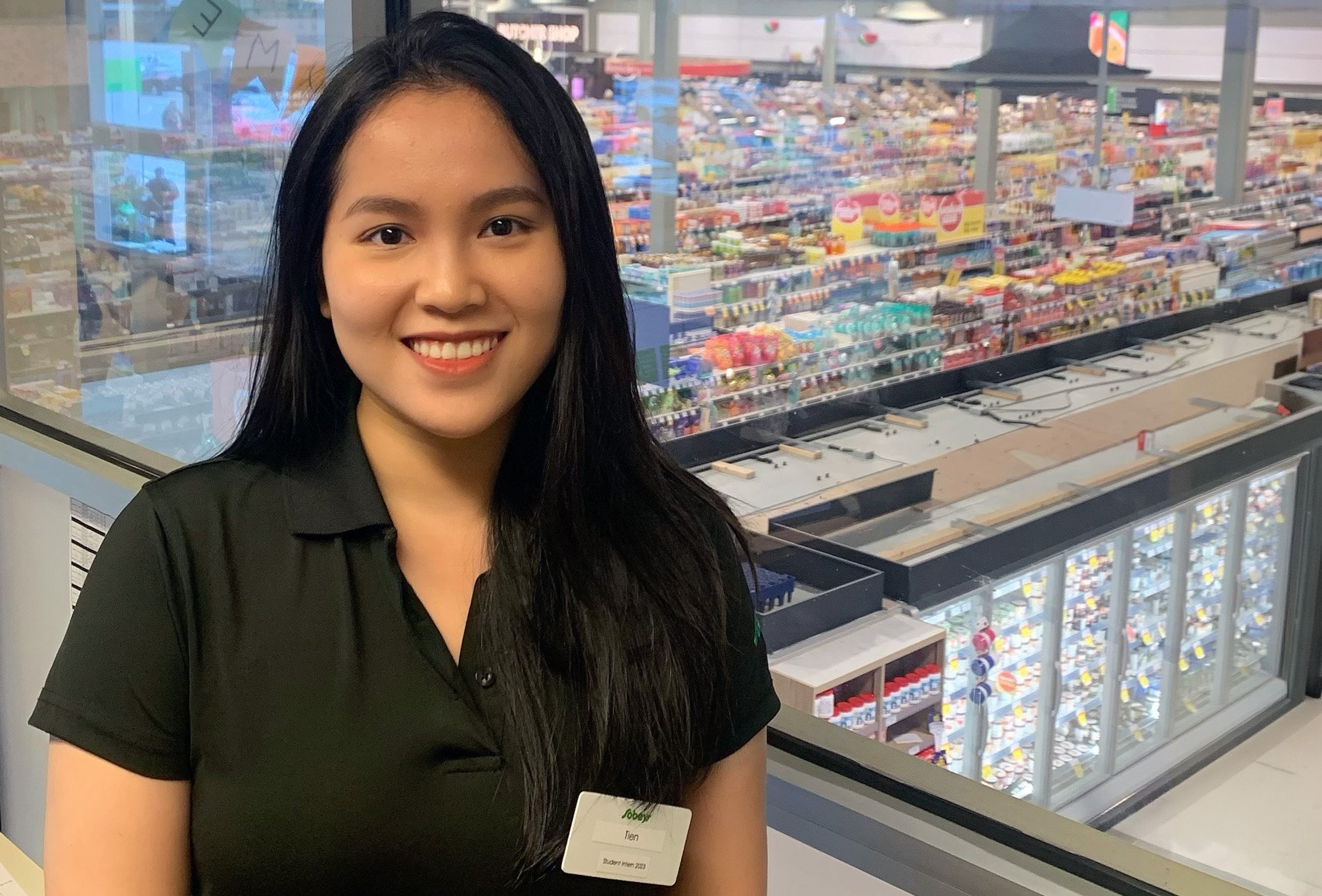
Diem Tien BComm’24, working as co-op student at Sobeys in the Summer of 2023
At one of Canada’s top business schools, co-op now counts toward the degree.
Co-op means paid work terms, career-launching connections and a résumé that stands out. That means students can gain meaningful paid work experience while staying on track to graduate on time. Sobey's co-op program is a valued bridge between campus and career. The model allows students to alternate between academic terms and paid placement.
Saint Mary’s University’s Sobey School of Business will be launching co-op for academic credit within the Bachelor of Commerce program. Eligible students who complete co-op work terms will now earn three credit hours per placement, up to nine credits across three work terms, counting toward elective requirements in their 120-credit degree.

Prospective co-op students being given a tour of the Nova Scotia Power headquarters.
“This is a student-centred change that strengthens our degree without adding barriers,” says Dr. Vurain Tabvuma, Associate Dean, Undergraduate and Professional Graduate Programs. “I want to see students succeed both in and out of the classroom. A business degree should prepare students not just for their first job, but for a lifetime of leadership, adaptability and meaningful work.”
The new model creates dedicated, credit-bearing courses tied directly to co-op placements, with clear expectations, faculty oversight and assessed academic deliverables. Co-op for credit takes effect in 2026–27, with the first credit-bearing course expected in Spring 2027.
Students set goals at the start of their work term, then reflect in depth on what they learned, what they contributed, how they handled workplace challenges and how their coursework supported, or challenged, what they encountered on the job.
Faculty advisors and co-op office staff provide ongoing support, monitor progress and assess the final submission. While the courses are graded pass/fail and do not affect a student’s GPA, they count directly toward degree completion once credit is awarded.
The shift to credit does not change the support structure students already rely on. Saint Mary’s University’s co-op office will continue to provide professional development workshops, one-on-one coaching in résumé writing, interview preparation and workplace professionalism, along with employer coordination and the job-matching support that underpins the program.
Research shows that graduates who complete co-op programs are significantly more likely to secure full-time employment within two years of graduation compared to their non-co-op peers. National data suggests students with work-integrated learning experience have higher starting salaries and a stronger job-education match, landing roles directly related to their field of study.
For international students, co-op is often one of the fastest routes to gaining Canadian work experience and building professional networks while still in school. The credit-bearing model is expected to encourage more students to complete the full co-op sequence, deepening their skills across multiple placements and strengthening the local talent pipeline for Nova Scotia employers.
As the leading business school in Atlantic Canada, the Sobey School of Business has long-standing relationships with industry partners and a robust alumni network across the region and the country. These connections span key areas of business, including accounting, finance and banking, marketing, AI and machine learning, business innovation and human resource management. They have long supported student placements and will provide a strong foundation for the new co-op for credit model.
Those employer relationships can lead to meaningful long-term opportunities for students. Crowe MacKay LLP in Yellowknife, Northwest Territories, recently hosted Ananthkrishnan Natesan, a Bachelor of Commerce student majoring in accounting and co-op student, who will complete his third work term with the firm this summer before returning full-time after graduation.
“Ananth is very professional and meticulous in how he approaches his work. He is engaged, excited and eager to learn, always! He received comments from senior management on his first file since returning, noting that he was within budget and very positive. He was challenged with new sections he hadn’t seen before, like AR, Revenues and Investments, and met this challenge perfectly. Well done,” says Crowe MacKay LLP.
The co-op program connects students with employers of all sizes, from large corporations to smaller start-ups. Students may complete placements in Nova Scotia, elsewhere in Canada or internationally. Current co-op students are working in Toronto, Yellowknife and Calgary, and international students may also pursue co-op opportunities in their home countries.
Many graduates of the program also return as alumni employers, creating new pathways for Sobey students to gain experience, build confidence and enter the workforce with a stronger sense of what they can contribute.
Co-op available in every major at Saint Mary’s
The Co-operative Education option allows you to apply your knowledge, develop skills and gain confidence, while you earn money to help pay for tuition. Co-op consists of three, four-months work terms.