
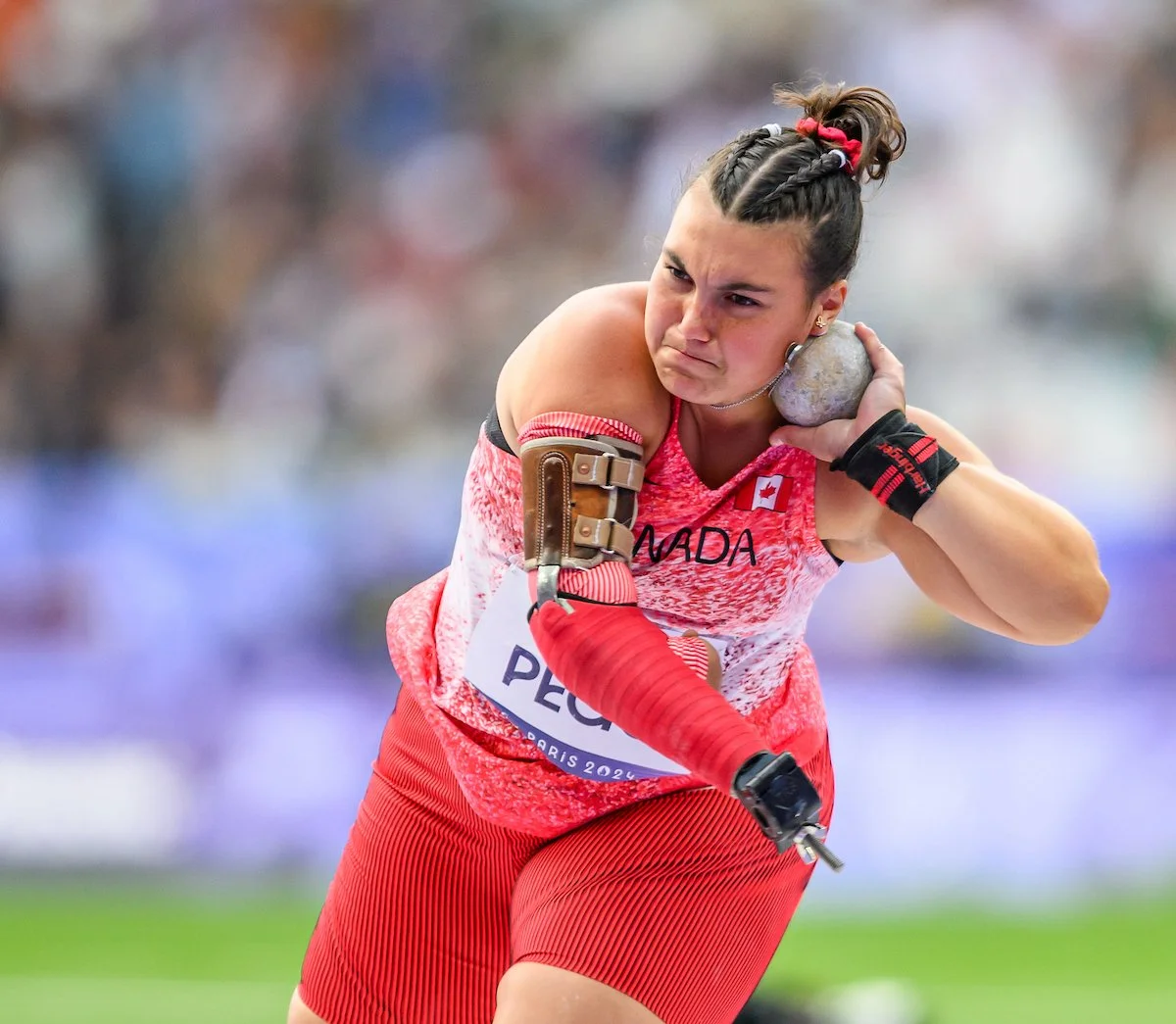
Katie Pegg competes in the Women’s Shot Put F46 Final at the 2024 Paralympic Games in Paris, France on September 4, 2024. Paralympic.ca
Most students worry about juggling school, work and exams. For Saint Mary’s track and field athlete Katie Pegg, life is similar: managing school, exams and her varsity athletics each term.
The only difference is, Pegg is a Paralympian, and her schedule also includes high-performance training to compete on the world stage.
Now in her fourth year as a biology major, Pegg finished seventh in the world in Paris in 2024—her first Paralympic Games. Pegg, who was born with a missing radial bone in her right arm, has been a vocal advocate for young athletes to get into parasports. Her decision to compete under this designation earned her a bronze medal at the 2025 World Para Athletic Championships in New Delhi, India.
Featured in our lineup of SMU’s Olympians, Pegg adds to our rich history of athletic excellence here at Saint Mary’s, and she refers to her international experience as a “dream come true” for her goals as an athlete.
So, how does a student-athlete handle the responsibilities that come with balancing a heavy competition schedule with student life? Coming off the heels of Huskies Mental Health week, Pegg gave us a behind-the-scenes look at the reality behind the podium.
A mental game: training for the world stage
Pegg’s involvement in shot put at SMU happened quickly—almost by fate; she talked to the right person at the right time to try out. She followed a similar path when she found out she qualified for the Paralympic Games.
Going from “getting back into shot put” to qualifying for the Paralympics in a matter of months is a big adjustment, especially for someone still in school. Although physical training was a priority for Pegg—especially strength and conditioning—preparation was as much a mental game as a physical one.
“Preparing for the Paralympics was surreal. Because of how fast my path was through the high-performance environment, we were really dialled in on how best to support my mental preparation for the games.”
Pegg relied on a myriad of on-campus resources to support her through this career-making athletic opportunity, leaning on her academic advisors, coaches, professors and athletic directors to ensure she could achieve her goals in sport while still succeeding in her education. “It’s nice to know that there are people here at SMU who are ready to support you through every step of the student-athlete journey,” she says. “Even to this very day, they check in with me to tell me I can reach out to them for support with anything I need.”
With supports in place for her academics and training, Pegg worked hard at creating strategies to manage the pressure that comes with international competition. Reframing her self-talk to honour the process, and not just the win, was key to her pre-game strategy.
“Early on, I felt like I need to prove myself to others. Now, I focus on showing myself what I can do—and that was a big mindset shift we made as I prepared for international competitions.”
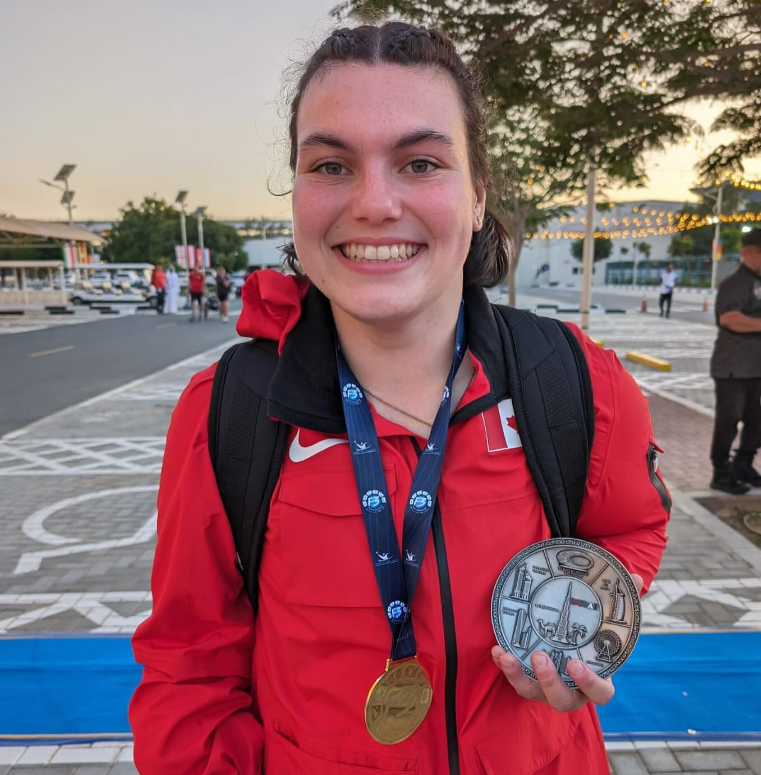
“One of the biggest takeaways going into the world championships was to remove some of the weight I was carrying mentally going into it. ‘It’s just another circle; it’s just another ball.’ I had to keep in mind that it’s another competition and your moments in these events don’t take away the hard work and training you put in ahead of that competition.”
Back to reality: adjusting to life off the pitch
The high of making the podium at her first Paralympics wore off quickly, and getting back to reality after the games came with its own set of challenges. “Everyone talks about the post-game blues,” says Pegg, “and part of me thought it wouldn’t impact me that badly, but it really did.”
Post-game blues can take many forms, including playing back and overanalyzing a performance. For Pegg, it manifested as extra pressure on herself to keep performing at that level after the international competitions ended. The aftermath of the season can be just as much of a mental battle as the training period that comes before it.
“I am still working on how best to manage these stressors and pressures, especially going from the Paralympic Games to going back to our indoor season. I put a lot of pressure on myself to keep performing at that same level, and it was almost as if I didn’t keep performing at that level, people might question how I got to the games in the first place.”
Pegg has since leaned on her supporters and other resources to develop better strategies for navigating life before, during, and after the games. Managing such a wide variety of stressors requires an agile support system—and she’s found that right here on campus.
“I found after my second world competition that I was better able to transition back to my normal routine—it was a lot easier on my mental health. I have worked on developing a more robust support group and had better strategies in place for managing that post-competition transition.”
“It’s really important to develop those relationships with on-campus supports early in your career as a student-athlete. It can feel intimidating to reach out at first but building that relationship early has helped us work together to make sure my education works for me and supports my goals and responsibilities.”
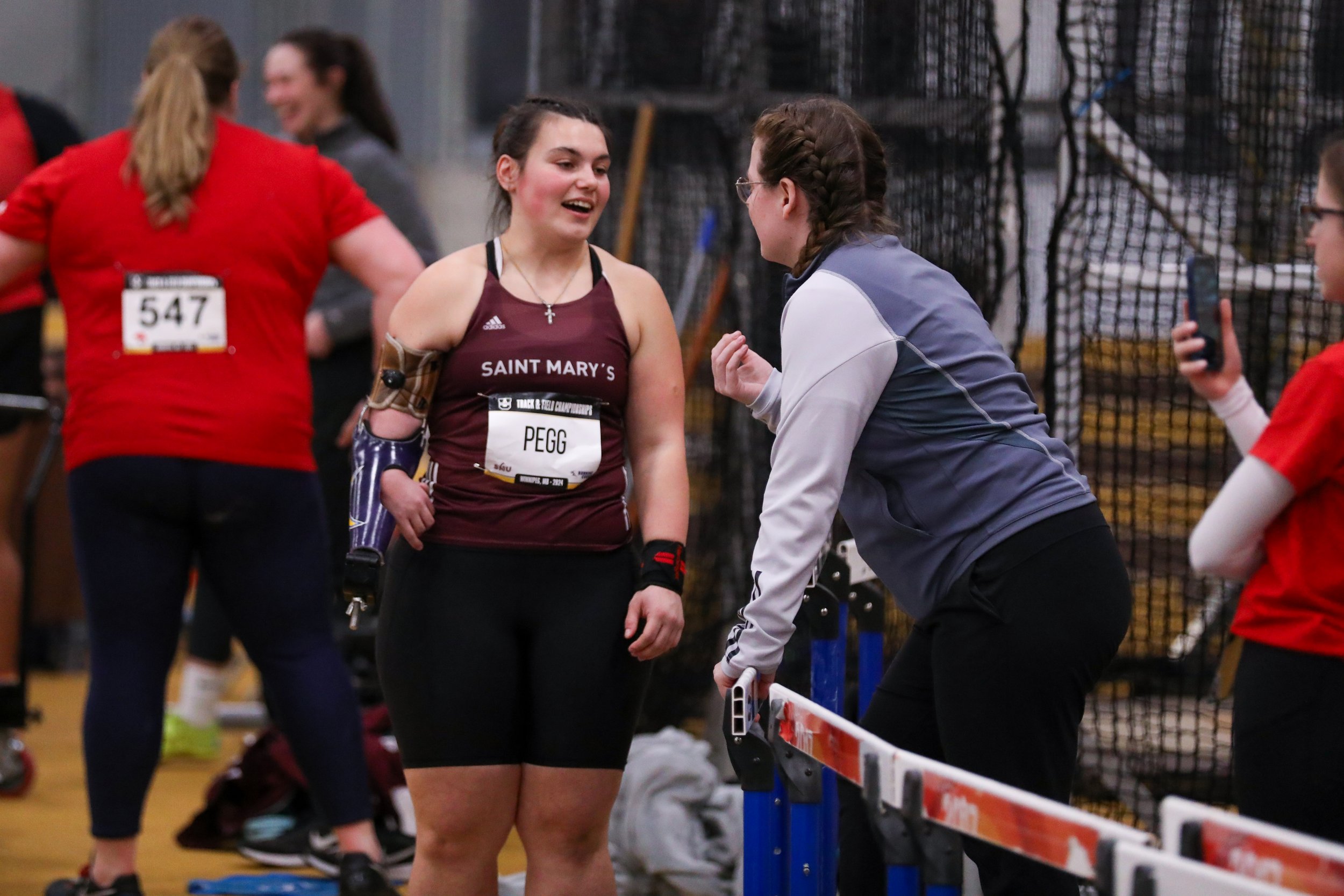
Katie and Assistant Coach Jodi Langley at the AUS Championships in February 2026
That support system paid off at the 2026 Atlantic University Sport Track & Field Championships, where Pegg threw a new personal best of 12.78m, winning a bronze medal and breaking a 43-year-old Saint Mary’s school record.
Looking ahead to next year, Pegg says she’s found what works for her to manage her health, wellness, and responsibilities. Among other things, she makes sure she has a dedicated schedule and relies on structure to keep everything going while making time for herself. She also crochets in her spare time—a hobby she finds relaxing and restorative in her time away from sport.
Pegg will now compete at the U SPORTS Track & Field Championships, March 5-7 in Winnipeg, MB.
Supporting student-athlete mental health
Athlete mental health isn’t just an afterthought here at SMU; it’s at the forefront of our programming and our resources. The Scott McCain & Leslie McLean Centre for Sport, Business and Health is working with student-athletes to build a network of peer-driven resources that follow the mental wellness model that helped Pegg succeed.
“We believe high performance is mostly a result of individual effort,” says the centre’s managing director, Jacob Glover. “But that effort is most healthy, most manifest, and most sustainable when it is supported by a large network of people who care about the athlete— and in which that athlete can trust. Our work is not about building that network for student-athletes, but about creating the conditions for them to build it themselves.”
For more about athlete wellness at SMU, follow the centre’s social channels to stay up to date on their Athletics Ambassador’s program, or check out the SMU Huskies website to keep an eye on initiatives like Mental Health Week games. Saint Mary’s students also have access to additional supports, including the Counselling Centre.