Faculty of Science

M.Sc. student Shelby Scott describes meaningful work in Forensic Sciences

Shelby Scott

Shelby Scott

M.Sc.-student Shelby Scott, a Forensic Anthropology student at Saint Mary’s University, has been putting her education to use in a meaningful way. She has recently returned to Halifax from Cyprus, where she was working with a group that identifies missing persons for the Committee on Missing Persons (CMP) in Cyprus. The CMP’s objective is to recover, identify and return to families the remains of 2000 people who went missing during conflict in the 1960s and 70s.

Shelby has also done forensic work in Thailand and South Africa and recently presented at the American Association of Physical Anthropologists (AAPA) conference in New Orleans, LA. She is supervised by Dr. Tanya Peckmann, Anthropology professor at Saint Mary’s and an experience forensic anthropologist.

She answered a few questions about her studies and her work in Cyprus.

Q. How did you get involved in this program in Cyprus?
I have always been interested in forensic anthropology in humanitarian contexts, and knew that I would need to investigate international opportunities in order to gain this kind of experience.

I got the two-month student contract after hearing about it from Dr. Claudia Garrido Varas, a member of my supervisory committee and a forensic adviser with the International Committee of the Red Cross (ICRC).

Q. With whom did you work?

The Committee on Missing Persons (CMP) in Cyprus is a bi-communal body established in 1981 by the leaders of the Greek Cypriot and Turkish Cypriot communities with the participation of the United Nations.

The objective of the CMP is to recover, identify, and return to their families the remains of 2000 persons (501 Turkish Cypriots and 1,493 Greek Cypriots) who went missing during the inter-communal fighting of 1963 to 1964 and the events of 1974.

The CMP has three Members, two appointed respectively by the Greek Cypriot and Turkish Cypriot communities and a third Member selected by the International Committee of the Red Cross and appointed by the United Nations Secretary-General. 

The CMP also employs a bi-communal forensic team of more than 60 Greek and Turkish Cypriot archeologists, anthropologists, geneticists, and psychologists. I worked with a team of Greek and Turkish Cypriot forensic anthropologists at the CMP Anthropological Laboratory. 

What did you learn in this role, and was there anything you didn’t expect?

As a qualified graduate student, I have had the unique experience of working alongside CMP forensic anthropologists to clean, photograph, and analyze exhumed skeletal remains.

I was responsible for associating individual or fragmented bones with larger skeletal elements, and generating biological profiles to estimate the age, sex, and stature of the skeletal remains, as well as identifying particular pathologies, traumas, or dental characteristics. I also examined all clothing and personal effects found among the remains.

Many of the remains analyzed by the CMP are commingled and often severely fragmented, which makes skeletal reconstruction and identification difficult. As a result of these circumstances and the experience I have therefore gained, I have greatly enhanced my forensic anthropological skills, especially with regard to commingled and fragmented skeletal remains.

Another skill that I improved upon through this position is the analysis of juvenile skeletal remains (i.e. the remains of children). There are many Cypriot children that went missing as a result of the inter-communal fighting of 1963 to 1964 and the events of 1974; I was shocked by the number of juvenile remains that have been exhumed. Regardless of how long you have worked in this field, or how much experience you have as a forensic anthropologist, identifying the remains of juvenile victims of war will always be shocking and emotionally difficult.

That sounds like it was very meaningful work. Did you meet any of the families of victims?

Once the CMP formally identifies the remains of a missing person, the families concerned are informed without delay by the respective Cypriot Member of the Committee. Families notified of the identification of their missing relative(s) are offered the possibility to meet with scientists involved in the identification process and to view the remains in a facility located next to the CMP Anthropological Laboratory. 

While I was completing my contract in Cyprus, I did not have the opportunity to meet with the families of victims or participate in the return of remains. I likely would not have been able to do so had the opportunity arisen, as I do not speak Turkish or Greek.

However, in past positions I have been involved in through my degree at Saint Mary's University (the Nova Scotia Medical Examiner Service, for example), I have had the opportunity to meet the families of deceased individuals, and I find that it is always tragic yet rewarding. The raw grief of families and the confirmation that their loved ones are gone is overwhelmingly sad. But by identifying the remains of a family’s loved one they are able to arrange for a proper burial and end a long period of anguish and gain closure. I always try to think of that as a positive.

What are your plans for the future?

Having just completed my position with the CMP, I aim to finish my Masters thesis, tie up my various other research initiatives, and graduate with a Master of Science in Applied Science degree from Saint Mary's University. I aim to begin my PhD (Forensic Anthropology) in September 2018. Ideally, I will remain within the realm of academia throughout my career, while also engaging in consultation work internationally and within Canada.

Saint Mary’s mourns the passing of Dr. Alfonso Rojo

Dr. Rojo teaches a Biology class circa 1962

Dr. Rojo teaches a Biology class circa 1962

It is with heavy hearts that Saint Mary’s University announces the passing of Professor Emeritus Dr. Alfonso Lucio Rojo. He passed away peacefully at his home in Halifax on Tuesday, August 15, 2017, at the age of 96.

Dr. Rojo joined Saint Mary’s University and founded the Biology Department in 1961; he was also instrumental in establishing the Faculty Union (SMUFU). For twenty-seven years, Dr. Rojo worked across the hall from his wife, Dr. Enriqueta Unturbe Rojo, the first woman professor at Saint Mary’s University. When he retired in 1986, Dr. Rojo was named Professor Emeritus. He maintained an active research practice well into his 90s.

All three of his children are Saint Mary’s alumni. His daughter, Monica Rojo, taught Spanish in the Department of Modern Languages and Classics from 1995 to 2009.

SMU solar eclipse viewing event a success

eclipse_day.jpg

Thanks to the Department of Astronomy & Physics and the Division of Engineering, hundreds of visitors to Saint Mary’s University campus safely enjoyed the partial solar eclipse on Monday, August 21. PhD in Astronomy candidate Mitchell Young spearheaded the public viewing event, which provided the opportunity to safely view the partial eclipse through the lens of a telescope or safety glasses. Visitors also had the opportunity to experience eclipse totality through a head-mounted HTC Vive connected to Google Earth Virtual Reality. 

Meanwhile, in the Midwest…

A contingent of Saint Mary’s students and faculty members travelled over 3,000 kilometres last week to experience the total solar eclipse visible across 14 states in the Midwestern United States. Among them were Master of Science in Astronomy candidate Tiffany Fields, Bachelor of Science student John Read, and Burke Gaffney Observatory Director Dave Lane.


Saint Mary’s PhD thesis research recognized with international award

Aleka MacLellan

Aleka MacLellan

Saint Mary’s University is proud to announce that recent PhD in Industrial/Organizational Psychology graduate Aleka MacLellan has received the 2017 Kenneth E. Clark Student Research Award from the Center for Creative Leadership and the International Leadership Association. This prestigious award honours MacLellan’s doctoral thesis in leadership psychology, “The Role of Leaders in Motivating their Subordinates at Work.”   

“To have my PhD dissertation selected from among submissions from six countries across the world is an honour,” says Dr. Aleka MacLellan. “It also shows that research conducted at Saint Mary’s University is making an impact globally, as well as in Canada.” 

While there is substantial research on the importance of motivation in the workplace, little is known about how to change motivation. MacLellan’s thesis examines whether leaders’ personal levels of motivation and style of leadership affect employee motivation in the workplace. Her findings indicate that motivational effects often attributed to transformational leadership may instead be the result of a “motivation contagion” effect.

“Aleka's research brings a rigourous research methodology to bear on a question that is of both theoretical and practical importance. How leaders can inspire and motivate others is a critical question for organizations and Aleka's research brings us much closer to the answer to that question,” says MacLellan’s doctoral thesis supervisor Dr. E. Kevin Kelloway, Canada Research Chair in Occupational Health Psychology, and Professor in the Department of Psychology, Saint Mary’s University.

MacLellan is grateful to Cystic Fibrosis Canada, an organization she previously volunteered and consulted for, for supporting her research. By allowing her to collect data during the first and second year of her PhD program, she was able to defend her PhD dissertation in less than three years.

MacLellan would also like to acknowledge the support of Dr. Anja Van den Broeck of the Research Centre for Work and Organization Studies (WOS Bxl), whom she collaborated with during two research semesters spent at the University of Leuven in Brussels, Belgium.

MacLellan recently started a position at Lee Hecht Harrison Knightsbridge, a consulting firm in Toronto, Ontario.

“Given that my areas of focus are in leadership assessment for the purpose of selection, succession planning, and development—as well as team effectiveness and organization culture—it is very important to consider the role leaders have on their team members,” says MacLellan. “I look forward to addressing this challenge in my new role as a Talent & Leadership Development Consultant.”

In October, MacLellan will return to Brussels to present her award-winning research at the International Leadership Association Global Conference.

About the Kenneth E. Clark Award

The Kenneth E. Clark Award from the International Leadership Association (ILA) and the Center for Creative Leadership (CCL) recognizes outstanding unpublished papers by undergraduate and graduate students.

Winners of the award receive a cash prize; travel, accommodation, and registration to ILA’s Annual Conference; a complimentary 1-year membership in the ILA; and recognition at the ILA conference and in various multi-media ILA publications.


Dr. Lori Francis appointed Acting Associate Dean of the Faculty of Science

Dr. Lori Francis

Dr. Lori Francis

Saint Mary’s University is pleased to announce that Dr. Lori Francis has been appointed Associate Dean of the Faculty of Science – Student Affairs (Acting).

Dr. Lori Francis has been a faculty member in Saint Mary’s University’s Department of Psychology since 2002, and was promoted to Full Professor in 2014. A graduate of St. Francis Xavier University, she holds an MSc in Psychology from McMaster University and a PhD in Industrial/Organizational (I/O) Psychology from the University of Guelph.

During her tenure in Saint Mary’s Faculty of Science, Dr. Francis has taught a wide range of BSc and MSc courses, including Intro to Psychology, upper-level undergraduate courses, and doctoral seminars. Since 2011, she has been Graduate Program Coordinator for the MSc and PhD in Psychology. Dr. Francis has also served on Academic Senate and was a long-time member of Saint Mary’s Pension Committee.

Dr. Francis’ research, which pertains to occupational health, safety, and wellness in the workplace, has been funded by the Social Sciences and Humanities Research Council (SSHRC), Nova Scotia Health Research Foundation (NSHRF), and Canadian Institutes of Health Research (CIHR).

As Associate Dean of Science – Student Affairs (Acting), Dr. Francis will oversee the Science Advising Centre and the Science Numeracy and Academic Proficiency (SNAP) Centre, a free, drop-in tutoring centre dedicated to first-year science students. She will also review and provide the final decision on a variety of student issues handled through the Science Advising Centre. 

Saint Mary’s chemistry professor receives federal funding for her antibiotic research

Dr. Clarissa Sit

Dr. Clarissa Sit

Saint Mary’s chemical biologist Dr. Clarissa Sit’s research into how to combat antibiotic-resistant bacteria and fungi received a big boost today as the result of an investment of $171,204 from the federal government.

“Saint Mary’s University is home to innovative research that impacts not only our institution but contributes to addressing problems of global importance,” said Dr. Malcolm Butler, Vice-President, Academic and Research. “We are very appreciative of this federal investment as it represents a core part of our mission as a university, to engage in innovative research and disseminate its results in a way that will serve the community from the local to international level.”

Dr. Sit’s research addresses one of society’s largest public health challenges: antibiotic-resistant bacteria, viruses and other microorganisms. As a result of this funding, Dr. Sit will have access to a high-resolution mass spectrometer, equipment that will increase the success rate of finding new molecules in soil that have antibiotic or drug-like properties. If successful, this could lead to the discovery of microbes that develop new natural products, which can be used to develop new medications.

“While this new equipment is essential for my research, it also provides the first high-resolution mass spectrometer on campus, which is incredibly useful to my colleagues in chemistry, biology, geology, and environmental science in their research,” said Dr. Sit.  “I am very grateful to the Canada Foundation for Innovation and the Government of Canada for their support and I know that this investment will have a big impact on both my research and scientific research in general at Saint Mary’s.”

This investment comes from the Government of Canada provided through the Canada Foundation for Innovation’s (CFI) John R. Evans Leaders Fund (JELF). Support from the federal CFI JELF program provides a portion of the funding needed for institutions to acquire research infrastructure to enable cutting-edge innovation, with contributions from the province and private sector making up the balance of the support.

“This federal infrastructure award recognizes Dr. Sit’s unique and innovative experience, and allows her to establish a lab at Saint Mary’s destined to make important contributions in the area of natural antibiotic research,” said Dr. Adam Sarty, Associate Vice-President Research and Dean of the Faculty of Graduate Studies and Research. “It also allows the next generation of Saint Mary’s students to train in state-of-the-art experimental techniques.”

Chemistry grad awarded prestigious postgraduate scholarship

Kyle Awalt

Kyle Awalt

This fall, recent Saint Mary’s graduate Kyle Awalt is headed down under to pursue a Ph.D. in Medicinal Chemistry at the University of Monash in Melbourne, Australia. Kyle, who graduated this spring with a Bachelor of Science in Honours Chemistry, received a Monash Graduate Scholarship and Monash International Postgraduate Research Scholarship, two highly competitive awards worth roughly $70,000 a year. At Monash, Kyle will study under the supervision of Dr. Peter J. Scammells, Medicinal Chemistry Theme Leader and Associate Dean (Research) at Monash Institute of Pharmaceutical Sciences, Monash University. Monash’s prestigious pharmacy program routinely ranks among the best in the world.

Since his second year of study, Kyle has worked as a research assistant to Dr. Robert Singer, current Chair of Saint Mary’s Department of Chemistry. Dr. Singer is a leader in green chemistry and a long-time collaborator of Dr. Scammells.

Kyle credits his experience at Saint Mary’s with his scholarly achievement. “My success has been driven by the paper I published and my work in Dr. Singer’s lab,” says Kyle. “I don’t think I would have had the same level of opportunity as an undergraduate at a larger school.”

Kyle’s undergraduate honours thesis led him to co-author a paper, Utility of iron nanoparticles and a solution-phase iron species for the N-demethylation of alkaloids, published in the peer-reviewed journal RSC (Royal Society of Chemistry) Green Chemistry. It describes a key step in the preparation of naloxone, a drug used to treat opiate overdoses, including fentanyl. Using green solvents and iron as a catalyst, Kyle and his co-authors optimized one of the chemical reactions necessary in the production of the potentially life-saving drug.

Given the current global opioid crisis, this work is particularly timely. “A relatively straight line can be drawn between what we’re doing in the lab and what happens in the real world,” says Kyle. “It’s very rewarding.”

In addition to Dr. Robert Singer, Saint Mary’s University, Kyle’s collaborators include Dr. Peter Scammells and others from the Universities of Monash and Nottingham.

After completing his Ph.D. at Monash University, Kyle plans to pursue postdoctoral studies in Europe. Ultimately, he would like to return as a faculty member at a Canadian institution.

"Small universities like Saint Mary's encourage collaboration and allow undergraduate students the opportunity to take ownership of their research,” says Kyle. “Ultimately, I hope to return to that as a professor.”


Dr. Adam Sarty appointed Associate Vice-President Research and Dean of the Faculty of Graduate Studies and Research

Dr. Adam Sarty

Dr. Adam Sarty

Dr. Adam Sarty will be taking on the leadership role of Associate Vice-President Research and Dean of the Faculty of Graduate Studies and Research, effective August 8, 2017.

The Board of Governors approved this appointment following the recommendation of the search committee chaired by the Interim Vice-President Academic and Research, Dr. Esther Enns.

Dr. Sarty has extensive knowledge of and experience with Saint Mary’s, having joined the Department of Astronomy and Physics in 2000. Since that time he has taken on many roles, most recently Associate Dean of Science - External and Student Affairs.

A 3M National Teaching Fellow and recipient of many teaching and leadership awards, Dr. Sarty is a champion for both learning and research – key elements of his new role.

Dr. Sarty’s own research in the field of subatomic physics involves the study of the electromagnetic properties of protons, neutrons, and light atomic nuclei. His research area has an international scope, working at facilities in both Germany and the United States with collaborators from around the world.

Saint Mary’s University and TRIUMF shine light on the Strong Nuclear Force

Dr. Rituparna Kanungo, Department of Astronomy & Physics, and Amit Kumar, Master of Science alumnus, at TRIUMF.

Dr. Rituparna Kanungo, Department of Astronomy & Physics, and Amit Kumar, Master of Science alumnus, at TRIUMF.

Physicists are one step closer to understanding the mysteries of the strong nuclear force (the strongest force of nature) responsible for binding subatomic particles, thanks to Saint Mary’s researchers.

Astronomy and Physics professor Dr. Rituparna Kanungo and Saint Mary’s alumnus Amit Kumar, together with a team of Canadian and international researchers, have gained insight into the characteristics of the strong nuclear force through a highly-sensitive experiment conducted at ISAC Charged Particles Spectroscopy Station (IRIS).

IRIS is a Saint Mary’s University facility located at TRIUMF, Canada’s national laboratory for particle and nuclear physics in Vancouver.

Otherwise simply known as the “strong force,” the strong nuclear force is perhaps the least understood of the four basic forces in nature; the others are gravity, electromagnetism, and the weak force. Responsible for binding together the fundamental particles of matter (quarks) to form larger particles (protons and neutrons), the strong force also holds the atomic nucleus.

The project, which synthesized a state-of-the-art radioactive ion beam experiment and ab initio theory, was led by Dr. Kanungo and Dr. Petr Navratil from the TRIUMF theory department. Amit Kumar, a graduate of Saint Mary’s Master of Science in Applied Science, contributed greatly to the research at TRIUMF’s IRIS facility, as did TRIUMF postdoctoral fellow Angelo Calci.

The research work is published in Physical Review Letters highlighted as Editor’s Suggestion and discussed in APS Physics Viewpoint.

The team would like to gratefully acknowledge research support from NSERC, the Canada Foundation for Innovation and Nova Scotia Research and Innovation Trust. TRIUMF receives funding via a contribution through the National Research Council of Canada.

Saint Mary's Faculty of Science signs new 2+2 agreements with BNUZ

Saint Mary’s has had a partnership with Beijing Normal University (BNUZ) since 2002, encompassing a number of study abroad programs, transfer credit agreements, and a Saint Mary’s satellite campus at BNUZ.

There are 2+2 agreements in Business Science, and Arts that enable BNUZ students to complete the first two years of university study on campus at BNUZ, and to transfer to Saint Mary’s to complete the final two years of their degrees in Halifax.

Seated: Xiangdong Geng, Chair of University Council, BNUZ; Dr. Robert Summerby-Murray, President, SMUStanding: Professors Hongyu Xiao and Hongshun Chen, Faculty Members, School of Information Technology, BNUZ; Dr. Malcolm Butler, VP Academic and Res…

Seated: Xiangdong Geng, Chair of University Council, BNUZ; Dr. Robert Summerby-Murray, President, SMU
Standing: Professors Hongyu Xiao and Hongshun Chen, Faculty Members, School of Information Technology, BNUZ; Dr. Malcolm Butler, VP Academic and Research, SMU; Dr. Steven Smith, Dean, Faculty of Science, SMU

On July 10, 2017, the Faculty of Science at Saint Mary’s University signed a new 2 + 2 articulation agreement with Beijing Normal University, Zhuhai.

BNUZ students can now complete the last two years of a Bachelor of Science (B.Sc.) with a Major in Computing Science at Saint Mary’s after successfully completing two years of required courses at BNUZ. Students graduate with a degree from Saint Mary’s University. A similar agreement for Psychology was signed on June 12 at BNUZ.

The most recent signing ceremony coincided with the BNUZ@SMU Summer Institute, an annual professional development program attended by faculty and administrators from BNUZ.


PhD candidate wins prestigious Vanier Scholarship

Amy Heim

Amy Heim

Saint Mary’s University is proud to announce that Amy Heim, a PhD candidate in the Faculty of Science, is the recipient of a three-year Vanier scholarship worth $50,000 per year.

Heim’s work is in the area of Evolution and Ecology, and she was honoured for her research proposal titled “Using traits to enhance plant co-existence and maximize ecosystem services in the green roof environment.”

“I am very excited that Amy won this scholarship. It’s a great endorsement of her innovative research,” said supervisor Jeremy Lundholm.

A plant community ecologist who specializes in understanding the co-existence mechanisms between plant species in harsh environments, she is currently working in two distinct environments: the coastal barrens of Nova Scotia and on extensive green roofs.

Heim explains that both habitats are exposed to drought, high wind, and extreme temperatures, making them useful habitats to compare co-existence patterns in a natural and artificial environment.

“For my green roof research I am looking at how specific combinations of species with specific plant traits can improve the ecosystem services provided by green roofs,” says Heim.

Her work also focuses on better understanding how urbanism impacts humans and the environment as more people move to cities. “Our research will develop a practical approach for selecting high-performance plant combinations that will make green roofs more efficient, reducing several issues related to urbanism,” she explained.

When asked what this scholarship means to her, Heim said that it will let her fully concentrate on her research, and also make it easier for her to create collaborations with researchers across the globe. She has plans to complete an internship with a green roof researcher in Japan during the fall of 2018.

“As an international student, Amy is not eligible for regular NSERC scholarships, so we are grateful for this level of support for her PhD studies. This frees up grant funding and as a consequence I can now fund Amy’s travel to a conference in Italy in the fall,” said Lundholm.

“Research is a collaborative effort so I believe these opportunities will enhance my own studies,” says Heim.

About Vanier Scholarships

Vanier Scholarships are awarded to students in the areas of health research, natural sciences and/or engineering, and social sciences and/or humanities research.

The Vanier Canada Graduate Scholarships program aims to attract and retain world-class doctoral students by supporting students who demonstrate both leadership skills and a high standard of scholarly achievement in graduate studies in the social sciences and humanities, natural sciences and engineering, and health sciences.

Three equally weighted evaluation criteria are considered: academic excellence, research potential, and leadership.

Canadian and international students are eligible to be nominated for a Vanier CGS. Vanier CGSs are valued at $50,000 per year, for up to three years. For more info, visit the Government of Canada site.


Math prof continues to find success with science fiction

Dr. Robert Dawson

Dr. Robert Dawson

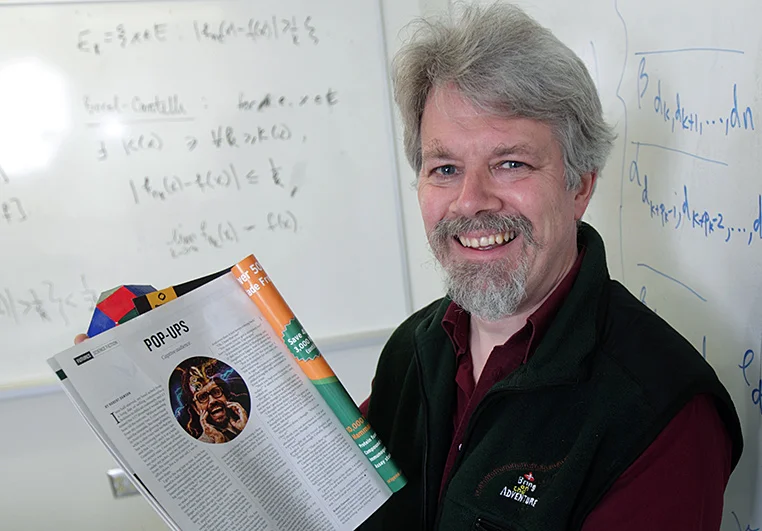
When he’s not teaching or exploring geometry and category theory, Saint Mary’s mathematics professor Dr. Robert Dawson is probably imagining what the future might look like—at his word processor. Since he began writing fiction seven years ago, he’s published a number of short stories—mostly science fiction—and poems.

Though not all his short stories are informed by hard science, mathematical principles often turn up in his written works: "Damned Souls and Statistics" was born from a discussion about statistical techniques and "The Fifth Postulate" came straight out of the undergraduate geometry course that he sometimes teaches. “Ladies’ Night” is about a card shark who schools her marks in probability theory.

“I’ve also written stories based on made-up but plausible results in mathematical logic and real results in classical mechanics,” says Dr. Dawson.

His latest short story, “Sparrowfall” is his second story published in the “Futures” section of Nature, an international weekly journal of science; “Pop-ups” was the first. “Futures” is a science fiction column that presents an eclectic view of what the future may hold. It encourages writers to imagine the limitless possibilities of “what may be lurking around the corner.”

“Sparrowfall” depicts a haunting interaction between a homeless person in crisis and the computerized voice of an autonomous city.