
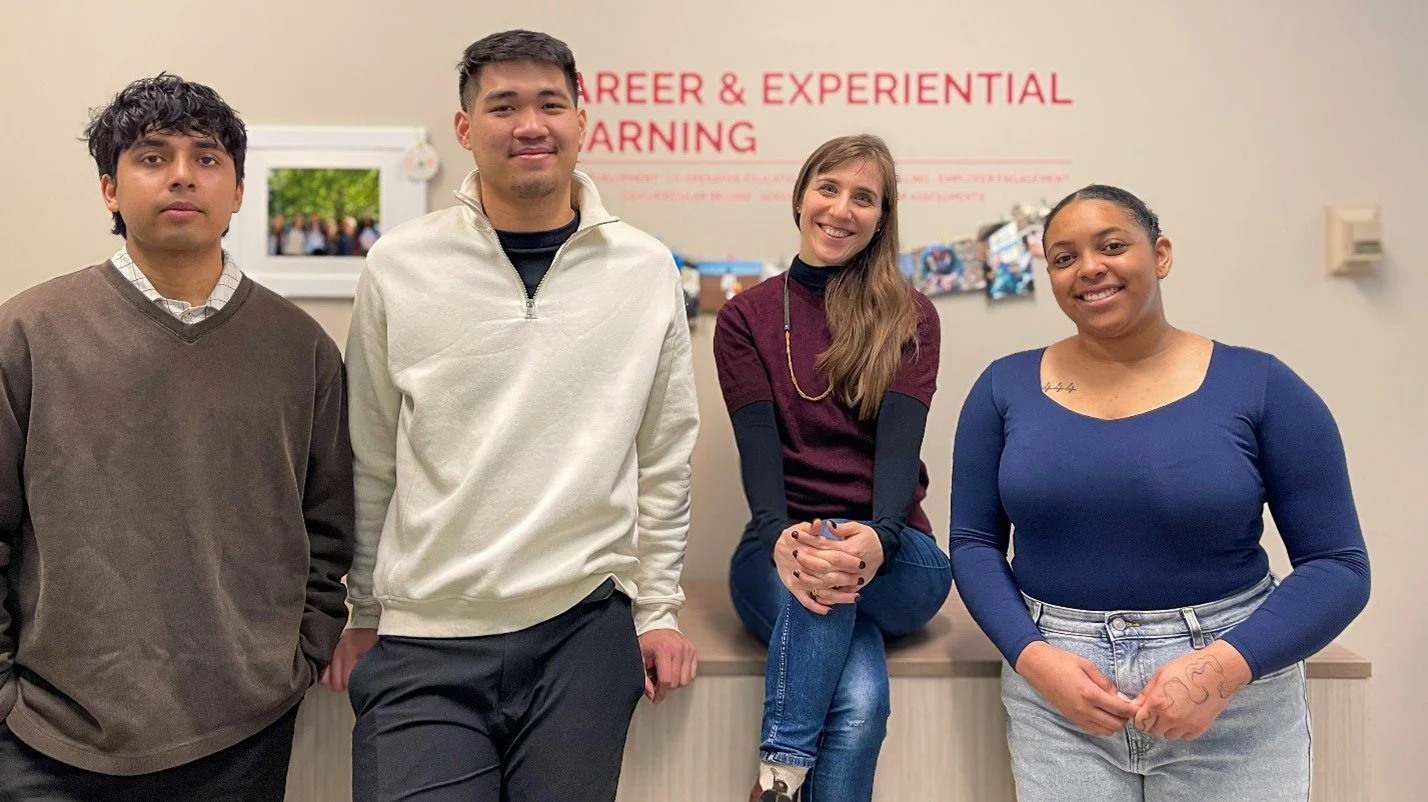
Community Service Learning Team: Masrooq Hossain, Diego Ramos, Novella Nicchitta and Keslyn States
The Saint Mary’s Community Service Learning (CSL) program has seen unprecedented success and growth in recent academic terms, reflecting strong student and faculty interest in community-engaged learning. Through collaborative projects that address community-identified needs, CSL connects academic learning with meaningful community engagement, helping students apply their studies in practical contexts.
CSL-integrated courses at SMU span a wide range of disciplines, from history, literature and intercultural studies to computer science, environmental science, psychology and business, but share a common focus on connecting academic learning with community engagement. Thanks to expanded external funding, Community Service Learning now supports an average of 350 students each year and reached a notable 425 participants across 32 courses in 2025.
In the last year, CSL has provided 83 students with bursaries to support engagement, recognize commitment and enable meaningful community projects. Ten highly engaged students were selected for funding through the pilot Community Engaged Learning Certificate, a nationally-funded initiative supported by Career Experience and Work Integrated Learning (CEWIL) Canada. Designed for students who demonstrate a strong commitment to CSL, the certificate recognizes deeper involvement and guides participants in reflecting on their experiences and translating that learning into resume-ready competencies with career coach support.
SMU students have many opportunities to demonstrate learning outside of the classroom, including CSL, co-operative education and co-curricular recognition
“What we’re seeing through CSL is students stepping into meaningful work and realizing how much they have to offer while they’re still learning,” said Novella Nicchitta, CSL Placement Coordinator.
“As the program continues to grow, we’re creating more opportunities for students to apply their coursework in community settings, and for faculty and partners to collaborate in ways that benefit everyone involved.”
“Students respond extremely well to the CSL option and frequently report that they 'love it' because it feels meaningful, applied and connected to real-world issues,” shared Dr. Margherita Cameranesi, Assistant Professor of Psychology, who has integrated CSL into multiple courses.
“In my courses, I intentionally design CSL-related assignments that are directly relevant to the host community organization’s goals and needs so students can contribute in concrete, appropriate ways.”
“Experiential learning is a great way to stay involved and give back to your community. I was able to have experiences which deeply enriched my learning of psychology. I think it is so important to be reminded that psychology is not just theories and symptoms – my hands-on experience was a very important reminder of this. ”
For many students, CSL is where coursework connects directly to community engagement. Honours Psychology student Sage Rizcallah, who took Typical and Atypical Development in Winter 2025, described their placement with Autism Nova Scotia’s Arts program as a chance to deepen their learning beyond the classroom.
The CSL program also makes experiential learning more manageable during a busy semester. “Many university students are simply too busy to be able to get applicable and course-related volunteer experience throughout the year," Rizcallah noted. "Experiential learning is a great way to get such experience, while still contributing work to an ongoing course, making it more manageable to fit into an already busy semester.”
Dr. Tatjana Takševa, Professor and Chair of the Department of English Language and Literature, says CSL gives students the chance to bridge academic theory with meaningful experience.
“CSL fosters deep integrative learning and active application of theoretical knowledge in real-world settings, helping students connect classroom learning to authentic demands and expectations,” Takševa noted. “CSL facilitates discovery of multiple career paths, showing students how they can put to work their arts education for meaningful participation in today’s globally oriented civil society.”
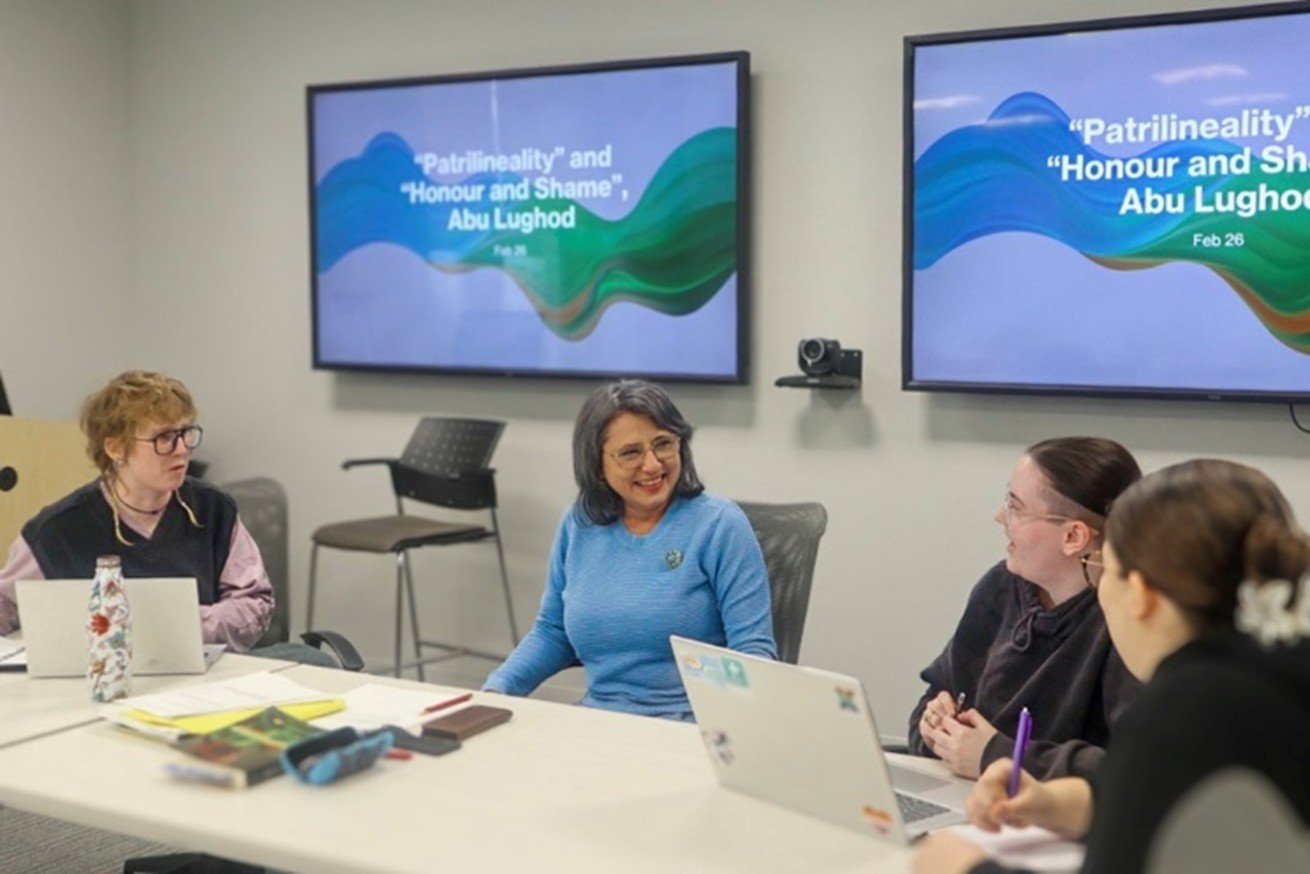
Dr. Tatjana Takševa and students in WGST 6604: Contemporary Issues of Feminism
Adebola Osegbun, a master’s student in Dr. Takševa’s Transnational Feminism course, described her CSL component at The Alexa McDonough Institute for Women, Gender and Social Justice as “the best and most memorable experience of my graduate studies”.
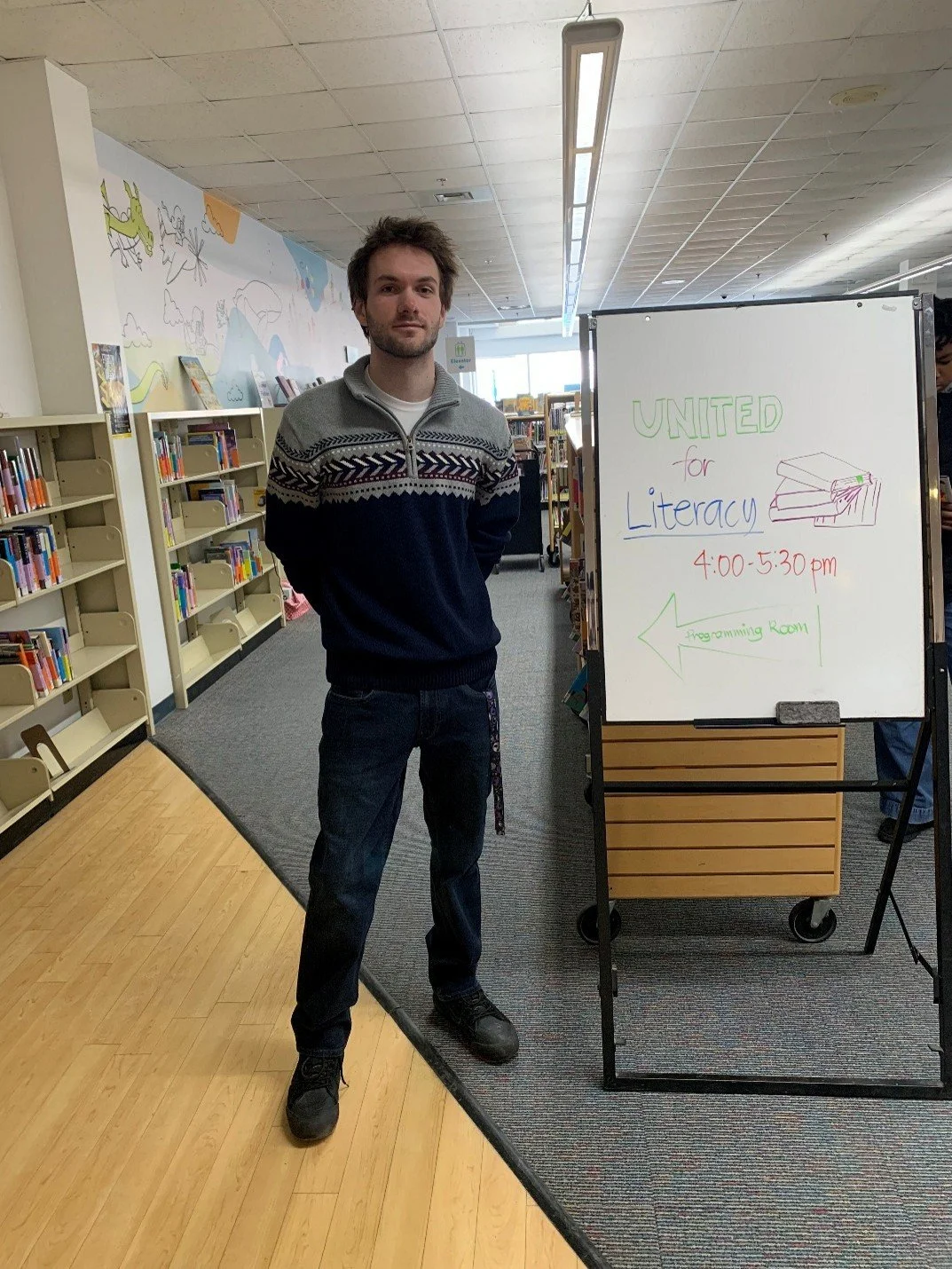
Matthew Nault at his CSL placement, and now workplace, United for Literacy
Similarly, Matthew Nault described his CSL placement with United for Literacy—connected to Dr. Takševa’s Reading and Wellness course—as “an amazing opportunity for experience and resume building that will be invaluable later in my career.”
Nault also participated in the pilot Community Engaged Learning Certificate and is one of several students whose placement roles have evolved into paid employment opportunities.
Beyond employment, CSL helps students explore potential career paths, expand their professional networks and gain clarity about what kind of experiences feel meaningful. For students like Chloe Gohier-Mossman, CSL also helped her build professional connections, gain advocacy experience and clarify her future academic goals.
“CSL opened doors for me to explore career opportunities, build professional connections and advocate for the communities I belong to, all while applying what I’m learning in my courses,” Gohier-Mossman shared about her experience working with the Chisholm LINKS Literacy Program.
Miranda Haley, Chisholm LINKS Program Manager, shared that CSL placements benefit both community partners and students. “The CSL program supports organizations like ours in filling important part-time roles, while giving students meaningful experience,” Haley said. “We value the opportunity to guide and mentor students as they develop practical skills, confidence and professional insight. At the same time, we learn from their perspectives, energy and academic knowledge, which strengthens our organization and the work we do in the community.”
To learn more about CSL opportunities for students, faculty, and community partners, visit SMU Community Service Learning, or connect with the CSL Placement Coordinator at service.learning@smu.ca.