
Dr. Lousie Edwards MSc’03 is one of the first Black Canadians to earn a PhD in astronomy
By Tara Thorne
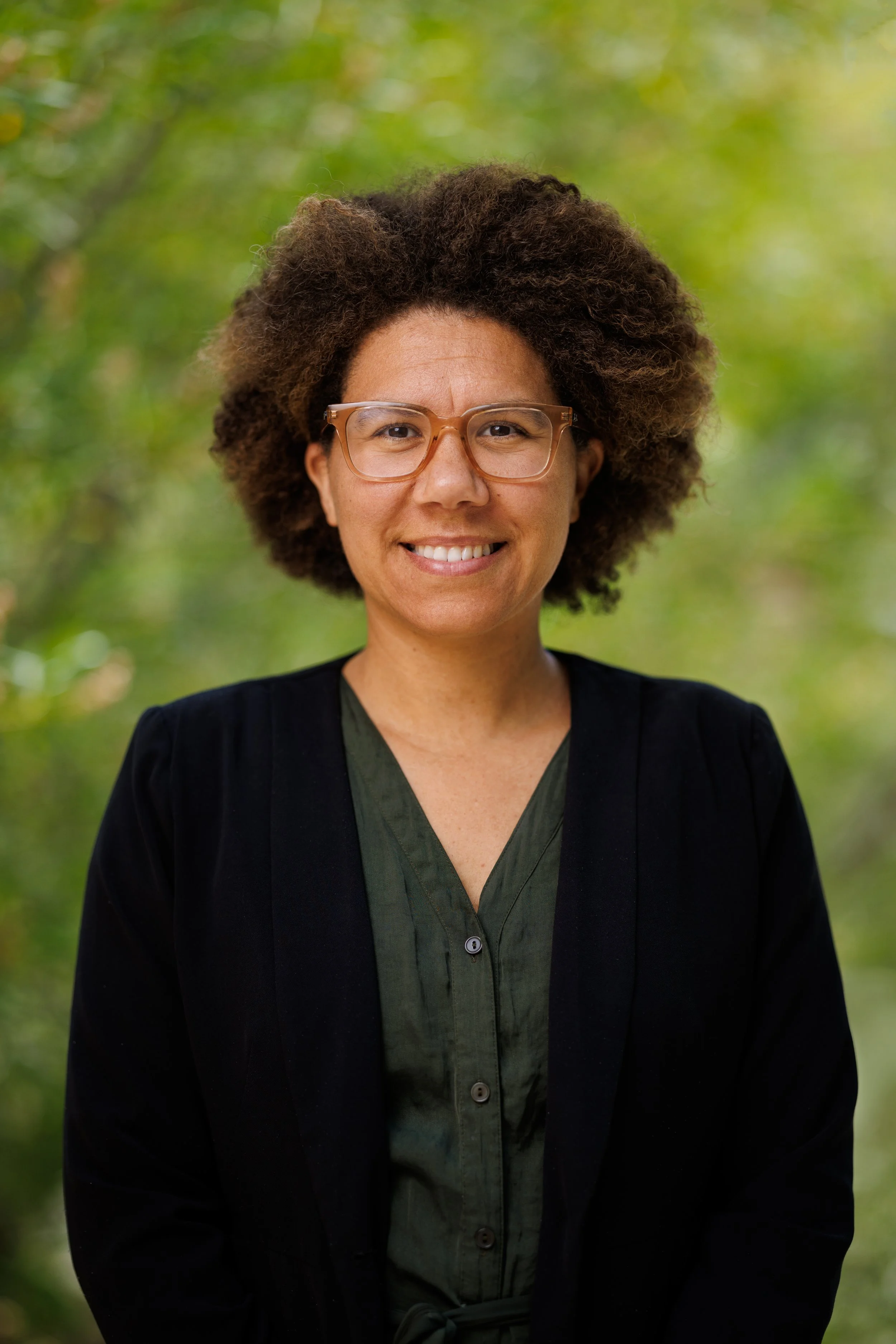
Dr. Lousie Edwards MSc’03
A quarter-century ago, Dr. Louise Edwards MSc'03 took a chance on a city she’d never visited, switched coasts and began her Master of Science in Astronomy at Saint Mary’s.
“It was on the ocean, which was familiar,” said Edwards, who grew up in British Columbia and received her undergrad at the University of Victoria. “I was very excited to go to Halifax. As a Black Canadian, I knew there was a large community of Black folks there, which in Victoria didn’t exist then. I was really excited about that.”
She arrived to a small cohort of four students, two a year ahead of her, Glenn Kacprzak and Edwards.
“We all became very good friends. People were very friendly – not just in the reputation of east coasters, but also in the close-knit nature of the department,” said Edwards from Washington, DC, where she’s a Program Director at the National Science Foundation until she returns to her job as associate professor of physics at California Polytechnic State University next year. “David Clark was one of my professors. He knew we were coming across the country for school, and he invited us to his home for Thanksgiving that year.”
Edwards reached a very particular height that few other scientists can claim – while at Saint Mary’s, she was chosen to appear on a stamp as part of a Canada Post series celebrating universities.
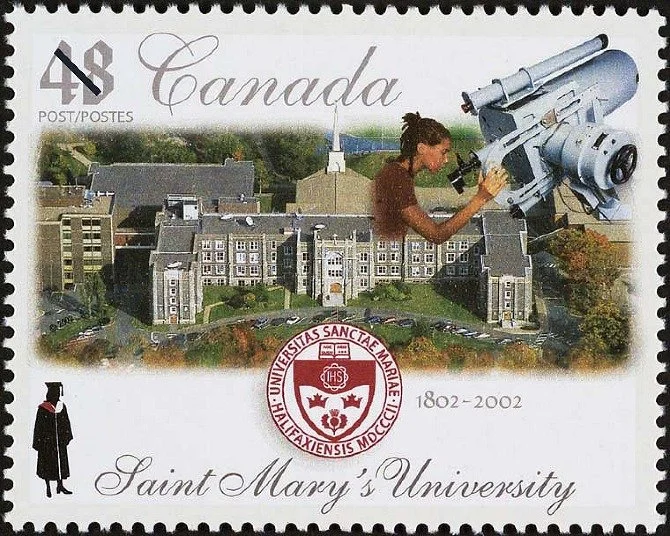
Edwards was featured on the Saint Mary’s stamp, part of the Canadian Universities Collection (2002) by Steven Slipp Design
“Saint Mary’s has had astronomy for a very long time, and they told me they wanted to honour that tradition.” Edwards and Kacprzak were each photographed for the stamp, “and we had no idea who would get chosen until it came out.” (Spoiler: It was her.)
“I was wearing a silver chenille super-fluffy sweater. But they had Photoshopped it so I’m wearing a Saint Mary’s sweatshirt,” she laughed. “My mom bought up a whole lot of stamps.”
Since receiving her master’s in 2003, Edwards has been travelling around North America teaching and studying. Her area of focus is, humbly, the largest objects in the universe, including the brightest cluster galaxies and the cosmic web. She received her Ph.D. from Université Laval – one of the first Black Canadians to earn the degree in astronomy – and conducted her postdoctoral research at Caltech and Trent University. She taught at Mount Allison and Yale before landing at Cal Poly.
She has been based in California since 2016, but has been on leave since the summer of 2024 to serve on rotation for the National Science Foundation, where she administers funding for research in astrophysics.
Hot-button topics include instrumentation; Edwards points to a new telescope at the Vera Rubin Observatory in Chile as an example. “It’s going to give us more galaxies and stars than have ever been observed in all of history.” There’s also a significant amount of research surrounding Artificial Intelligence. “AI is so much bigger than ChatGPT. It encompasses a range of computational techniques and advancements, including machine learning. Astronomers have been very involved and even crucial to the development of computation.”
Edwards’ role is to guide the process to determine which scientists should receive funding from the Foundation, which has a nearly $10 billion annual budget and accounts for a quarter of the federal funding received by American academic institutions for research. “One of the reasons that the U.S. and Canada have such strong science and economies is because there’s this investment – strong and steady in science and engineering.”
It’s a big, exciting job, and she’s having a blast doing it.
“I get to read everybody’s top ideas in the moment,” said Edwards. “I’m seeing the science everybody wants to do right now, today.”
Disclaimer: This material was written while Dr. Edwards was serving at the National Science Foundation. Any opinions, findings, and conclusions or recommendations are solely those of the authors and do not necessarily reflect the views of the National Science Foundation or the Federal government.
This story was featured in the Fall edition of the Maroon + White alumni magazine. Visit the online magazine to read more alumni stories!