

Saint Mary's graduates have new ways to celebrate their language, culture and identity as Convocation continues to evolve alongside the university community.
Convocation is built on tradition: the gowns, the academic hoods, the procession, and the moment a graduate's name is called and they cross the stage, marking the culmination of years of work. At Saint Mary's University, these customs have been passed down through generations, evolving alongside the institution throughout its 225-year history.
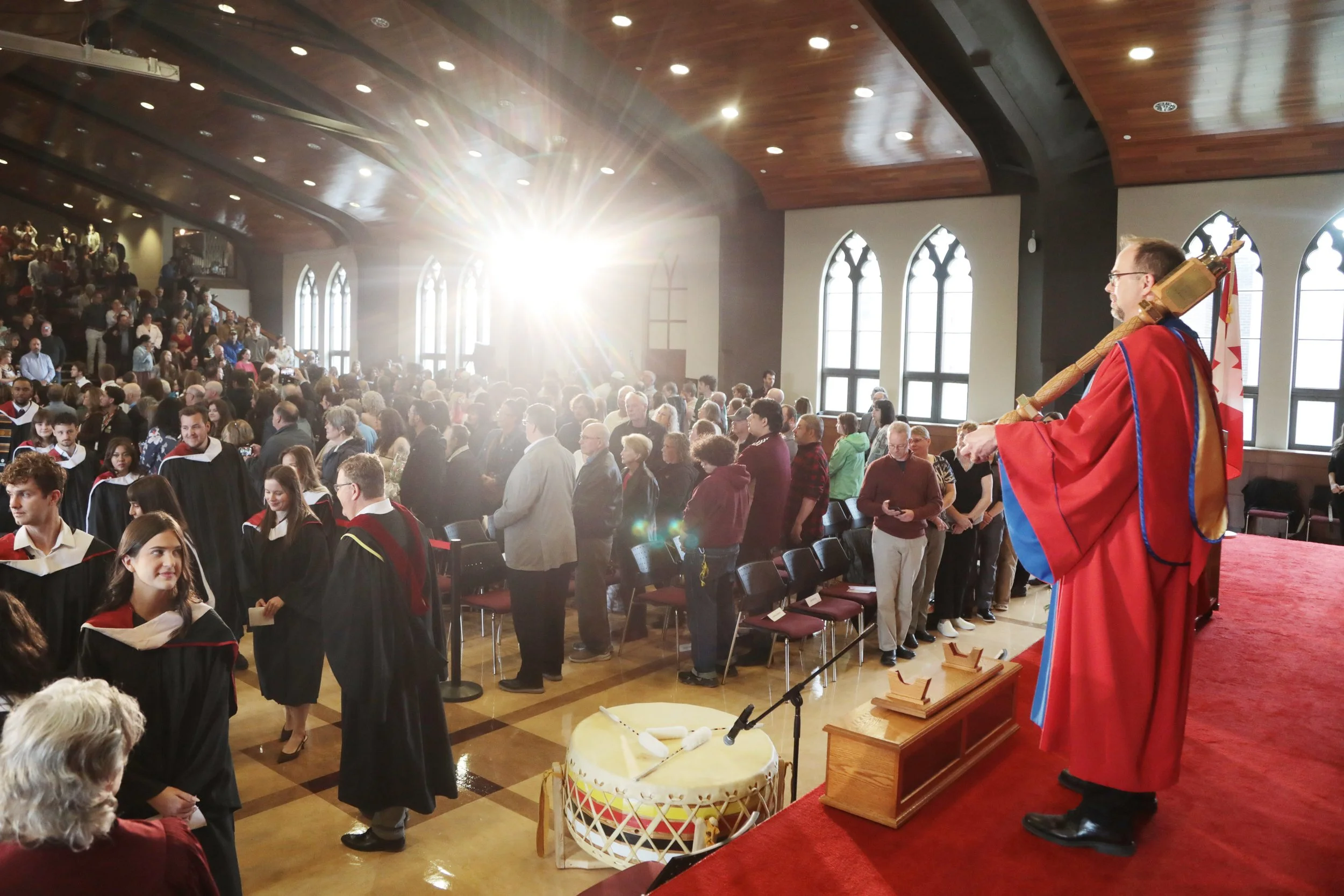
The ceremonial mace, presented to Saint Mary’s in 1980, remains a longstanding part of the academic procession
The ceremonial mace, carried at the head of the academic procession, arrived in 1980 as a gift from Maritime Command honouring alumni who died in the two world wars. The academic robes and hoods follow conventions established centuries ago at Oxford and Cambridge. The flags displayed on stage represent the countries of graduating students, part of a university tradition recognizing its international community.
“We’re preserving the academic customs while introducing new expressions of language, culture and identity, so graduates can see more of themselves in this milestone moment,” says Dr. Michael Khan, President and Vice-Chancellor at Saint Mary’s University. “The flags on our stage only hint at how many roads lead here. Some students’ families have lived in Mi’kma’ki for thousands of years. Others crossed an ocean to study in Halifax. Every one of those journeys belongs on this stage.”
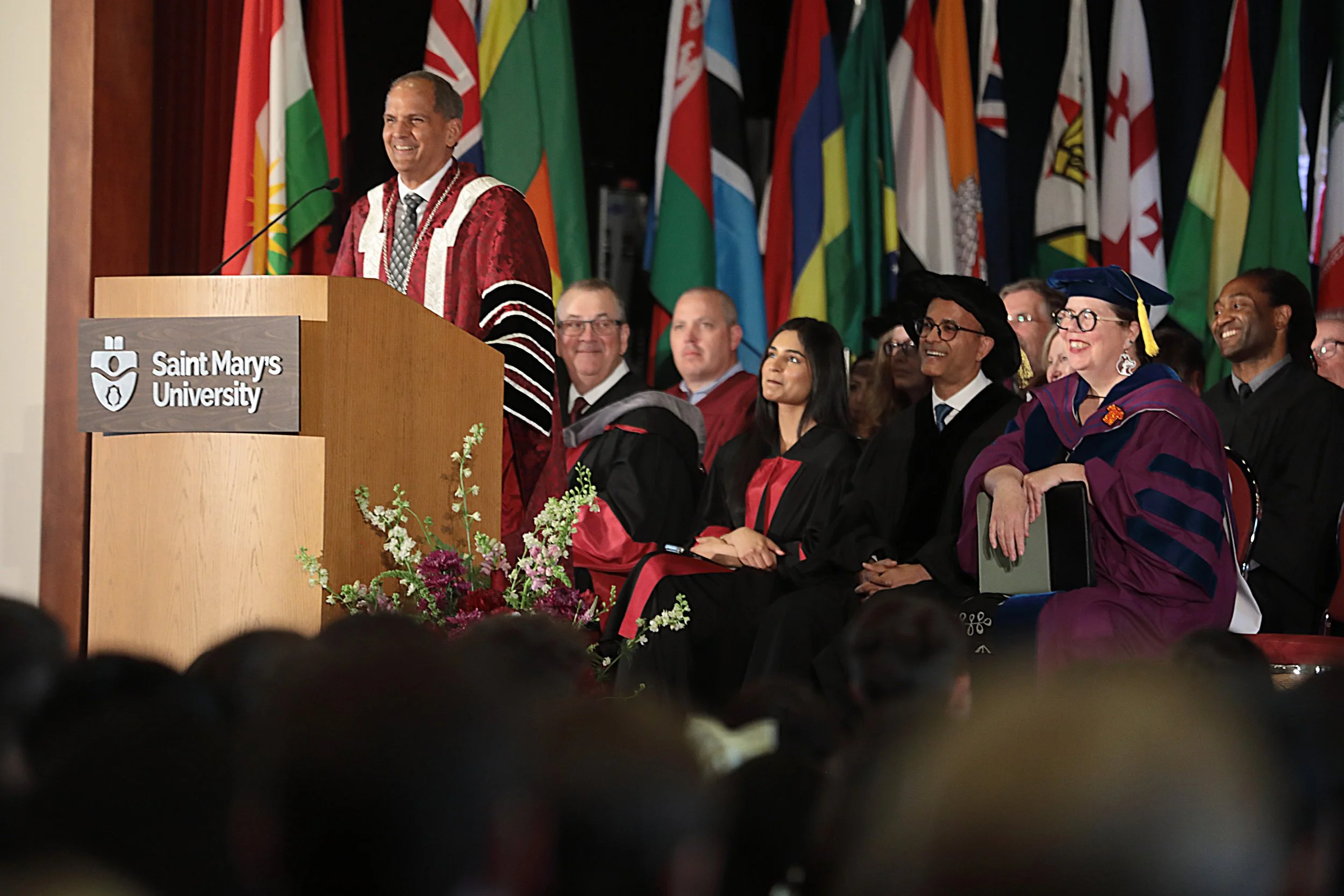
“The flags on our stage only hint at how many roads lead here.”
A degree in the language of this place
One of the most significant changes begins months before graduates cross the stage. When students apply to graduate from Saint Mary's, they can now choose whether they would like their degree, diploma or certificate parchment printed in English or Mi'kmaw.
The change places the Mi'kmaw language on one of the university's most formal documents, issued by an institution located in Mi'kma'ki, the ancestral and unceded territory of the Mi'kmaq.
In 2022, Nova Scotia's Mi'kmaw Language Act came into effect, formally recognizing Mi'kmaw as the province's original language and supporting efforts to protect and revitalize it.
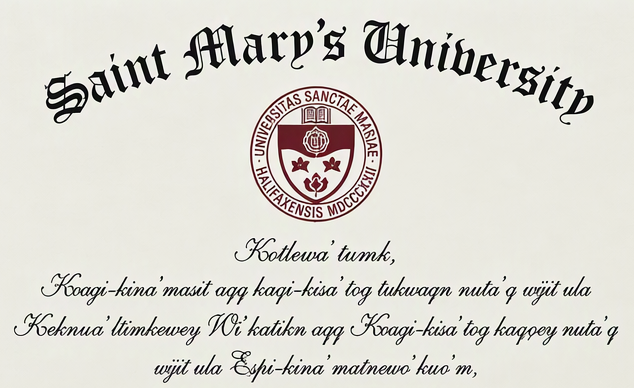
A sample of the new Mi’kmaw-language degree parchment, now available as an option for Saint Mary’s graduates
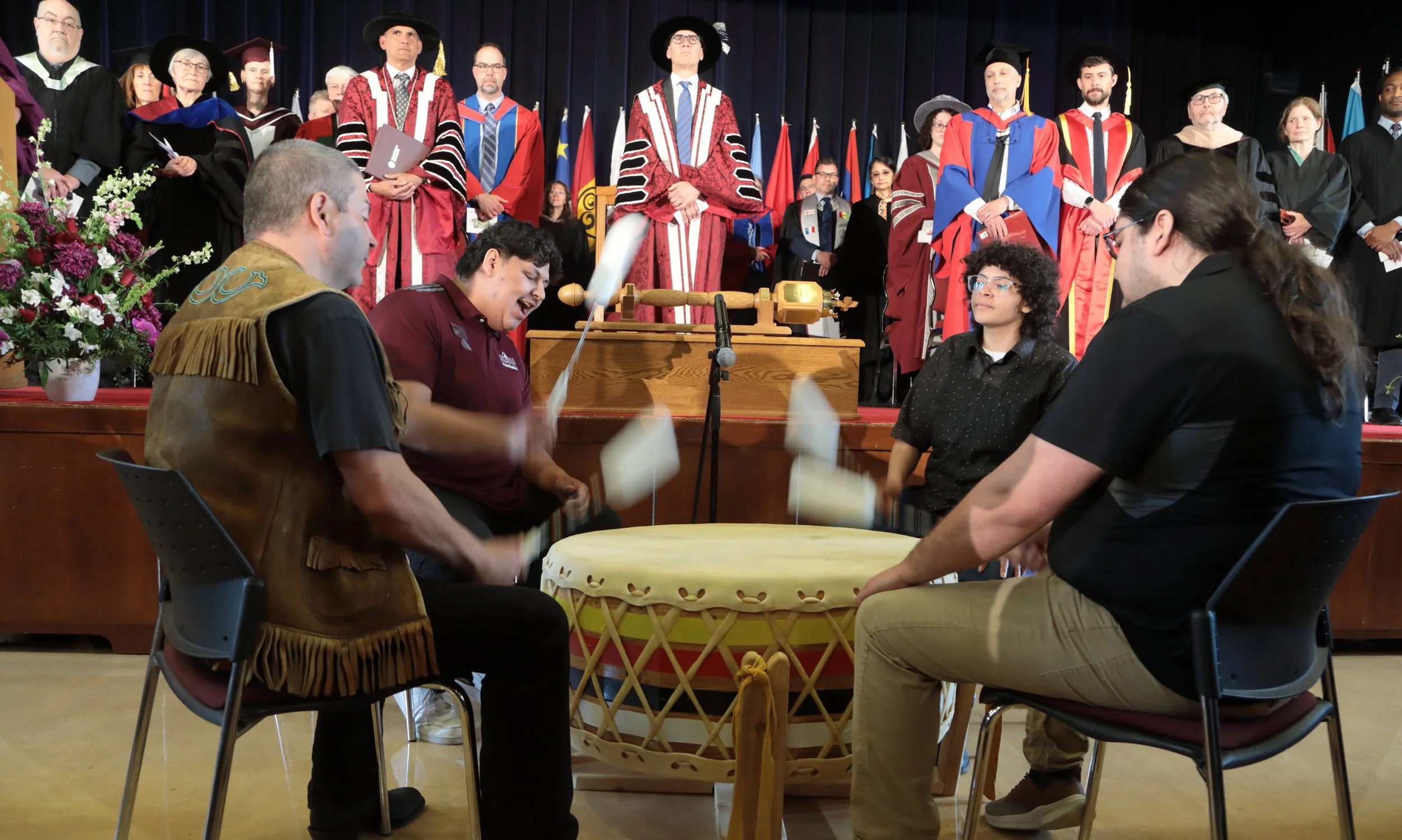
Indigenous Student Advisor Kylar Johnson drums at Spring Convocation with Raymond Sewell, Cole Prosper and Cedar Pictou
In 2025, Indigenous students selected the name Qomuti for their dedicated campus space through an open, community-led process. Meaning "a place of safe haven" in Mi'kmaw, Qomuti offers students a place to gather, study, smudge and participate in cultural activities.
Indigenous drumming and song have also become part of university gatherings. In 2021, Saint Mary's and the Saint Mary's University Students' Association introduced a community teaching drum intended for use at Convocation, Mawio'mi and other events.
At Spring Convocation in 2026, Indigenous Student Advisor Kylar Johnson and other members of the university community offered drumming and song as graduates and their families gathered. These traditions bring Indigenous language and cultural expression into spaces where students celebrate their academic achievements.
Starting this fall, graduates renting their academic regalia can also rent or buy an official Saint Mary’s Indigenous stole. Its design was inspired by and uses the colours of the traditional Mi’kmaw Medicine Wheel, which represents the interconnectedness of all creation and the four directions.
A new expression of Black identity and achievement
In consultation with Black Student Advisor Ebun Oladele, the Kente Stole was made available for Black students for the first time during the Spring 2026 Convocation. The stole is solely for Black-identifying students and is permanently a part of the SMU convocation regalia.
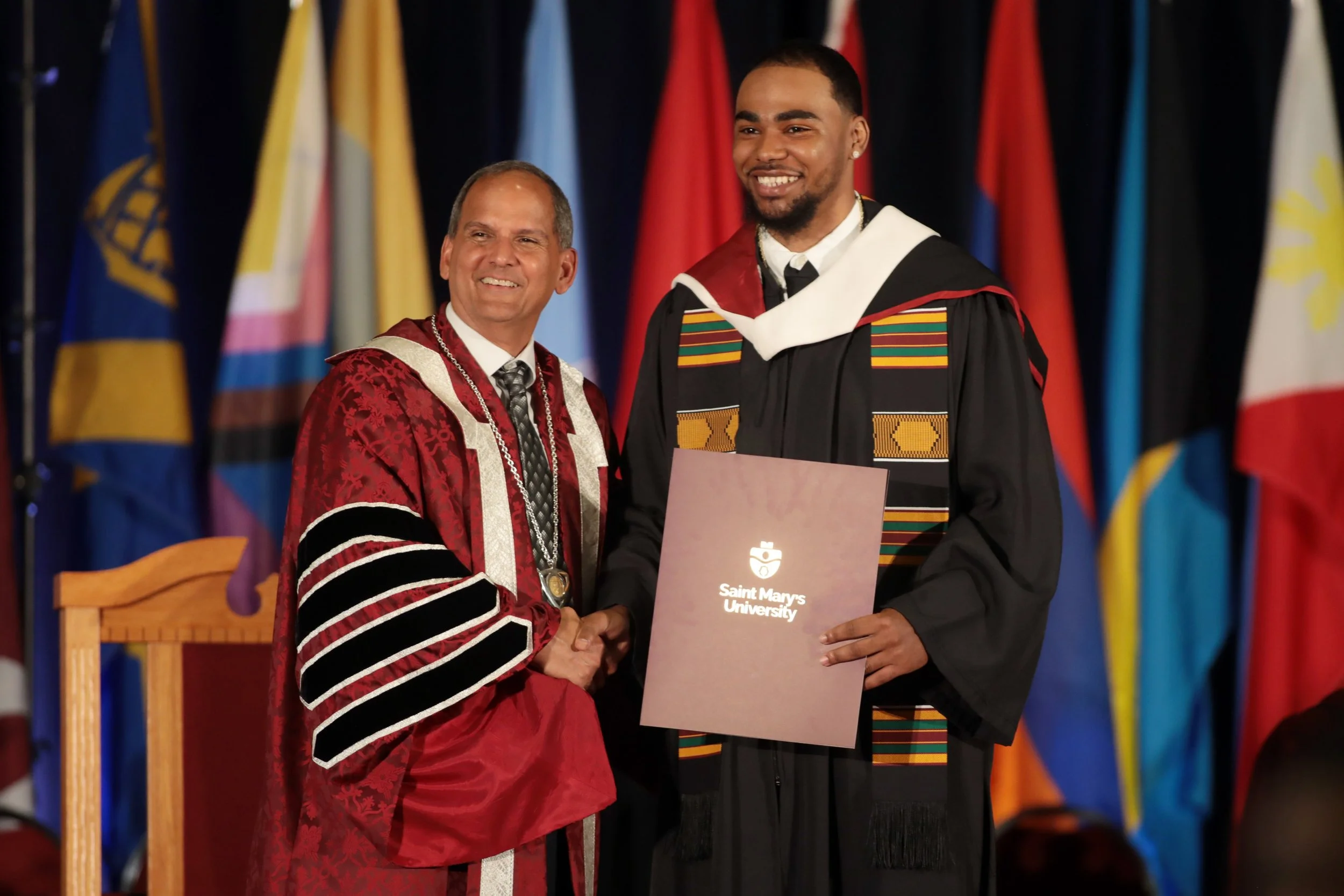
Dr. Michael Khan with 2026 graduate Trydell Mintis, who is wearing the Saint Mary’s Kente stole
Worn over academic regalia, the stole draws on a centuries-old West African textile tradition, particularly the Asante and Ewe weaving cultures of Ghana and Togo.
At Saint Mary's, the new stole arrived amid broader efforts to support Black students and strengthen their sense of belonging on campus. In spring 2025, Saint Mary's established its first dedicated Black student space. Officially named Sankofa: Black Excellence Commons in January 2026, the space was shaped through the efforts and advocacy of Black student leaders and university staff.
Sankofa, a concept rooted in Ghanaian Akan traditions, emphasizes learning from the past to inform the future. Today, Sankofa provides Black students with a place to study and build community.
“The naming of this space is an act of recognition, but also an act of responsibility,” says Ebun Oladele MA'20, Black Student Advisor at Saint Mary's University. “It asks us to protect it, nurture it, and ensure it continues to serve generations of Black students to come. This space represents safety, grounding, community, and affirmation. It is a place where SMU Black students can exhale, gather, organize, create, and simply be.”
Removing barriers to participation
Some Convocation traditions are expressed through what graduates wear or the language printed on their parchments. Others are reflected in how the university makes the ceremony accessible to everyone.
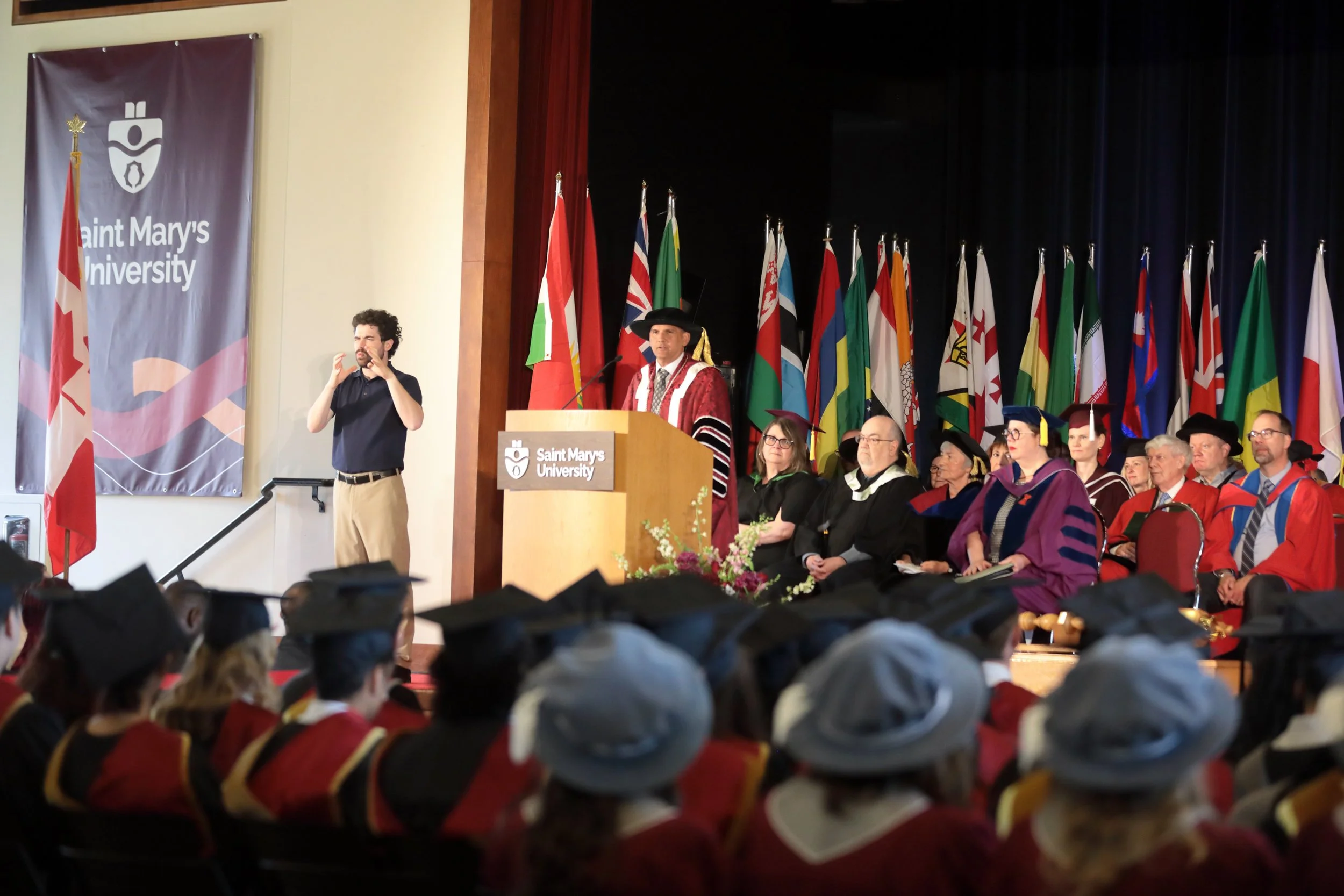
A sign language interpreter conveys Dr. Khan’s remarks during Convocation
At every Saint Mary's Convocation, American Sign Language (ASL)-English interpreters are on stage. Graduates and guests who use ASL do not need to request interpretation in advance—the service is built into the ceremony itself.
Saint Mary's has a longstanding connection to Deaf academics and research involving sign languages. In 2017, a university-community partnership launched the Atlantic Provinces Sign Language Place Names Map, documenting local place names in American Sign Language and Maritime Sign Language. The project involved Deaf community members and helped share the region's distinct signing traditions.
Accessibility has also shaped the university's physical spaces and academic supports. The Fred Smithers Centre for Student Accessibility traces its roots to 1985, when Saint Mary's became home to the first designated post-secondary accessibility centre in the Maritimes. Today, the Centre provides individualized accommodations, accessible testing spaces and assistive technologies.
More recently, Saint Mary's opened a new universal washroom in the Patrick Power Library, designed with a ceiling lift, an adult-sized change table and sufficient space for larger mobility devices. The university's 2025–2028 Accessibility Plan focuses on removing barriers to participation and incorporating the perspectives of people with lived experience.
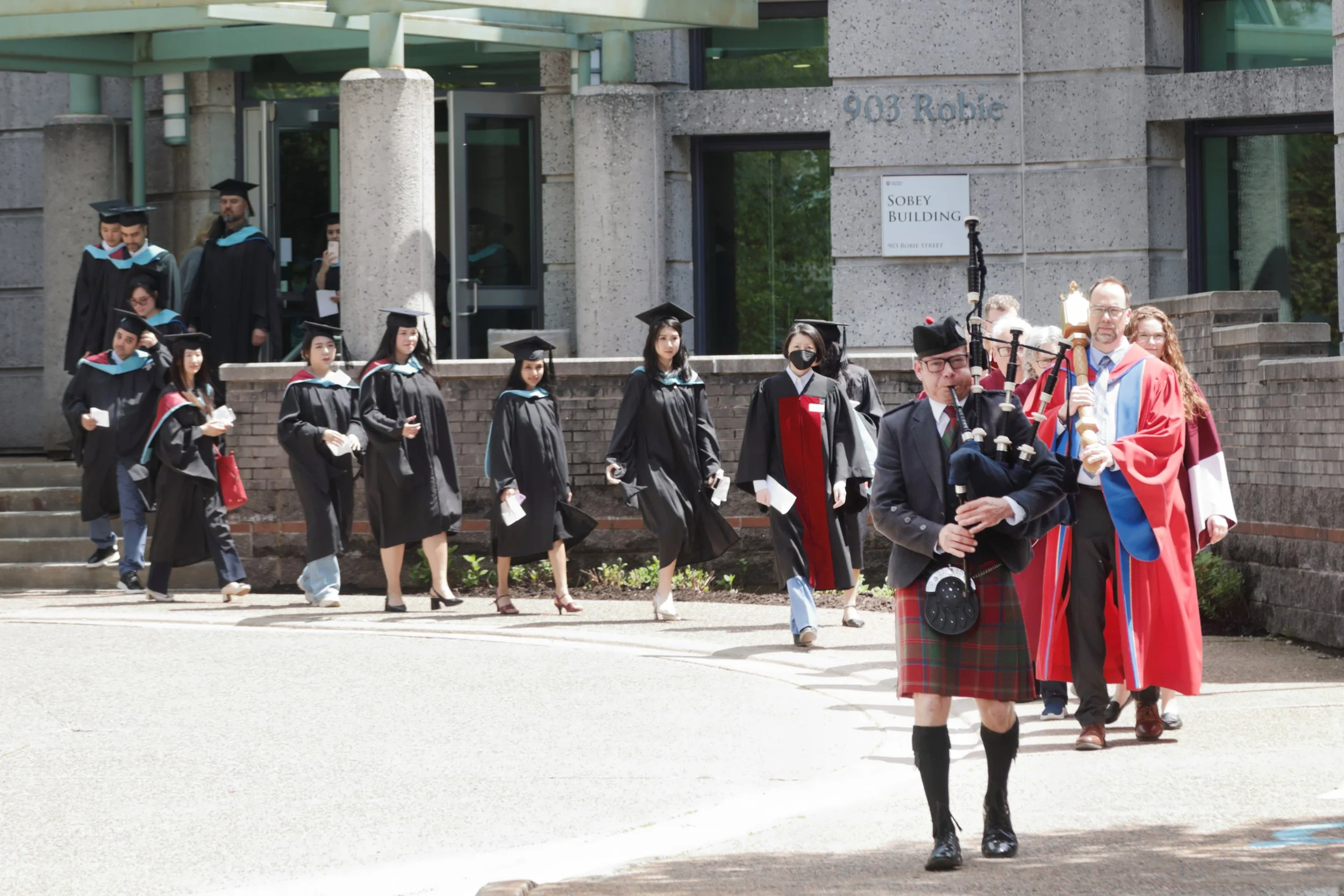
A bagpiper leads the academic procession at Convocation, honouring Nova Scotia’s Scottish heritage
A new chapter in a longstanding tradition
This year's Fall Convocation also marks another historic first. Janis Sobey-Hames will be formally installed as Chancellor during the morning ceremony, becoming the first woman to hold the role in Saint Mary's history. Her installation adds another chapter to the university's ceremonial history.
The developments reflect priorities outlined in Saint Mary's 2024–2029 strategic plan, World Without Limits, which identifies equity, diversity, inclusion and accessibility as central to the university's future.
For graduates crossing the stage this fall, these changes will be visible in the languages, symbols and traditions surrounding their achievements. Each is part of a Convocation ceremony that continues to evolve alongside the people it celebrates.
Fall Convocation takes place on Friday, November 13, 2026. Find the convocation program and watch the ceremony live stream at smu.ca/graduation.