Faculty of Arts

Summer research projects enhance education for Arts students

StudentResearchPoster.jpg

One of the many benefits of attending an institution such as Saint Mary’s is the research opportunities afforded to undergraduate students. This summer, five students from various departments in the Faculty of Arts were able to gain skills, knowledge and experience in their chosen fields of study – two will even end the summer with publications in their name.

Yingjun Chen, a fourth-year Honours French student, jumped at the chance to work with Dr. Rohini Bannerjee translating “Coupeuses d’azur,” a feature poem by Mauritian artist Khal Torabully, from French to English. “I’m finding it really enjoyable, because I’m doing something I love,” says Chen. She’s discovering many intricacies involved in translation, including appreciating the challenges of word choice, and whether to keep a rhyme or focus on the meaning. The goal is to send the 35-page poem to a publisher and use this experience as the basis for her Honours thesis. 

Fourth-year Honours Psychology student Le Khoi Anh Pham spent his summer conducting research alongside Dr. Nicolas Roulin and two graduate students, on asynchronous virtual interviews and cross-cultural personnel selection. “Contributing ideas to the research gave me confidence and insight into what post-graduate-level research and academic work are like.” He will be named as a third author in an upcoming article using the research, and has already been hired to complete another project with Dr. Roulin.

Bethany Leal just finished her first year of university, but that didn’t stop her from applying to work with Dr. Alexandra Dobrowolsky on a project critically examining Canada’s image of being a diverse, multicultural, welcoming nation. The project began with the Trudeau blackface scandal but expanded from there, considering this summer’s events. “Learning and self-reflection is a lifelong journey,” says Leal. “It can’t really be condensed into one summer or one research project, but it really helps to have had this opportunity.” This experience helped to solidify her future goals. Now majoring in Political Science, she hopes to specialize in systemic reform and holding governments to account – especially around issues of race and culture.

Fifth-year IDS and Political Science student Katheryn Lewis has been busy this summer on projects, also with Dr. Dobrowolsky. She is helping round out research on the Atlantic Immigration Pilot program, legislative responses to COVID-19 among the provinces, territories and national government overall, and feminist governance with regards to COVID-19, comparing and contrasting feminist institutions in Canada, the U.S. and Mexico.

Minoring in Film Studies, third-year student Andrés Guardia is researching Nova Scotia film director Margaret Perry, with Dr. Jennifer VanderBurgh. He has been working to create a more in-depth picture of Perry’s life and work – to show she is an auteur, not simply a director of industrial (tourism) films. “Now that I have watched them, I am really seeing the artistic elements to the films and Ms. Perry’s authorship. It’s very powerful and, as art, I can appreciate it,” says Guardia of the unexpected outcome of his work. He wants to create music once he finishes his degree – and this experience has given him a good base and understanding of the principles to apply to his own creations.

The robust research experience gained by all five students this summer has already greatly impacted their future careers and aspirations, thanks to funding through the Social Sciences and Humanities Research Council of Canada (SSHRC). These examples of undergraduate involvement in hands-on learning showcase the benefits and power of putting the motto “do what you do” into practice.

Saint Mary’s research in psychology, management, and history receives federal funding

IMG_0521.JPG

Saint Mary’s University researchers have received federal funding for projects totaling $300,000 from the Social Sciences and Humanities Research Council’s Insight Grants competition.

“Research in the social sciences and humanities is a fundamental element of how society understands and interprets itself, providing the insight needed to critically explore the true impact of our established institutions, both positive and negative,” says Dr. Adam Sarty, dean of Graduate Studies and associate vice-president of Research at Saint Mary’s University. “These grant recipients are all challenging key aspects within our culture – from the criminal justice system, to sexual abuse cover-up within the Catholic Church, to workplace incivility, to examinations of medical malpractice. I am very proud of our recipients for their willingness to challenge conventions and engage in this research that enriches both our local and global communities.”


The following is a list of Saint Mary’s Insight Grant recipients:


Recipient: Dr. Meg Ternes (Psychology)
Title: Lie Detection in the Criminal Justice System: Exploring Deception Cues in Field and Laboratory Studies

Dr. Meg Ternes

Dr. Meg Ternes

Description: Most of us are not good lie detectors; lie detection accuracy is usually at chance level. Yet, lies accompanied by powerful emotions and false emotional displays can have major consequences, especially in the criminal justice system where the perceived credibility of an alleged victim’s distress or an offender’s remorse can inform decisions concerning verdicts, sentencing, or parole. For this project, Dr. Ternes and her team will examine the efficacy of nonverbal, verbal, and facial cues to deception (together and separately) using laboratory and field research approaches. The laboratory study will consider emotionally-laden lies and truths told by undergraduate students under controlled conditions, while the field study will consider lies and truths told by criminal suspects in police interviews. The results of these studies will improve our understanding of which combinations of cues contribute the most to deception detection. These results will be shared with professionals in the criminal justice system who have to make these important credibility judgements on a regular basis.


Dr. Cathy Driscoll

Dr. Cathy Driscoll


Recipient:
Dr. Cathy Driscoll (Management)
Title: Exploring Collective Moral Disengagement in Cover-up of Sexual Abuse in the Roman Catholic Church

Description: The broad aim of my research project is to better understand, and effect change in, organizations that are engaged in potentially contradictory practices to their principles, mission, and values. Specifically, this project will focus on institutional and leader moral disengagement in the context of the cover-up of clergy sexual abuse (CSA) of minors in the Roman Catholic Church (RCC). Using content and discourse analysis, I will study current and historic RCC leader discourse from 1990 to 2020 across four countries. Better understanding insights into the organizational dynamics and discourse strategies in this context can provide valuable applications to the RCC with an estimated 1 billion members, as well as to other organizations’ crises, control dynamics, corruption, and misconduct issues (e.g., banks and public sector).


Camilla.jpg

Recipient: Dr. Camilla M. Holmvall (Psychology and Management)
Title: Examining how workplace incivility impacts leader well-being: The moderating role of leader gender

Description: Workplace incivility has been highlighted as highly prevalent in organizations and also highly damaging to employee attitudes, behaviours, and well-being. Research has focused predominantly on mistreatment directed from supervisors toward subordinates, and between coworkers. However, supervisors, managers, and leaders can also be targets of disrespect. Understanding how, and when, leaders’ well-being is impacted by workplace incivility has significant implications, in part due to leaders’ influence on the achievement of the objectives of the organization as well as on their followers’ performance and well-being.  In this 5-year mixed-methods grant, we draw on relevant theory (e.g., selective incivility, stereotype activation and threat) to examine the possible different experiences of male and female leaders in terms of both their likelihood of experiencing incivility as well as on its impacts on their well-being. 


blake+brown.jpg

Recipient: Dr. Blake Brown (History)
Title: A History of Canadian Medical Malpractice Law, 1935-1980

Description: This research will break new and exciting ground in historical research in Canada. It will produce the first history of medical malpractice law in English Canada from 1935 to 1980. One of the most contentious areas of law in the mid twentieth century, malpractice law developed in significantly different ways in Canada than in the United States. The project will explain key changes and trends, and also consider the impacts of technology and the roles of gender, ethnicity and race in shaping the results of malpractice lawsuits. The study ends in 1980, by which time Medicare and the emergence of professional self-regulation complaint systems altered how governments, the medical profession, and individuals approached negligence issues. Focusing primarily on actions against physicians and surgeons, the research will also explore how hospitals and other medical professionals became entangled with litigation. This research will interest historians and also legal scholars, medical professionals, lawyers, policy makers and the general public, since medical malpractice is an important and pressing policy issue.


The Social Sciences and Humanities Research Council’s Insight Grants support research excellence in the social sciences and humanities. Funding is available to both emerging and established scholars for research initiatives of two to five years. Stable support for long-term research initiatives is central to advancing knowledge. It enables scholars to address complex issues about individuals and societies, and to further our collective understanding.

The Social Sciences and Humanities Research Council of Canada (SSHRC) is the federal research funding agency that promotes and supports postsecondary-based research and research training in the humanities and social sciences. By focusing on developing talent, generating insights and forging connections across campuses and communities, SSHRC strategically supports world-leading initiatives that reflect a commitment to ensuring a better future for Canada and the world.

The work SSHRC supports encourages the deepest levels of inquiry. It spurs innovative researchers to learn from one another’s disciplines, delve into multiparty collaborations and achieve common goals for the betterment of Canadian society. Research outcomes are shared with communities, businesses and governments, who use this new knowledge to innovate and improve people’s lives.

Nova Scotia Provincial Heritage Fair goes virtual for 2020

cropped-img_1286.jpg

The 2020 Nova Scotia Heritage Fair is going virtual and is open to all Nova Scotian students in Grades 4 to 9.

"It was very important to us to find a way to continue, despite school closures,” says Dr. Kirrily Freeman of the Saint Mary’s Department of History, who coordinates the Provincial Heritage Fair each year. “Students work so hard on their projects throughout the year to prepare for this. Holding a virtual fair will be a good way to keep a connection with the kids, showcase their wonderful work, and highlight our youth and community, as well as our history and heritage, in these challenging times."

Every year, schools across the province hold fairs featuring heritage and history-themed projects by students in Grades 4 to 9. Winners go on to participate in the Nova Scotia Provincial Heritage Fair, usually held over two days in early June at Saint Mary’s University with educational workshops, awards and a public showcase.

Africville is the 2020 honouree for the provincial heritage day and heritage fair. The close-knit community was built on the shores of Bedford Basin by descendants of the Black Loyalists and Black refugees who came to Nova Scotia in the late 1700s and early 1800s. See the Nova Scotia Heritage Day website for information and videos.

Students are invited to submit their projects on any aspect of Canadian history or heritage to kirrily.freeman@smu.ca  before June 1, 2020.  Any parents or students with questions can also send an email to the address above.

Submissions should include:

Projects will be displayed publicly throughout the month of June on the Nova Scotia Provincial Heritage Fair Instagram site, @nsprovincialheritagefair. Any students looking for inspiration can check out these highlights from the 2018 and 2019 Provincial Heritage Fairs.

Updates from the Nova Scotia Provincial Heritage Fair will be posted on its website, on Facebook at @novascotiaheritagefairs, and on Instagram at @nsprovincialheritagefair.

Developing comprehensive mental health services for those attracted to minors

As a researcher and psychologist, I’ve always had a strong interest in violence prevention, particularly the prevention of sexual violence against children. Although it is a difficult subject that impacts many, we must conduct research on the causes of childhood sexual abuse if we want to reduce its occurrence.

Risk for sexual abuse can never be explained by one single factor, and we need a multi-pronged approach to prevent it. An example of one risk factor is a sexual interest in children; however, research shows that this is not the same as child sexual abuse. Not everyone with a sexual interest in children offends against children or is destined to do so.

The area my team and I have focused on is individuals with a sexual interest in children who reside in the community and are not involved in the criminal justice system. While it’s not common knowledge, there are people with a sexual interest in children who desire mental health services. It bears stating that there are others who are not struggling, are coping with this reality, and live offence free lives.

Of those interested in treatment, some seek support to help them avoid offending. Others would like treatment to address various mental health concerns.  Both treatment needs are important. Helping people to develop healthy coping strategies is vital so that people can live meaningful and offence free lives. Unfortunately, outside of the criminal justice system, there are significant barriers to accessing mental health services for this group.

My research has more recently focused on understanding treatment needs and barriers to treatment. The aim is to develop mental health programs for people with a sexual interest in children who are not involved in the criminal justice system. One of the areas that have been identified as a significant barrier for people who may desire these services is concern about negative attitudes that influence their desire to seek treatment and how these attitudes might impact their care.

We are currently conducting a survey to determine how to accurately measure the attitude of the general public on this topic. This survey is part of an unfunded study conducted by myself and two students. We hope that this will advance research in the area.

We can create an environment where people who are dealing with a sexual interest in children and want mental health services can access those services. I believe we have a moral and ethical responsibility to help anyone who wants these services, regardless of their identity.

I recognize that this topic evokes strong emotions in others, which is understandable given the nature of this matter. Sadly, strong emotions can prevent the tough conversations we must have if we hope to develop effective responses that can prevent sexual abuse.

Written by Skye Stephens, Ph.D. R.Psych, a psychologist and Assistant Professor at Saint Mary's University.


Award-winning local authors at Saint Mary’s Reading Series

A pair of very different authors from Inverness kept a full house spellbound at the most recent Saint Mary’s Reading Series event, Dec. 4 in the Patrick Power Library Classroom.

Frank Macdonald shared passages from his hilarious novel, The Smeltdog Man, published in October 2018 by Pottersfield Press. The book tells the tale of a Cape Bretoner who learns to survive in the corporate world after his accidental invention – a marijuana-induced, munchie-inspired ‘Smeltdog’ – evolves into Canada’s most successful fast food franchise, the Good Karma Corporation. 

Macdonald is the award-winning author of A Forest for Calum and other novels, short stories, plays, poetry and songs. He has twice been nominated for the International IMPAC Dublin Literary Awards, and is also well known for his long-running column in The Inverness Oran

Joining him was Tom Ryan with readings from his gripping new novel for young adults, Keep This to Yourself, published in May by Albert Whitman & Company. Just a few days before the event on campus, the thriller was selected by The Globe and Mail for ‘The Globe 100: Books that shaped 2019’. The story revolves around a gay teenage sleuth in a small coastal town that has been terrorized by a string of murders, including the death of his best friend. Among many great reviews, Quill & Quire calls the novel “both a powerful coming-of-age story and a frequently surprising mystery”.

A 2017 Lambda Literary Fellow in Young Adult Fiction, Ryan has also been nominated for the White Pine Award, the Stellar Award and the Hackmatack Award. His books have been Junior Library Guild selections and chosen for the ALA Rainbow List. He currently resides in Ottawa. Follow his adventures at www.tomryanauthor.com or via his Twitter and Instagram feeds.

The Saint Mary’s Reading Series is open to the public and explores a wide variety of literary genres, from novels to poetry, graphic novels, creative non-fiction and more. Other highlights through the fall season were Anne Compton, Ryan Turner, alumnus Danny Jacobs, and Sylvia Nickerson.  

For updates on events coming up in 2020, follow the Series on its Instagram and Facebook channels, or through the Department of English Language & Literature on Twitter.

Students engage panel on need for peace education

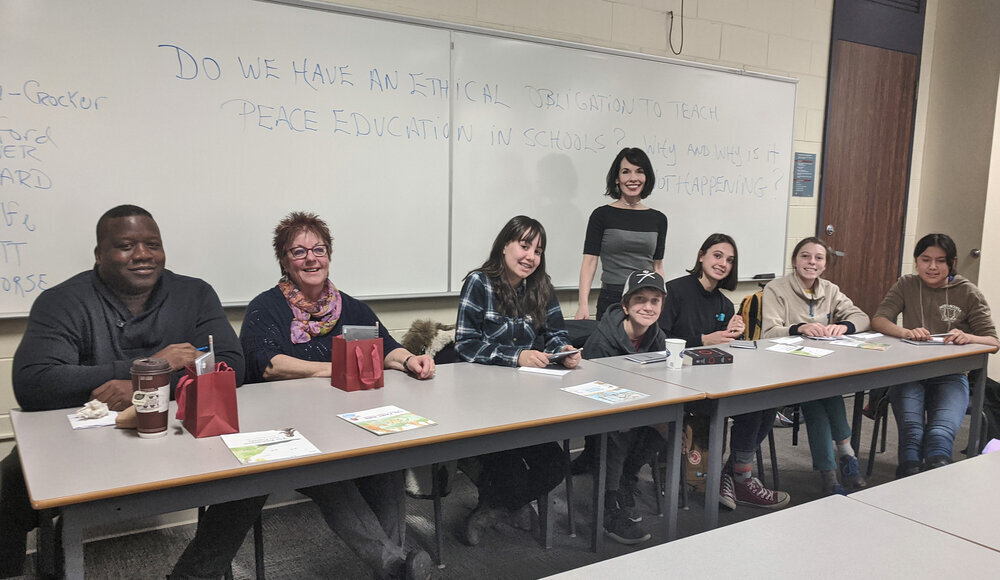
Do we have an ethical obligation to engage schools in peace education? This was the guiding question for a panel discussion at Saint Mary’s when educators from Nova Scotia public schools met with Peaceful Schools International’s Youth Consultant Committee to discuss the need for conflict resolution and peace education programs for Nova Scotian youth.

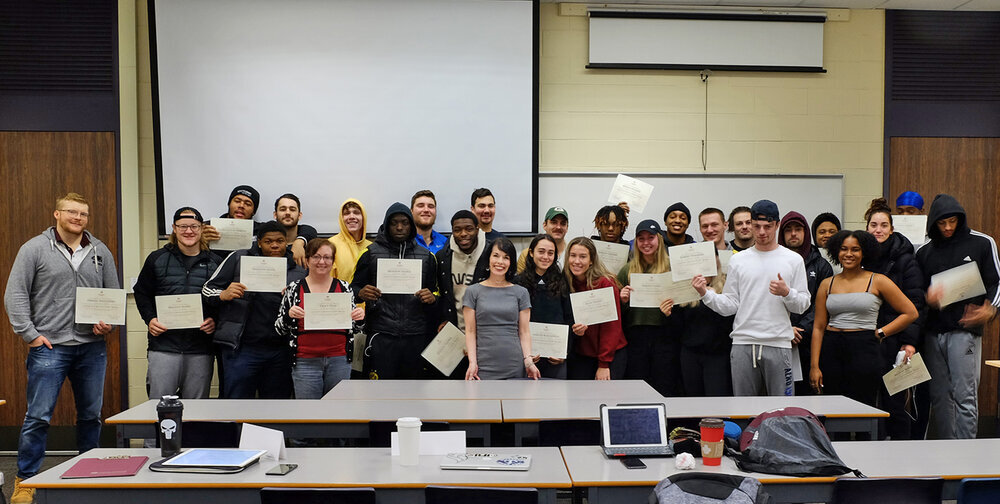
The panel was organized as part of a Faculty of Education course taught by Prof. Bridget Brownlow entitled Peace Education: International Perspectives and Practice, where the 38 students enrolled in this year’s class examine the themes of peace education and conflict resolution in a global context. In addition to their academic studies, students work towards a Certificate in Conflict Resolution, designed to help them develop the perspectives and skills required to navigate and manage interpersonal conflict.

Having spent this semester investigating peace education initiatives around the globe, reflecting on personal experiences of conflict, and building the skills to resolve disputes, students in Prof. Brownlow’s class had the opportunity to exchange ideas with students and educators from local schools. Five members from the Youth Consultant Committee, all of whom attend Oxford School, were joined by Calvin Scott, the African Nova Scotian Student Support worker for Halifax West High School and Heather Morse, a retired principal with the Annapolis Valley Regional School Board to reflect on the need for conflict resolution and peace education.

Calvin Scott suggested peace education could be a powerful tool to support African Nova Scotian students facing discrimination in the public school system. Helping them navigate the daily realities of racism was, he said, “not only an ethical, but a moral obligation.”

Heather Morse, who reflected on her experiences developing elementary school curricula that incorporated many of the principles of peace education, described the challenges of having to compete with the requirements of the core curriculum. Despite the lack of time and resources for peace education, she said the ideas shared by the Youth Consultant Committee were reason for hope. “I am so impressed by the insight and awareness around conflict resolution we heard today, both from the youth committee and from Prof. Brownlow’s class,” she said.

Brendan Kohls, a student in the class, suggested that conflict resolution skills are often dismissed as being “something kids intuitively pick up along the way. But most don’t. These are real skills, and we all need to learn them.” His classmate, Elaine Brickell Sands, reflected that “it’s hard for most people to take that first step. But in this class, we explore ways to build connections among people from different backgrounds, such as race, religion, gender and so on. I’ve learned that active listening and asking open questions are a great way to draw out our commonalities and overcome our differences.”

This panel discussion builds on Saint Mary’s long history of developing expertise in peace education, established chiefly under the leadership of Dr. Hetty van Gurp, the founding director of Peaceful Schools International and an Adjunct Professor in the Faculty of Education. The Halifax-based organization, which supports schools that have made a commitment to “creating and maintaining a culture of peace,” now has more than 200 partner institutions around the world.

Prof. Brownlow, the Conflict Resolution Advisor for Saint Mary’s and an Adjunct Professor in the Faculty of Education, is also the president of Peaceful Schools International. Each year, members of the organization — in partnership with the SMU Conflict Resolution Society — travel to elementary schools around Northern Ireland to facilitate conflict resolution workshops for children affected by sectarian division.

“Working with my students this semester has been such an honour,” said Prof. Brownlow at the end of class. ”A good number of them are varsity athletes with very busy practice and game schedules. Yet they come each week with insightful reflections on how the things we learn in class have an impact on their lives outside the classroom. What more could I ask for?”

Brandon Ihanza, a member of the football team, had the final word. After commenting on how many of his teammates have benefited from developing perspectives on conflict resolution this semester, he said “…so, on behalf of the football team, I’d like to thank you for bringing us all into your class, and for providing us such a positive learning environment.”

Saint Mary's student wins YMCA Peace Medal

SMU student Trayvone Clayton - here with the Hon. Mayann Francis, BA'72, LLD'12 — won one of three 2019 YMCA of Greater Halifax/Dartmouth Peace Medals. (Photo credit: YMCA Greater Halifax/Dartmouth)

SMU student Trayvone Clayton - here with the Hon. Mayann Francis, BA'72, LLD'12 — won one of three 2019 YMCA of Greater Halifax/Dartmouth Peace Medals. (Photo credit: YMCA Greater Halifax/Dartmouth)

This article by Amy Brierley, journalism student at the University of King’s College, was originally written for and published on The Signal. Re-published with permission. Follow Amy on Twitter: @amybrierley

With his community beside him, Trayvone Clayton pushes for peace

Trayvone Clayton is being recognized for his work to create a thriving, more vibrant community — but he says he isn’t doing it alone.

On Tuesday morning, Clayton stepped onto the stage at Halifax’s Pier 21 to accept one of three 2019 YMCA of Greater Halifax/Dartmouth Peace Medals.

“I had to go to school in a suit and everyone was putting me on their Snapchat and social media,” Clayton says, laughing, recounting his friends’ enthusiastic reactions to his win in an interview this week.

When Clayton, 21, first found out he won the award, he was in shock. “I was thankful, but I didn’t really know what to say,” he says. “But I can’t take full credit.”

He says friends Kate Macdonald, DeRico Symonds, Shevy Price, dad Marcus James, and many others in his community have been there with him all the way.

“I have a lot of support behind my back and it’s a great feeling to have that.”

For 31 years, the YMCA has honoured people who have made exceptional contributions to peace building in their communities with the YMCA Peace Medal.

Clayton joined other award winners across the country on Monday in being recognized for their work in, “building and rebuilding conditions of fairness, inclusion, empathy, security, and respect for diversity,” according to the YMCA’s website.

Clayton — a third-year criminology student at Saint Mary’s University, athlete, youth mentor and community organizer — says he’s been there for his community for as long as he can remember.

It was earlier this year, while attending the National Black Canadians Summit in Ottawa, though, that he began to see and speak out about how his experience of discrimination in Halifax reflects larger, systemic racism in Canada.

Through supporting youth in his community to follow their dreams and changing the systems that take those dreams from them, Clayton is making waves in Halifax and beyond.

“My community, Uniacke Square, has always been discriminated against, judged, there’s always been barriers in front of us,” says Clayton.

“I want the kids coming up to be able to do what they feel they can do and have faith in their vision and be able to see that they can be a lawyer, they can be a doctor, they can be a judge, they can be whatever they want to be.”

Amanda Rose, development co-ordinator at YMCA of Greater Halifax/Dartmouth and Clayton’s nominator, says she has seen first-hand the impact Clayton’s advocacy has had on Halifax.

“He is a very strong advocate and role model for African Nova Scotian youth in Halifax, and youth in general,” she says. “He’s very passionate about supporting young leaders in our communities and he does that by being a young leader himself.”

THE POWER OF MENTORSHIP

Last year, one of Clayton’s beloved mentors, the late Wade Smith, received the YMCA Peace Medal. Clayton says this made winning the award that much more special.

“He was a mentor, he was a leader, a true community leader,” says Clayton.

He texted Smith’s wife soon after his win. “I just said thank you for everything, this is clearly all happening for a reason and she said, ‘trust me Tray, he’s up there smiling with all teeth right now.’”

This support is what gives Clayton hope — hope that’s sometimes hard to muster with the loss he has experienced through anti-black violence committed against his friends, family and black communities. And it’s the kind of support he wants to offer other young people.

“It’s definitely a long road ahead, change doesn’t come with a blink of an eye or in one day,” says Clayton.

At a recent community conversation about street checks, Clayton says he stood up to share what was heavy on his chest.

He says he asked the panelists to recognize that black communities have been calling attention to racism in policing for years. Now, he says, government and police must be the ones to reach out to remedy the injustice and mistrust caused by anti-black racism.

Clayton says speaking up in moments that can seem incredibly difficult is crucial to building peaceful communities.

“When kids see me doing the things I’m doing, they’re like ‘oh OK, well I can do it,’” he said. “We have to break down these barriers and break down these walls.”

AMY BRIERLEY

Amy is a journalism student at the University of King's College. She calls Antigonish N.S.--and more recently, Halifax-- home. She cares a lot about communities and the things that make them fair, just and thriving for everyone.

Two SMU honourees for Royal Society of Canada

Two Saint Mary’s faculty members were honoured in Ottawa recently, during the Royal Society of Canada’s annual Celebration of Excellence and Engagement..

Dr. S. Karly Kehoe

Dr. S. Karly Kehoe

Dr. S. Karly Kehoe, Canada Research Chair in Atlantic Canada Communities at Saint Mary’s, has served on the Royal Society’s national executive and Atlantic region steering committee for several years.

At the event, she became Vice-President of its College of New Scholars, Artists and Scientists, and will advance next year to become President.

The Royal Society of Canada also recognized Dr. R. Blake Brown for outstanding scholarship, naming him a member of its College of New Scholars, Artists and Scientists. His membership was announced in September but he was officially inducted into the College on Nov. 22.

Dr. Blake Brown

Dr. Blake Brown

A history professor and Graduate Coordinator for Atlantic Canada Studies, Dr. Brown is one of Canada’s leading legal historians whose research tackles vital questions in the history of law and public policy.

The Faculty of Arts at Saint Mary’s now has five scholars associated with the Royal Society of Canada. Dr. Peter Twohig, Associate Dean of Arts, and Dr. Gavin Fridell, Canada Research Chair in International Development Studies, became members of the College of New Scholars in 2014 and 2015, respectively. Dr. John Reid, Professor Emeritus of History and Atlantic Canada Studies, was elected in 2004 as a Fellow of the Society’s Academy of the Arts and Humanities.

National recognition for Saint Mary’s geographer

DvP+RCGS+group.jpg

Dr. Danika van Proosdij, whose research aims to help coastal habitats adapt to climate change, has just been elected as a Fellow of the Royal Canadian Geographical Society (RCGS).

“I’m really honoured and grateful for the nomination,” says the Professor of Geography and Environmental Studies. She was inducted to the esteemed organization during its College of Fellows Annual Dinner and 90th-anniversary celebration, held November 21 in the Canadian Museum of History in Gatineau, Quebec.

She joins two other geographers from Saint Mary’s who were previously elected as Fellows: Professor Emeritus Dr. Hugh Millward and the university’s President Dr. Robert Summerby-Murray. Having three Fellows here “speaks to the strength and depth of our program, and our commitment to the discipline as a whole,” says Dr. van Proosdij.

Dr. van Proosdij working at the Converse site.

Dr. van Proosdij working at the Converse site.

Just a few days after the gala ceremony, she was back out in the wetlands on a site visit to the Converse Marsh Managed Realignment Site, near Amherst.

She and the Saint Mary’s-based TransCoastal Adaptations team hosted the November 26 visit for a progress update to stakeholders on the five-year “Making Room for Wetlands” project, funded by the Department of Fisheries and Oceans’ Coastal Restoration Fund.

The team has been working collaboratively with Nova Scotia’s Department of Agriculture, CBWES Inc. and other partners in an effort to restore salt marshes in several areas. For coastal communities, salt marshes form the first line of defence against rising sea levels and storm surge, so restoring these ecosystems aims to help protect communities and coastal infrastructure. Work started a year ago at the Converse site, where sections of the old dyke were removed and realigned to allow tidal flow back into the area. Monitoring data collected by staff and students over the summer indicates that 15.4 hectares of salt marsh have been restored and the site is recovering well.

Saint Mary’s is a key player in the Atlantic region’s growing interdisciplinary hub for coastal adaptation research. In another project, “Making Room for Movement”, funded by NRCAN, Dr. van Proosdij and SMU students are exploring the social science element and working closely with Dalhousie’s School of Planning and its School of Resource and Environmental Management. Collaborating with other Saint Mary’s departments is also proving very beneficial.

“As we’re restoring some of these landscapes, a real added benefit has been the inclusion of archaeology,” says Dr. van Proosdij. “Getting an understanding of the historical use of that land helps to inform our restoration design, and to form better connection and communication with rights holders as well as stakeholders. It’s fascinating to be working on a landscape and looking at the juxtaposition between modern techniques and old techniques, and the value of the voices of those who have come before.”

Canada’s national defence within the global context

An undergraduate education can provide a very helpful foundation for careers in federal government, students heard recently from one of Canada’s top defence advisors.

“The things you’re studying here are going to be really important,” said Associate Deputy Minister Gordon Venner of the Department of National Defence. “We’re going to need a lot of people with the right skills.”

Speaking to a packed lecture hall at Saint Mary’s on November 21, Mr. Venner also explained that recruitment is an ongoing priority for National Defence and the Canadian Armed Forces. Service personnel and civilian employees are tasked with implementing government decisions related to the defence of Canadian interests at home and abroad.

An education in political science, public policy, geography, business, international relations, communications, science or environmental studies can be helpful, to name just a few areas, and so are the abilities to speak other languages and a greater understanding of other cultures, he said.

Mr. Venner’s lecture was mainly focused on the topic, “Understanding Canada’s defence policy within the evolving global security environment”. He was in Halifax to attend the 11th Halifax International Security Forum, but took time out before the conference to speak to students at Saint Mary’s. The lecture was hosted by the Department of Political Science, but was open to students in all disciplines.

Dr. Marc Doucet, Chair of Political Science, said it was a unique opportunity to hear from such a high-level civil servant.

"It is always valuable for students to hear how the topics discussed in class or course readings, in this case the policy-making process that led to Canada's new defence policy, is described by government officials directly involved," said Dr. Doucet.

Mr. Venner was appointed Associate Deputy Minister in 2017, after several years of serving as Assistant Deputy Minister of Policy for National Defence. Previously, he held a number of senior positions with Global Affairs Canada. His regional areas of responsibility have included the Middle East and North Africa and his work has covered issues related to the G8, APEC and the OECD. Mr. Venner was also Assistant Secretary to the Cabinet for Foreign and Defence Policy in the Privy Council Office. He served as Canadian Ambassador to Iran (2004-2006) and Counsellor at the Canadian Mission to the European Union (1996-2000).

Mr. Venner holds a master’s degree from the London School of Economics and a bachelor’s degree from the University of Western Ontario.

Teachers and professors explore cultural connections

SSTA+Executive+++keynote.jpg

More than 300 social studies teachers from across the province were students for a day on October 25, during their annual professional development conference. Held for a fifth year at Saint Mary’s University, the event included more than 30 workshops around the theme Cultural Connections, some led by professors in the Faculty of Arts.  

“It is such an important and powerful connection that must be kept between our learning institutions, especially as students transition into colleges and universities,” said Dr. Benita Bunjun of Social Justice & Community Studies, whose session focused on cultural relations in the classroom. “I think it’s really important that every year, these workshops show a diversity of people sharing expertise, a multiplicity of people who are educators, transferrers of knowledge, keepers of knowledge.”

She and Dr. Rohini Bannerjee of the Modern Languages & Classics department have been involved in the conference for several years.

“I’m always a little bit nervous about teaching teachers, but it’s also a great privilege because it helps in reminding all of us why we do what we do,” said Bannerjee, who taught a session about the Jewish experience in Mauritius during the Second World War. “Why we find teaching so important, and why being in the classroom with diverse points of view is important. Maybe when they come to hear me speak, they might see that my own lived experience is pretty diverse and that cultural connections are part of my everyday. At the same time, as teachers, we need to help our students create their own stories.”

The conference also included an education trade exhibition and a keynote address by Weldon Boudreau, an Acadian singer and teacher at École Beaubassin. Several off-site sessions took place at the Africville National Historic Site, Ross Farm Museum and the Treaty Truckhouse at the Sipekne’katik (Shubenacadie) River, where participants met with the Grassroots Grandmothers and Water Protectors.

“We really wanted to focus on the role that teachers play in the lives of students when it comes to students’ own cultural identity and how we can effectively celebrate students’ identities by bringing it into classrooms,” said Maureen McNamara, President of the Social Studies Teachers Association of Nova Scotia. “That’s why we asked Weldon to be our keynote; he had a really important story to tell about what it means to be proud of who you are and where you come from, and to understand who you are as an individual. Individual identity is really integral in creating meaningful learning experiences for students.”

Other Saint Mary’s faculty members who led workshops were Prof. Shana McGuire of Modern Languages & Classics on teaching about francophone cultures through film, Philosophy Chair Dr. Shelagh Crooks on strategies for teaching critical thinking; Dr. Rosana Barbosa of History on music and soccer as cultural history teaching tools; and Dr. Min-Jung Kwak of Geography & Environmental Studies on international students in Canada and their families.