
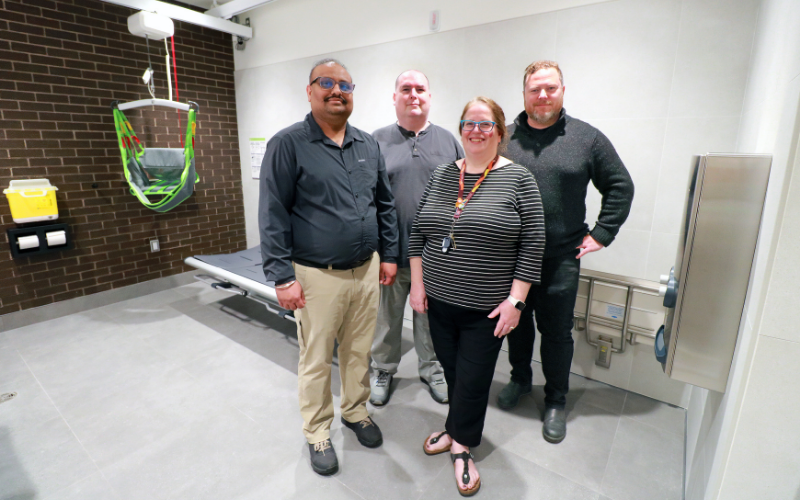

A warm welcome to 41 Chinese exchange students from Beijing Normal University (BNU) and Beijing Normal University – Zhuhai (BNUZ).
Saint Mary's honours National Aboriginal Day
Saint Mary’s honours back-to-back national football championship teams with Hall of Fame induction
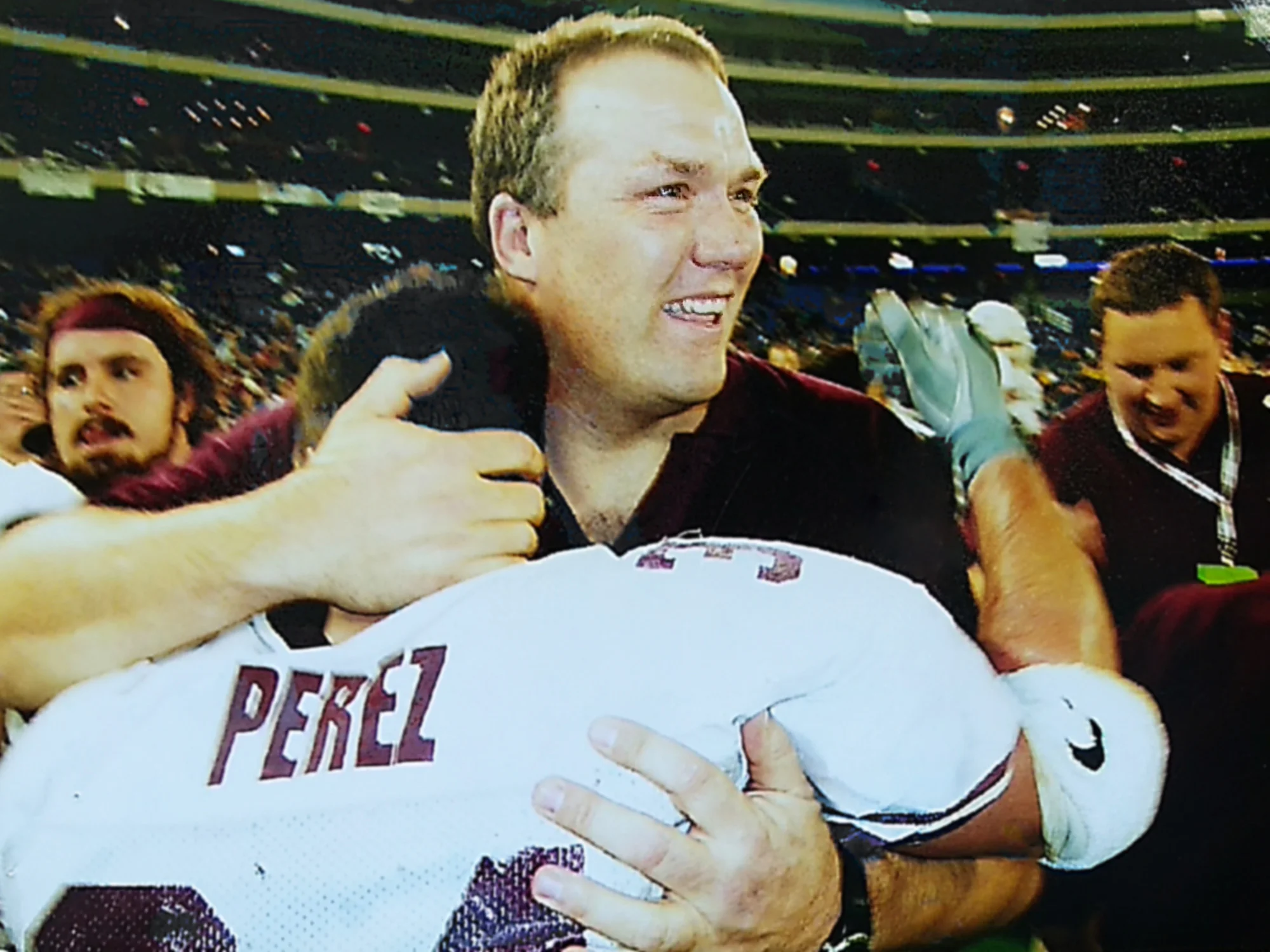
Back-to-back national championships are being honored this year as two Saint Mary’s University football teams will be inducted into the Saint Mary’s University Sport Hall of Fame.
13 Inuit leaders graduate with Sobey School Advanced Management Diploma

Saint Mary’s and partners recognized for efficient shared services program

Perry Sisk, Senior Director of Information Technology Systems & Support (second from left) represented Saint Mary's at the annual CAUBO awards ceremony in Ottawa.
The Canadian Association of University Business Officers (CAUBO), has awarded Saint Mary’s University and its partner institutions first prize in the category of Cloud Enabled Collaboration & Productivity at its annual conference in Ottawa.
Nova Scotia’s 11 post-secondary institutions make up the Nova Scotia Higher Ed IT Shared Services Program. Members are using the Office365 communication and collaboration platform to provide each institution with industry-leading cloud-based technology at lower costs.
A single procurement contract with Microsoft and a shared services project management office allows schools to share implementation plans, policies and best practices, change management and support services, as well as technical migrations and collaborative training. Vice-Presidents Finance and Administration, along with IT leaders from each institution, collaboratively manage the shared IT services.
The Office365 platform has enhanced both mobility and security, while reducing costs. Moving internal email systems and file storage to the cloud resulted in annual savings of $20,000 to $200,000 per institution for maintenance, and $100,000 system-wide in software licensing fees.
“Divested of servers and responsibility for upgrading applications and storage, IT organizations can focus on more value-added activities...”
In 2015/16, eight shared service projects were completed at a combined saving of nearly $350,000.
Divested of servers and responsibility for upgrading applications and storage, IT organizations can focus on more value-added activities, including ongoing transformation of service delivery, technology, and collaboration. In the future, the standardized platform could also facilitate sharing networks across multiple institutions.
Having leveraged the transferability of core infrastructure and IT systems among its institutions, Nova Scotia has created a model for adoption in other jurisdictions.
PhD candidate wins prestigious Vanier Scholarship

Amy Heim
Saint Mary’s University is proud to announce that Amy Heim, a PhD candidate in the Faculty of Science, is the recipient of a three-year Vanier scholarship worth $50,000 per year.
Heim’s work is in the area of Evolution and Ecology, and she was honoured for her research proposal titled “Using traits to enhance plant co-existence and maximize ecosystem services in the green roof environment.”
“I am very excited that Amy won this scholarship. It’s a great endorsement of her innovative research,” said supervisor Jeremy Lundholm.
A plant community ecologist who specializes in understanding the co-existence mechanisms between plant species in harsh environments, she is currently working in two distinct environments: the coastal barrens of Nova Scotia and on extensive green roofs.
Heim explains that both habitats are exposed to drought, high wind, and extreme temperatures, making them useful habitats to compare co-existence patterns in a natural and artificial environment.
“For my green roof research I am looking at how specific combinations of species with specific plant traits can improve the ecosystem services provided by green roofs,” says Heim.
Her work also focuses on better understanding how urbanism impacts humans and the environment as more people move to cities. “Our research will develop a practical approach for selecting high-performance plant combinations that will make green roofs more efficient, reducing several issues related to urbanism,” she explained.
When asked what this scholarship means to her, Heim said that it will let her fully concentrate on her research, and also make it easier for her to create collaborations with researchers across the globe. She has plans to complete an internship with a green roof researcher in Japan during the fall of 2018.
“As an international student, Amy is not eligible for regular NSERC scholarships, so we are grateful for this level of support for her PhD studies. This frees up grant funding and as a consequence I can now fund Amy’s travel to a conference in Italy in the fall,” said Lundholm.
“Research is a collaborative effort so I believe these opportunities will enhance my own studies,” says Heim.
About Vanier Scholarships
Vanier Scholarships are awarded to students in the areas of health research, natural sciences and/or engineering, and social sciences and/or humanities research.
The Vanier Canada Graduate Scholarships program aims to attract and retain world-class doctoral students by supporting students who demonstrate both leadership skills and a high standard of scholarly achievement in graduate studies in the social sciences and humanities, natural sciences and engineering, and health sciences.
Three equally weighted evaluation criteria are considered: academic excellence, research potential, and leadership.
Canadian and international students are eligible to be nominated for a Vanier CGS. Vanier CGSs are valued at $50,000 per year, for up to three years. For more info, visit the Government of Canada site.
Math prof continues to find success with science fiction
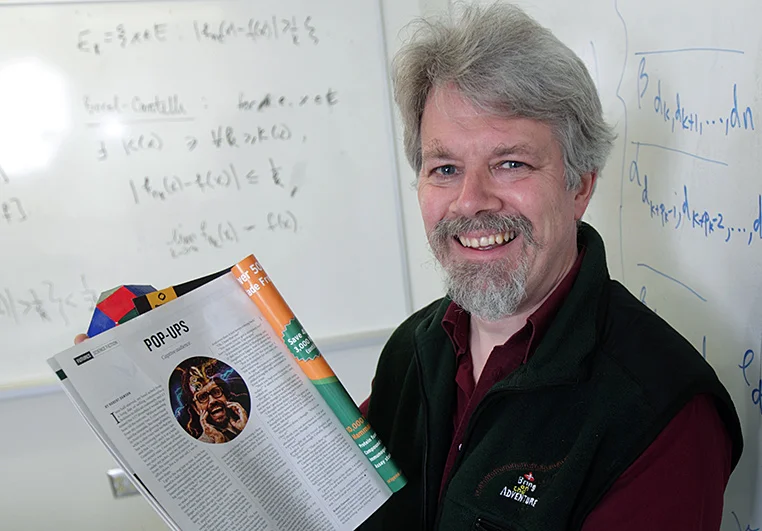
Dr. Robert Dawson
When he’s not teaching or exploring geometry and category theory, Saint Mary’s mathematics professor Dr. Robert Dawson is probably imagining what the future might look like—at his word processor. Since he began writing fiction seven years ago, he’s published a number of short stories—mostly science fiction—and poems.
Though not all his short stories are informed by hard science, mathematical principles often turn up in his written works: "Damned Souls and Statistics" was born from a discussion about statistical techniques and "The Fifth Postulate" came straight out of the undergraduate geometry course that he sometimes teaches. “Ladies’ Night” is about a card shark who schools her marks in probability theory.
“I’ve also written stories based on made-up but plausible results in mathematical logic and real results in classical mechanics,” says Dr. Dawson.
His latest short story, “Sparrowfall” is his second story published in the “Futures” section of Nature, an international weekly journal of science; “Pop-ups” was the first. “Futures” is a science fiction column that presents an eclectic view of what the future may hold. It encourages writers to imagine the limitless possibilities of “what may be lurking around the corner.”
“Sparrowfall” depicts a haunting interaction between a homeless person in crisis and the computerized voice of an autonomous city.
High Commissioner of India visits Saint Mary's
His Excellency Vikas Swarup, High Commissioner of India (HCI), and author of Slumdog Millionaire (also published as Q&A), dropped by Saint Mary's.
Saint Mary's mourns the passing of Dr. Edward McBride
Edward John McBride, 83, BS, MA, DCL (Hon.), of Halifax, Nova Scotia, passed away peacefully at his home at Parkland on the Gardens on May 31, 2017.
McBride was a popular member of the Department of Political Science from 1967 to 1994. He received the William Stewart Medal for Teaching in 1987, was named Professor Emeritus in 1990 and received an honorary Doctor of Civil Law in 2012.
Read SMU’s McBride made future leaders on the Chronicle Herald site.

Edward John McBride
Saint Mary’s students embark on extraordinary archaeological expedition to Cuba

At Wednesday's media event, Dr. Jonathan Fowler showed students some of the equipment they'll be using in Cuba
Twelve Atlantic Canadian university students are about to embark on an extraordinary archaeological expedition to Cuba, spearheaded by Saint Mary’s University’s Department of Anthropology.

Aaron Taylor
From June 1 to 17, students from Saint Mary’s University, the University of New Brunswick, Memorial University, and Dalhousie University will be excavating artifacts at Cuba’s historic Angerona Coffee Plantation. The excavation is in partnership with Havana’s Cabinet of Archeology and the College of San Geronimo. The dig is the first collaboration of its kind between Cuban and North American students and archaeologists.
“I don’t believe anyone in the world is doing anything like this right now,” said Aaron Taylor, an alumnus of Saint Mary’s Anthropology and Atlantic Canada Studies programs who will serve as the program’s instructor.
“One reason we’re being permitted to dig is because we’re from Canada, and Cuba and Canada have a good relationship,” said Taylor. “But the other reason is that Saint Mary’s wants to collaborate and make it a true joint Cuban-Canadian project.”
Angerona is a Cuban national historic site and former slave plantation, 80 kilometres east of Havana. During the 19th century it was one of the largest slave plantations in the Americas—yet little is known about the day-to-day lives of the people who lived there. The Canadian students, as well as a student from Cuba, will work to uncover artifacts and other evidence to create a more complete picture of those lives and how they fit into our knowledge of the Atlantic slave trade.
The trip is the first of what will be at least a five-year partnership between Saint Mary’s, Havana’s Cabinet of Archeology and the College of San Geronimo.
“As the world seems to be dividing into us-vs-them, it’s essential that young people get to experience another culture, one very different from theirs,” said Taylor. “Many Canadians know Cuba by its beaches, but not as much the people and the history. Cuba has been isolated for a long time in so many ways, so this is an exciting time, and an exciting project to be a part of.”
Saint Mary’s researcher recognized for contributions to Accessibility Act

Dr. Linda Campbell (back row, far left) and other members of the Bill 59 Community Alliance
Over the past year-and-a-half, Saint Mary’s University professor Dr. Linda Campbell has worked diligently to improve a very important bill to the province of Nova Scotia through a partnership called the Bill 59 Community Alliance. Their work on Bill 59, otherwise known as the Accessibility Act, has helped to ensure that the bill addresses the needs of Nova Scotians with disabilities.

Dr. Linda Campbell (right) with Amberlin Hines, a deaf student from Gallaudet University who visited Saint Mary’s in 2015.
Recently their hard work was recognized by the Partnership for Access Awareness when they were awarded this year’s Mel Hebb Hourglass Action Award for their contributions to Nova Scotia’s Accessibility Act. The Partnership for Access Awareness bestows the Action Award annually during National Access Awareness Week to celebrate individuals who promote the inclusion of persons with disabilities in Nova Scotia.
Lauded by the Honorable Graham Steele as a “remarkable example of effective citizen action,” the Bill 59 Community Alliance helped to make Nova Scotia more inclusive by bringing together high-level civil servants and advocates from diverse backgrounds.
Dr. Campbell recalls the first meeting with the Premier’s Office, in which the Alliance shared their concerns and recommended solutions.
“It was an informative meeting. The Premier’s Office staff was attentive and thoughtful, and we left the room feeling positive about the way forward.”
This meeting led to an invitation from the Executive Council Office to join key players in redrafting the bill. The result, the Accessibility Act, received significant praise. Key features of the bill include a 2030 deadline for Nova Scotia businesses, organizations, and governments to provide barrier-free access to buildings, and a detailed implementation plan to ensure targets are met.
"As an environment scientist, my first priority is to advocate for healthy environments; however, often I must advocate for access before I can even speak about the environment,” says Dr. Campbell. “This two-step process means that others lose access to the knowledge and expertise that I can offer. Establishing a strong Accessibility Act allows people like me to focus on our jobs and careers. "
Bill 59 received Royal Assent on April 28, 2017.
Dr. Linda Campbell is a Senior Research Fellow in the Department of Environmental Science and Acting Chair of the School of the Environment. She carries out international-level research on environmental contaminants and freshwater ecosystems, has published extensively on these issues, and is frequently consulted by governments and private businesses.
As one of only two Deaf professors in the world doing aquatic research, Dr. Campbell mentors deaf students and has published on the issues facing Deaf academics. She also co-led an interactive sign language place name project at Saint Mary’s University.
In addition to her work with the Bill 59 Community Alliance, where she co-represented the Deaf community, Linda sits on the Board of Directors for the Canadian Hearing Society and Gallaudet University in Washington DC, the only Deaf liberal arts university in the world.
Advanced Placement students get a taste of university life at SMU conference
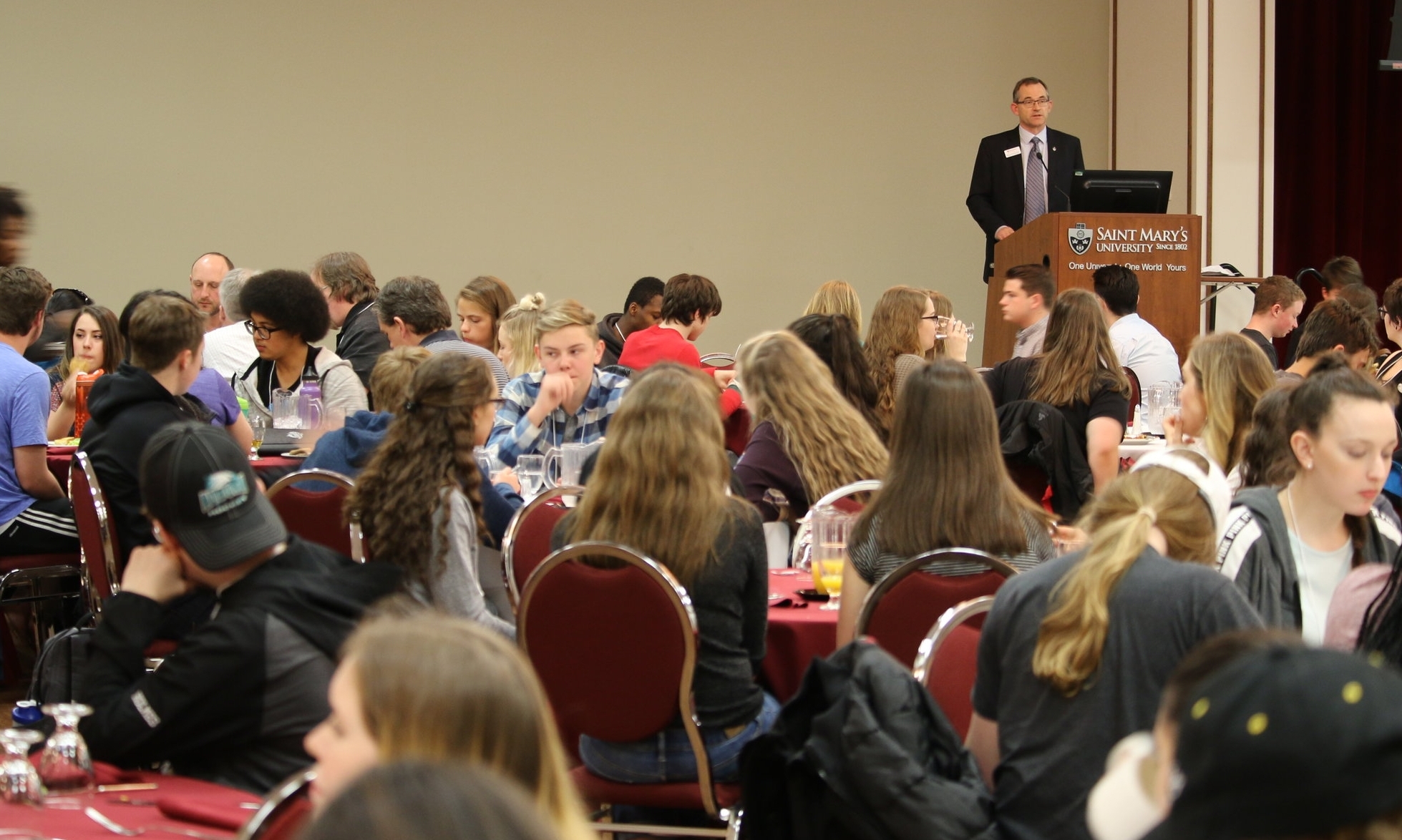
Saint Mary's President Dr. Robert Summerby-Murray addresses AP students
Hundreds of top high school students descended on the Saint Mary's campus to get a taste of life at university.
The one-day Provincial Advanced Placement Conference was for students enrolled in AP courses in Nova Scotia high schools.
Students were introduced to the three faculties at Saint Mary's: Arts, Commerce (Sobey School of Business) and Science. Afterwards, students attended workshops focused on learning, curiosity and student leadership. Other sessions included introductions to university-level courses such as Astronomy, Biology, Criminology, Religious Studies, Sociology, Geology and Computer Programming.
Students reactions
Audio clips