
We must act against racism: A message from President Summerby-Murray

A long history of overt and systemic racism led to the tragic death of George Floyd and many others before him and continues to be a global call to action. The protests in Minneapolis spread throughout the United States and around the world. It rightly reached us here in Canada and in Nova Scotia. 

This global movement calls on all of us to acknowledge and speak out against racism that exists in every country and society to this day.

It exists explicitly in violence and hate, but it can also exist in more subtle, but equally troubling ways, through our institutions, laws, and practices. Racism in all its forms – both explicit and systemic – must be condemned and it must be fought. This is the responsibility of every citizen.

It is part of our history and we need to acknowledge that.

It continues to exist, and we must also acknowledge that.

It did and does exist here in Nova Scotia, and we must acknowledge that.

Even before the death of George Floyd sparked a global call to action, African Nova Scotians and Black Canadians continued to be placed at systemic disadvantages and continued to face disproportionate socio-economic hardships.

I am also not blind to the challenges here at Saint Mary’s University. No institution or university is immune from this charge, but we are committed to doing better. Our leadership here promises that we will lead by example.

Earlier this year, we struck a Standing Committee on the Prevention of Racism, a key recommendation of an earlier ad hoc committee. Among other recommendations from the ad hoc committee, the current committee has a key mandate to raise awareness and oversee the implementation of other recommendations, including:

  • We commit to holding more workshops to help educate and combat racism.

  • We will revise our Code of Conduct to ensure it clearly addresses issues of racism.

  • We commit to developing a retention strategy focused on Indigenous and racialized students.

  • We commit to education and training to ensure we can identify, report, investigate and respond to incidents of racialized discrimination on campus

  • We commit to recruiting more racialized faculty and staff members

These are just some of the action items from the committee’s report we will move on.

As place of learning, our mission is to help educate the next generation of engaged citizens and ethical leaders. We must reflect and hold onto that mission now more than ever. The diversity of our student body is a source of pride and we are working harder to ensure our university and its structures reflect that diversity.

My heart goes out to the families of George Floyd and to all of those who are impacted by this insidious societal force. Many of us feel this way. Our feelings are not enough, nor are our words. We must act against racism and stand in solidarity with our Black colleagues and students.

We have had many discussions prior to the recent tragedies, and we will continue to have these discussions. Throughout this week, we have had many conversations internally to decide what actions were needed and to ensure we could make commitments to our community. To those who participated in those discussions – thank you. We are committed to continuing the discussions and dialogues to ensure we can meet the needs of our African Nova Scotian and Black students.

To members of the Saint Mary’s University family who are struggling right now, please know that we are here for you. You can access mental health resources and you will be given the support you need. Even while many of us are working from home, please know that you are not alone. Please reach out.

Today’s calls for justice are the result of a long and unacceptable history. In this moment, we must decide what happens next. We are committed to systemic change. We need each of you to share that commitment.

This is what we owe one another.

Resources

Here is a list of suggested books:

The Skin We're In: A Year of Black Resistance and Power (Desmond Cole): 
https://www.penguinrandomhouse.ca/books/536075/the-skin-were-in-by-desmond-cole/9780385686341

Policing Black Lives: State Violence in Canada from Slavery to the Present (Robyn Maynard): https://robynmaynard.com/policing-black-lives/

Me and White Supremacy (Layla F. Saad): https://www.meandwhitesupremacybook.com/

So you want to talk about race? (Ijeoma Oluo): http://www.ijeomaoluo.com/

If you want to speak to children about this issue, here is a link that has been shared by the Black Educators Association here in Halifax to educate children about racism.

Dr. Robert Summerby-Murray
President and Vice-Chancellor

Saint Mary’s moving online, increasing student supports

fall_term_campus.jpg

Saint Mary's University President Dr. Robert Summerby-Murray says that after extensive consultations, Saint Mary's University will transition to online course delivery for all courses and programs this fall.  

"The health and safety of our students, faculty, and staff is paramount," said Dr. Summerby-Murray. "For that reason, we are announcing our intention to move our courses fully online. Our decision ensures that all Saint Mary’s students, can start or continue their studies confidently and without interruption, no matter where they are in the world.” 

Dr. Summerby-Murray said the university is focused on continually improving its online delivery to ensure academic quality, an excellent student experience and to create opportunities for student and community engagement.  

"Saint Mary's prides itself on creating memorable student experiences and connecting with the greater community," said Dr. Summerby-Murray. "We are investing in enhanced services for faculty, staff, and students to ensure we can continue to grow and learn together."  

The university is focused on providing supports to those students who need it most by:  

  • Providing more than $1.5 million in additional student financial support for the upcoming year 

  • Launching Jump Start 2020, which includes online meetings and webinars where students will meet instructors, academic staff and fellow students before the fall semester begins 

  • Working closely with the Saint Mary's University Students’ Association to maintain a close connection and understanding of student needs  

  • Helping students understand the external sources of funding available to them 

"We remain committed to accessibility and equity as we move toward the fall term," said Dr. Summerby-Murray. "We believe that we have put in place the resources to help every student succeed."  

While all academic courses and programs will be offered online, the university will support special opportunities wherever possible for in-person on-campus participation in enriched learning and student life activities in a safe and responsibly managed environment. 

The university will host a series of town hall discussions with multiple groups to ensure members of the community can have input as the plans for the fall continue to be developed and refined.  

"Saint Mary’s University is known as a strong community, with exceptional local and global connections," said Dr. Summerby-Murray. "From these challenging times, we will emerge even stronger and with a renewed sense of our purpose and mission."  

More information

Media contact: 

  • Margaret Murphy  
    Associate Vice President, External Affairs 
    Saint Mary’s University 
    Email: margaret.murphy@smu.ca 


Inspiring new film spotlights sustainable communities solving environmental problems

Capture.PNG

A new documentary – to be released June 5, World Environment Day – focuses on the power of communities to find sustainable solutions to some of the world’s biggest challenges.  The film, Sustainable Futures – Communities in Action, highlights how local communities have dealt with challenges they face with the environment, the climate, and how to sustain economies and livelihoods.

 “The strength that comes from these small communities shows that building a sustainable future isn’t as far off as some would think,” says Dr. Tony Charles, a professor at Saint Mary’s University and director of the Community Conservation Research Network. “We hope that by showcasing the successes of people working together in their communities, it will open up a discussion about rethinking the world’s path to sustainability.”

 This 52-minute film follows four communities from different corners of the world as they deal with some of the biggest global challenges. The film begins in Dartmouth, Nova Scotia, where the local community battles for food security. It travels to the other side of Canada to the Tla-o-qui-aht First Nation, British Columbia, which is working to protect their rights and build relationships. The film moves to Papendorp, South Africa, where the local community fights to build a sustainable future, and Koh Pitak, Thailand, showcasing the community’s success achieved through caring for the environment.

The film is presented by the Community Conservation Research Network (CCRN) and Saint Mary’s University. It was produced by Nexus Media in Chester, Nova Scotia and financially supported by the Social Sciences and Humanities Research Council of Canada.

 The film will be available, starting June 5, at: www.communityconservation.net

Student entrepreneurs to receive more help starting their businesses thanks to new program

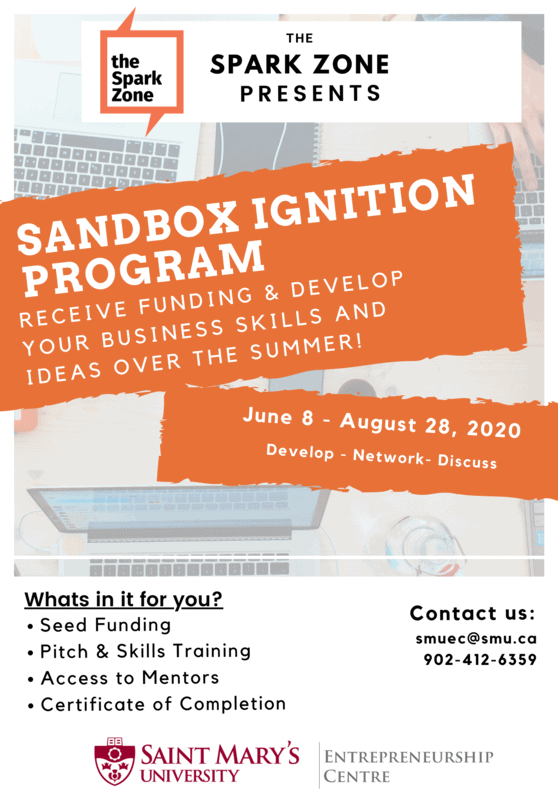
Saint Mary’s University is hosting a new program through the Spark Zone that supports student entrepreneurs to bring their business ideas into reality.  

The program, Sandbox Ignition, is providing over $50,000 in start-up funding to post-secondary students to support the launch of new businesses or community projects. The program also provides student entrepreneurs with the training, resources, and entrepreneurship ecosystem connections needed to move their ideas forward.

Spark-Zone-ignition-Program.png

“Providing student entrepreneurs with a bit of financial support can be a determining factor in their success in moving their ideas from concept to reality,” says Jason Turner, manager of skill development and training for Saint Mary’s University Entrepreneurship Centre. “During the best of times, it can be challenging for students to find the start-up capital they need to begin a business, let alone during a pandemic. This will be an important program for many young entrepreneurs this summer.”

Launching the program in the middle of a pandemic makes Sandbox Ignition a unique experience for all participants. The three-month program is entirely virtual and allows participants to provide weekly updates to capture their successes, failures and milestones. Students will use TikTok to share their weekly progress with the world, gaining storytelling experience, and traction for their products.

“It’s important for student entrepreneurs to have the appropriate connections and learn from people who have been in their position once before,” says Turner.

The program identified a 20-person roster of entrepreneurs, business faculty, and members of industry across Nova Scotia to mentor and provide advice to the students. The program begins June 8 and ends on August 31, 2020.

Saint Mary’s University is a proud partner of the Spark Zone, a Nova Scotia sandbox that fosters enthusiasm for entrepreneurship among post-secondary students across the province. The Spark Zone is dedicated to providing students with the opportunity to see their ideas become a real product or social innovation without fear of failure.

To register, or for more information visit https://smuec.ca/

Research project aims to transform mental health care for youth in Canada

Mental health research team: Top row: Michael Zhang (Management Science), Catherine Loughlin (Management), Pawan Lingras (Computer Science), Ethan Pancer (Marketing), Skye Stephens (Psychology)Bottom row: Steven Smith (Psychology), Leanna Closson (P…

Mental health research team: Top row: Michael Zhang (Management Science), Catherine Loughlin (Management), Pawan Lingras (Computer Science), Ethan Pancer (Marketing), Skye Stephens (Psychology)

Bottom row: Steven Smith (Psychology), Leanna Closson (Psychology), Mohammad Drira (Accounting), Meg Ternes (Psychology), Hai Wang (Computing Information Systems)

Middle: Rachael Collins (Criminology) Not pictured: Dalhousie University’s Jenny Chen (Management) and Claver Diallo (Industrial Engineering)

A new two-year research project at Saint Mary’s University, which aims to transform mental health care for youth in Canada, was granted $250,000 from the federal New Frontiers (NFRF) in Research Fund – Exploration stream. The Supporting Youth with Mental Health Conditions project will use machine learning and analytics to conduct their research.

The 13-member project team includes 11 members from the university and will be led by Dr. Michael Zhang, Management Science professor at the Sobey School of Business, and Dr. Steven Smith, Psychology professor in the Faculty of Science at Saint Mary’s University.

“Using machine learning techniques will help us analyze and integrate data about internalizing and externalizing mental health problems and show the need for unique care services,” says Dr. Zhang. “We hope to establish a coordinated system for mental health care that addresses the most common needs of each community.”

Most youth and families in Canada who need mental health care cannot receive appropriate care in their communities due to a variety of barriers.

“Addressing youth mental health issues is one of the most important challenges facing our society,” says Saint Mary’s University President, Robert Summerby-Murray. “We are proud to see so many faculty from across our campus, from so many disciplines, coming together to address this challenge with a researched, evidence-based approach.”

In 2015, the Mental Health Commission of Canada (HCC) reported that at least 75% of mental health problems and illnesses appear in childhood and adolescence. Approximately 5% of male youth and 12% of female youth, aged 12 to 19, have experienced a major depressive episode, and only a ratio of 1/6 children get the needed mental health services (MHS) from 15-20% of diagnosed cases.           

The NFRF is a federal research funding program that fosters world-leading discovery and innovation by encouraging Canadian researchers to explore, take risks, lead, and work with partners across disciplines and borders. It supports research that defies current paradigms, bridges disciplines, or tackles fundamental problems from new perspectives.  

For more information on NFRF visit:
https://www.sshrc-crsh.gc.ca/funding-financement/nfrf-fnfr/news-nouvelles/2020/exploration-2019-recipients-eng.aspx

Saint Mary’s University Language Centre takes world-renowned certification course online

Online_CELTA_Summer2020.png

COVID-19 is changing the way we study, work and live, and that includes how the Saint Mary’s University Language Centre offers its world-renowned Cambridge course for teaching English. The Cambridge Authorised Teaching Awards Centre at the language centre is now offering the opportunity to gain the Cambridge CELTA qualification 100 percent online in just five weeks. 

“If you have considered taking this course in the past, now is a good time to gain an internationally-recognized teaching English as a second language certificate online from the comfort of your home,” says Julian L’Enfant, CELTA Administrator at Saint Mary’s University. “You will receive the same rigorous training from our expert tutors in a dynamic online environment and teach real students from the local community.”

The CELTA is the gold standard teaching qualification with three out of four employers requesting CELTA for English language teaching jobs worldwide. Candidates will complete all of the training, teaching practice and assignments online and have access to the opportunities available to all CELTA graduates upon successful completion of the course. The CELTA is for anyone interested in starting a career as an English teacher, or for experienced teachers interested in developing their skills. 

For more information and to download the application form and pre-interview task, click here or email CELTA@smu.ca.

Top undergraduates win awards for paid summer research work at SMU

Group-Summer-Research-2020.jpg

Every summer, top undergraduate students at Saint Mary’s win the opportunity to do paid research with professors in their fields.

While the necessary campus closure due to the COVID-19 pandemic means that this summer will be a unique experience even for returning award students, important research work will continue as planned. With some ingenuity, work can and will happen online, and teams can work virtually – not just on campus, in the field, or in labs! A total of 34 awards were granted from a pool of more than 200 applicants. These are 12 or 16-week terms, and each student has been approved by a supervising faculty member.

This year there are four award programs that students were eligible for:

·       Natural Sciences and Engineering Research Council of Canada’s Undergraduate Student
Research Awards (NSERC USRA);

·       Dean of Science Undergraduate Summer Research Awards

·       Social Sciences and Humanities Research Council (SSHRC) Explore Summer Research Awards; and,

·       First Year Undergraduate Awards

USRA awards, open to Canadian students who have completed at least a year of a bachelor’s degree, are meant to help students develop their potential for a research career in the natural sciences and engineering.

SSHRC Explore awards are open to students studying social sciences and humanities. With these two award programs that are supported by our federal funding councils, combined with the Dean of Science and First Year awards, all Saint Mary’s University students, Canadian and international, have an opportunity to apply for summer research award positions, even after their first year of study.  

We note that this year, for the first time, we have also awarded one special joint Science and Sobey School of Business Deans Undergraduate Summer Research Award. We are also in the process of finalizing a partnership between our First Year Undergraduate Awards and a just-launched summer student research training program from Mitacs, a national not-for-profit organization that designs and delivers research and training programs across Canada.

“Saint Mary’s University has a long history of engaging undergraduate students with the research efforts of our faculty, and these experiences are a transformational positive experience for every student that has the opportunity,” said Dr. Adam Sarty, Associate Vice-President, Research and Dean, Faculty of Graduate Studies and Research.

“The one-on-one attention from our faculty members and teamwork with peers is a perfect complement to an undergraduate degree, and provides an exceptionally strong foundation for career entry, or future professional/graduate studies,” said Dr. Sarty.

Congratulations to the award winners, and best wishes for a successful, productive summer.

The successful candidates are:

NSERC-USRA

Kathleen (Maiti) McGrath – Astrophysics
Sophia Waddell – Astrophysics
Morgan (Lindsay) MacDonald – Biology
Terrell Roulston – Biology
Patrick White – Biology
Mackenzie Zinck – Biology
Kaleigh McLeod – Chemistry
Tanisha Ballard – Chemistry
Logan Cox – Chemistry
Jacob Hoard – Chemistry
Seamus MacInness – Computing Science
Evan Farrell – Computing Science
Tanaka Akiyama – Engineering
Sahana Kanabar – Environmental Science
Cameron Power – Environmental Science/Physics
Conor Waterfield – Subatomic Physics

Dean’s Awards
Jennifer McArthur – Psychology
Humaid Muhammad Agowun – Math/Computing Science
Adina Gherman – Psychology
Abigail Battson – Astrophysics
Nicola Augustin – Biology
Samantha Bennett – Environmental Science

First Year Undergraduate Award
Bethany Leal – Political Science  (Arts)
Jakob Conrad – Astrophysics (Science)
Mayara Mejri – Biology (Science)
Jacqueline Shaw – Psychology (Science)
Aquilya Smith – Accounting (Business)

SSHRC Awards
Shanley Weston – Business
Khoi Anh (Ayden) Pham – Arts
Andres Guardia – Arts
Katheryn Lewis – Arts
Jacob LeBlanc – Business
Yingjun Chen – Arts
Laura Eamon – Business


Sobey School researcher looking into the factors that may impact COVID-19 transmission

Dr. Yigit Aydede leads a research project that brings together data on the effects of weather, climate and local air quality, along with social mobility, to determine their effects on the transmission of COVID-19. The project was recently funded through the Nova Scotia COVID-10 Health Research Coalition.

Dr. Yigit Aydede

Dr. Yigit Aydede

“The expectation is that warmer days will mean lower transmission,” noted Sobey School of Business economics professor Aydede. “The assimilation of this data is going to be one of the best policy tools in terms of understanding the risk awareness, expectations and forecasting. This project will help the government determine the possible effects of mobility restrictions.”

Dr. Aydede said the project can only be done locally. “We are not the only one. This kind of research is being done around the world. You can’t take a model from, say, Amsterdam and use it here. It has to be local.”

The study will harness techniques of machine learning and neural networks to crunch vast amounts of data, examining them for relationships. Researchers will examine high-dimensional air quality and atmospheric data localized to a street-by-street basis, alongside satellite weather data, looking at their impacts on respiratory health. It will also factor in publicly available data from Google and Apple on social mobility, including not only what the reason for mobility is (shopping or recreation, for instance), but also what type of mobility is employed: car, transit, or walking, for example. Finally, they will pull in the publicly-available 811 and COVID testing data provided by the Nova Scotia government.

The weather and air quality data are coming from several different companies, two of which are based in Boston and Israel, called ClimaCell and Breezometer respectively. The actual analysis will rely on the robust processing platforms of Google and Amazon.

The funding was part of the Nova Scotia COVID-19 Health Research Coalition. Dr. Aydede is the principal investigator, and leads a collaborative team of co-investigators including Dr. Mutlu Yuksel (Dalhousie) and Dr. Daniel Silver (Acadia). The project is a partnership with MLport (a research portal on machine learning Dr. Aydede helped found), Acadia’s Institute for Data Analytics (AIDA), and Saint Mary’s University’s CLARI, the Change Lab Action Research Initiative.

The project team initially came together in 2018 to examine the data relating to chronic respiratory illness, such as asthma. When COVID-19 began infecting the Atlantic region, they recognized there would be value in pivoting to address the urgent needs brought by the pandemic. The project has received additional funding from Mitacs. Dr. Aydede notes that most of the project funding will go to support the staff required for the data analysis, including graduate students. 

The COVID-19 Health Research Coalition is dedicated to fostering a research environment that engages our academic partnerships and responds to the current needs of Nova Scotians and our health system, in addition to maintaining the expertise in innovative research, discovery science, population/social sciences, and health system improvement.

Exploring ways to help Nova Scotian pulp mills produce medical-grade pulp for N95 respirator production

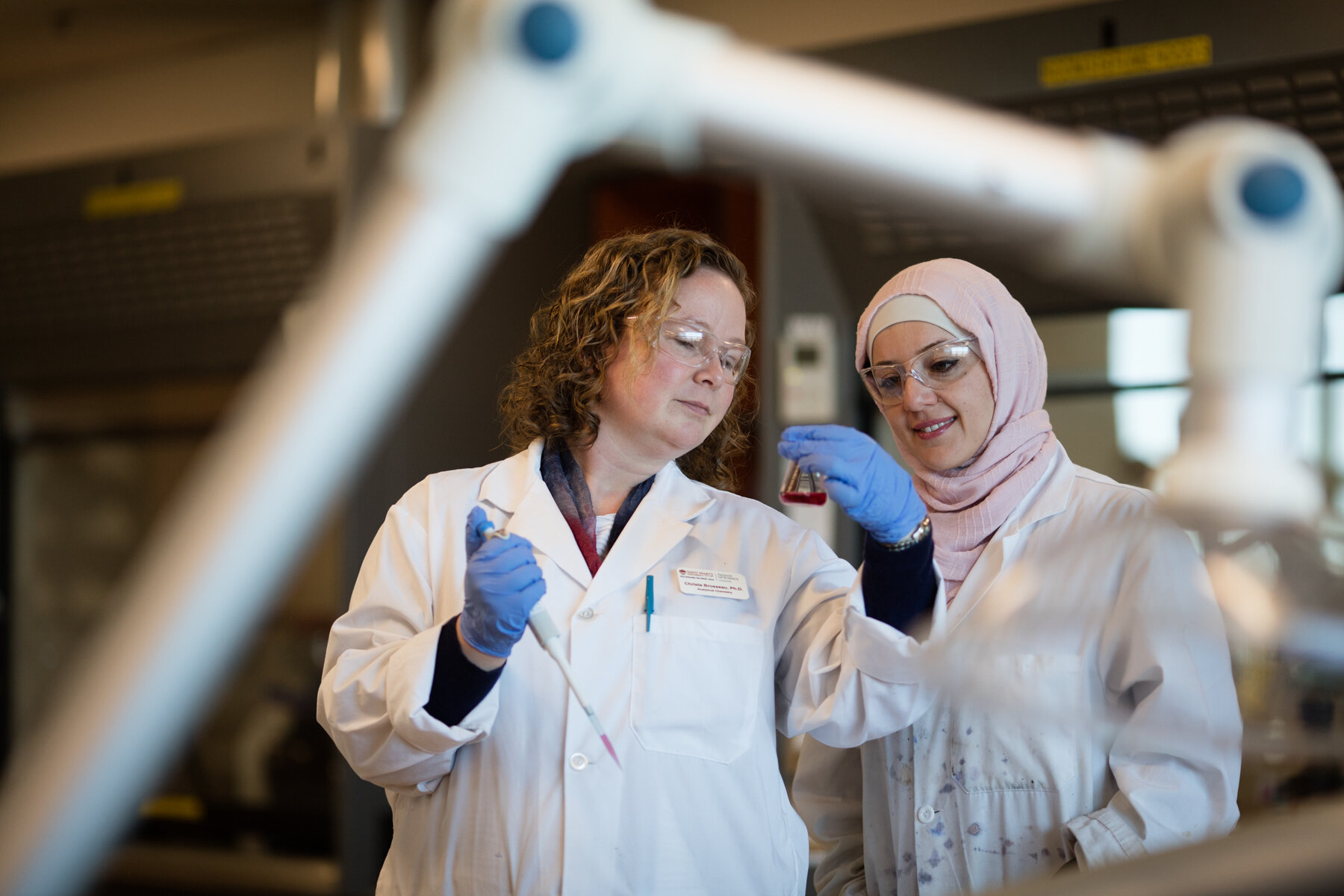
Dr. Christa Brosseau (left)

Dr. Christa Brosseau (left)

A Saint Mary’s University researcher is leading a project to help address a key support needed for the COVID-19 pandemic: personal protective equipment and their components.

“As a result of COVID-19, there is a massively increased global demand for N95 respirators,” says Dr. Christa Brosseau. “New technologies are urgently needed to help manage impending shortages, ideally with ’home-grown’ solutions.”

Dr. Christa Brosseau is a professor in Saint Mary’s University’s Faculty of Science and Canada Research Chair in Sustainable Chemistry & Materials. Her project will explore innovative chemical strategies to help determine if Nova Scotian pulp mills can produce medical-grade pulp for N95 respirator production. A recent grant from Research Nova Scotia will help propel this work forward.

N95 masks are typically composed primarily of synthetic polymer materials (polypropylene, polyester) with cellulose sometimes incorporated into one of the many layers that make up the respirator. At present, a single mill in Canada is producing medical grade pulp and they are struggling to keep up with the increased demand.

“Over the years, there has been an increased interest in making N95 respirators using only wood pulp”, says Dr. Brosseau. “However, wood pulp typically lacks certain properties that translate into effective respirator material.”

Dr. Brosseau’s team, in collaboration with the pulp and paper industry in Nova Scotia, will develop and test chemical additives that can address key challenges in the production of medical-grade pulp from thermomechanical pulp. Using combined expertise in the areas of chemical synthesis, materials characterization and process development, they will work towards an innovative “made-in-Nova Scotia” approach for creation of a product similar to the Western red cedar formulation currently produced in British Columbia.

If successful, this project could help meet the needs of frontline healthcare workers by supplying adequate PPE protection from COVID-19 while also supporting the Nova Scotian pulp and paper industry. The research team will work collaboratively with Port Hawkesbury Paper Mill who will provide thermomechanical pulp for experimentation.

“Although this research project was identified through our COVID research response initiative, it could also have a positive impact on the Nova Scotia forestry sector”, says Stefan Leslie, CEO of Research Nova Scotia. “As we pursue both a sustainable forestry industry and a response to the COVID pandemic, the research community is demonstrating its creativity and initiative.”

Note: This story originally appeared on the Research Nova Scotia website.

Nova Scotia Provincial Heritage Fair goes virtual for 2020

cropped-img_1286.jpg

The 2020 Nova Scotia Heritage Fair is going virtual and is open to all Nova Scotian students in Grades 4 to 9.

"It was very important to us to find a way to continue, despite school closures,” says Dr. Kirrily Freeman of the Saint Mary’s Department of History, who coordinates the Provincial Heritage Fair each year. “Students work so hard on their projects throughout the year to prepare for this. Holding a virtual fair will be a good way to keep a connection with the kids, showcase their wonderful work, and highlight our youth and community, as well as our history and heritage, in these challenging times."

Every year, schools across the province hold fairs featuring heritage and history-themed projects by students in Grades 4 to 9. Winners go on to participate in the Nova Scotia Provincial Heritage Fair, usually held over two days in early June at Saint Mary’s University with educational workshops, awards and a public showcase.

Africville is the 2020 honouree for the provincial heritage day and heritage fair. The close-knit community was built on the shores of Bedford Basin by descendants of the Black Loyalists and Black refugees who came to Nova Scotia in the late 1700s and early 1800s. See the Nova Scotia Heritage Day website for information and videos.

Students are invited to submit their projects on any aspect of Canadian history or heritage to kirrily.freeman@smu.ca  before June 1, 2020.  Any parents or students with questions can also send an email to the address above.

Submissions should include:

Projects will be displayed publicly throughout the month of June on the Nova Scotia Provincial Heritage Fair Instagram site, @nsprovincialheritagefair. Any students looking for inspiration can check out these highlights from the 2018 and 2019 Provincial Heritage Fairs.

Updates from the Nova Scotia Provincial Heritage Fair will be posted on its website, on Facebook at @novascotiaheritagefairs, and on Instagram at @nsprovincialheritagefair.

Emma DeLory takes over the reigns of Huskies rugby

Emma DeLory, the new head coach of the Saint Mary’s University Women’s rugby program.

Emma DeLory, the new head coach of the Saint Mary’s University Women’s rugby program.

Saint Mary's University is proud to announce that Emma DeLory has been named head coach of the Saint Mary's University women's rugby program. DeLory becomes the ninth coach in Huskies' history and takes over from Amber Davison, who is moving into an assistant role due to professional commitments.

"The first task is to put the pieces in place to build a winning culture," states DeLory. "The Huskies will look to get better each practice and each week as we become more familiar with each other."

Even in the current pandemic situation, DeLory is actively planning and connecting with the students through virtual means as she transitions into her new role. DeLory is no stranger to AUS Women's Rugby as she excelled as a student-athlete at Acadia University, receiving an AUS All-Star selection in 2015 while earning two degrees in Biology and Environmental Science.  

In addition to her new role, DeLory serves as Rugby Nova Scotia's development officer and the head coach of the Under-16 Women's provincial team. She also works with the Canadian National Women's Rugby program and serves as head coach of the Halifax West High School team.

"We are very excited about Coach DeLory joining our program as she brings passion and values that align with Saint Mary's University," says director of Athletics & Recreation Scott Gray. "She is well respected as a coach and leader in athletics and will be an asset to the Huskies in the building of our program."

New international research study asks: Is COVID-19 changing the way we cook and eat?

smu+shield.png

It might sound familiar: flour, pasta and yeast are more difficult to find than in the past, and you cannot ignore the photos of homemade bread or desserts circulating on social media. It seems for many that the approach when it comes to meals is completely different than before the emergence of the coronavirus. This has not escaped the notice of several researchers, either.

This change in cooking habits has led to a partnership between Saint Mary's University and the Food, Media & Society (FOOMS) at the University of Antwerp in Belgium to launch a research study into the matter. The Corona Cooking Survey is a large-scale international survey study into the impact of COVID-19 on how people deal with food and food-related media. This study allows the shifts brought on by the coronavirus in terms of buying, cooking and eating habits, to be identified. More than 30 countries have already confirmed that they will participate in the research project. 

Dr. Maryanne Fisher

Dr. Maryanne Fisher

"This is a really exciting project to be involved with for many reasons. Academics around the world have very quickly come together to explore one of the most basic parts of our daily life: eating," says Dr. Maryanne Fisher, a professor of Psychology at Saint Mary's and part of the study's project team. "The number of people who have turned to baking bread - one of the most basic skills that has endured for centuries - is simply amazing. But how did they learn how to make that bread, and what prompted them to do so?"

In Belgium, the survey has received more than 6,000 respondents in less than two weeks.

"We know from previous research that family and friends play an important role in people's relationship with food. Just think of the typical "family classics" or all the tips that friends and colleagues share about food," says Dr. Charlotte De Backer, an Associate Professor at the University of Antwerp and the study's project leader. "Other sources, such as influencers on social media, celebrities on television or recipes in magazines also have an impact on our food choices. That's why we want to use this study to investigate whether our habits have changed since the preventative measures were taken, and what role various media and people play in these changes."

Interested in participating in the survey? Click here.