Faculty of Arts

Inspiring words from Arts Valedictorians: “We all have a place in this university”

Baden Mercer

Weam Ibrahim

Baden Mercer and Weam Ibrahim have unique messages to share as valedictorians for the Faculty of Arts graduation ceremonies on Friday. Their speeches do have some common threads, though: gratitude for faith, family and the supportive environment at Saint Mary’s University.

Baden Mercer

“Religion for me has always been a personal area of study but not something I imagined I would study academically,” says Mercer, who started out as a political science major. After taking a few courses with the Department for the Study of Religion, he was intrigued and opted to do a double major.

“In today’s world, it’s definitely interesting to see how religion intersects with political systems, and to explore those tensions,” says Mercer, who grew up in Dartmouth and is an active member of the Anglican Church of Canada.

Last year, Mercer received the Harry and Lily Rutte Award for Spirituality in the Workplace, for a paper he wrote on the military chaplaincy. Winning the award motivated him to continue his research, so he’s returning to Saint Mary’s this fall to pursue a Master of Arts in Theology and Religious Studies. For his master’s thesis, he’ll expand his research to a national scale and explore how chaplains address contradictions between faith in the military and violence out in the field.

During his time at Saint Mary’s, Mercer has also been a passionate advocate for students with disabilities, as a student on the autism spectrum. “The Fred Smithers Centre of Support for Students with Disabilities has been a phenomenal support for me,” he says. The centre plays an integral role in helping students succeed in their academic goals, with services ranging from career counselling to ASL interpretation and providing a quiet place to write final exams.

The university’s smaller class sizes also provide a supportive atmosphere for students with disabilities, he adds: “Here, the professors get to know you, and take an active interest in how you’re doing. For new students coming in, if you’re ever having difficulty, there is always someone here to talk to at Saint Mary’s, whether it’s a classmate, faculty member, advisor, counsellor and so on.”

He’s the second generation in his family to graduate from Saint Mary’s—his father Dwayne studied engineering here 20 years ago.

Weam Ibrahim

Born in Libya, Weam Ibrahim was eight years old when her family moved to Canada so her father could pursue his PhD in Halifax. Soon she will have a Bachelor of Arts, and this fall she will begin work on a master’s degree in curriculum studies at Mount Saint Vincent University, in the Teaching English to Speakers of Other Languages (TESOL) program.

“It takes a village for someone to graduate university,” says Ibrahim, explaining she couldn’t have made it this far without the support and encouragement of her parents, her three younger brothers, and relatives back home.

“I can’t wait to hug my mom immediately after the ceremony and thank her for everything that she has done for me throughout my degree, then call my dad and brothers in Qatar. Then I am looking forward to making a memorable video call to my entire family in Libya, as they are all planning to gather together and watch the ceremony online.”

In her speech, she will share a thought-provoking quote from the Quran, which translates to “Perhaps you hate a thing and it is good for you, and perhaps you love a thing and it is bad for you; God knows and you don’t know.”

The lesson behind this passage is to try your best to welcome opportunities, no matter how they may appear in the beginning. Even something like learning to navigate the pandemic, she says. “Let these experiences serve as a reminder that we are able to overcome any difficulty that comes our way, wherever we may be.”

An honours BA with an English major and a minor in international development studies has turned out to be “the biggest blessing in disguise,” she says, though she didn’t realize that when she first embarked on her studies.

“I have always enjoyed the sense of community and acceptance during my time at Saint Mary’s,” Ibrahim adds. “As a visible minority, being accepted and appreciated everywhere I went on the SMU campus has played an enormous role in my university experience. It goes without saying that SMU manages to make everyone from all different backgrounds, faiths and races feel like we all have a place in this university.”

Q&A with FGSR Valedictorian Charlene Boyce

Charlene Boyce

Charlene Boyce

Charlene Boyce (BA'92, MA'22) is a writer and creative professional who has worked in communications, community engagement and graphic design. She actively seeks work that aligns with her values, whether that be in higher education, non-profit systems change or environmental work. Her path has been circuitous and scenic, and she wouldn't change a step.

Her journey as a mature student began in MBA courses, but she realized that her interests lay in the nexus of history, culture and identity. She began her Master of Arts in Atlantic Canada Studies in 2019, completing her oral-history-based thesis during the pandemic while working full time. Through interviews with former employees, musicians and patrons, she explored the history of the Misty Moon Showbar and the implications that history holds for Halifax’s cultural identity.

In 2021, her short story Flour and Fire won first place in a Reedsy challenge and she has recently had a poem shortlisted by the Writer's Federation of Nova Scotia.

Preferred Name: Charlene M. Boyce

Hometown: Truro (born in New Glasgow)

Graduation Date: May 19, 2022

Previous Degrees: BA'92 (SMU), DiplGD’94 (NSCC)

Thesis title: Music, Money, Memory and Cultural Identity: An Oral History of the Misty Moon Show Bar

Thesis description: The Misty Moon Show Bar was an iconic nightclub in Halifax that was open 1969-1994 and lives on in infamy, tied to a cultural identity of Halifax as a violent city of many bars. Interviews were undertaken with 13 narrators who worked at, were patrons of, or were musicians who played at the club, in order to establish an oral history and dig into the validity of this association. A thematic analysis establishes the community was linked through music, monetary benefits and shared experience. The report exposes the connections and care at the core of the collective identity, while looking at the ways that the Misty Moon is still collectively
commemorated.

Why did this type of research appeal to you? 

In 1988 when I came to SMU, I quickly discovered the downtown bar scene and I have remained intrigued by the interweaving of personal identity and cultural identity, reflected in some of the discourse around different interpretations of Halifax history and city’s identity. 

Why did you choose Saint Mary’s University for your graduate work? I was working here when the idea began to crystallize and I was familiar with some of the excellent history work undertaken here in the Atlantic Canada Studies program. I think talking with Raymond Sewell about his experience was a clinching factor for me. 

Any other successes you’d like to share, or difficulties you were able to overcome? During the drafting of this thesis, at home in the dark days of the pandemic, I honed and perfected my Productive Procrastination techniques. I’ve written more than 20 short stories during this time, one of which won a competition; I have also written poems, and undertook my first 3-Day Novel challenge, producing a 60,000 word manuscript in three days. I feel like this experience has really unlocked my long-harboured writing ambitions. 

Future plans? Keep writing, keep finding work that aligns with my values and keep learning. 

Advice to students? By all means, let fear keep you from doing things like jumping out of perfectly good airplanes, but never let fear keep you quiet when you need to speak, and don't let fear hold you back from taking exciting chances, like stepping into a new career or moving across the country. The growth you will achieve is worth the risk.*

*If you are already a skydiver, kudos to you! Someday, maybe I will... but probably not!


Multiple degrees enhance the family business for mother and daughter

Elora Gehue standing beside her mother, Olwyn Gehue

Elora (standing) and Olwyn Gehue

Simultaneous studies in Arts and Commerce added up to the perfect combination for Elora Gehue of Halifax—and for her mother, Olwyn Terris-Gehue. The pair were seated side by side during their graduation ceremony this week at Saint Mary’s University.

“I’m not really sure how she felt about it when we first started to attend classes together but it definitely got better,” Terris-Gehue recalls with a chuckle.

“It’s been a great experience, honestly,” says Gehue, herself a mother of two young sons. “I think it made us closer too, being able to learn and grow with each other.”

The mother and daughter, ages 58 and 27, share an appreciation for the interdisciplinary learning options at Saint Mary’s. They took quite a few classes together, and are graduating with an unusual combination of credentials:

Academic curiosity and the entrepreneurial spirit run deep in the Gehue family. The variety of programs complement each other as well as the family businesses, which include Lotus Business Solutions, Gehue’s business consulting firm; Ataj, a construction company with her father; and the family’s first retail outlet, Crystal Moon Wellness Boutique, which opened last fall just off Spring Garden Road. A pet supply store and an inclusive clothing shop are in the planning stages, and Gehue also starts a new job soon as Indigenous Student Advisor at Dalhousie University.

“We graduated together once before, in 2017,” notes Terris-Gehue, who was the last person to receive a Bachelor of Education degree from Saint Mary’s that year. Her daughter’s first BA included a major in International Development Studies and minors in English and Sociology. The IDS program sparked Gehue’s interest in equity, diversity and inclusion, which led to her focus on human resources. 

“Realizing the issues that I have as somebody who isn’t visibly diverse, it can be very complicated to navigate,” says Gehue, whose father is from Sipekne’katik. “So for me, venturing into HR is a way to help promote changes within corporate structures, because it can be very tough. Diversity is not just skin deep, it’s a lot of things.”   

During her first degree, Gehue was a member of the Alumni Council and served as president of the Indigenous Student Society. She coordinated the first Mawio’mi on campus, and volunteered on a committee that helped to implement some of the recommendations from the President’s task force on Indigenous students.

Her parents always encouraged her to be open and curious about exploring her culture as well as different paths of spirituality, and studying religion at Saint Mary’s opened up many areas of questioning and critical thinking. Traditional healing is a big focus in the family store, with smudge kits, gemstones, books, dreamcatchers, beadwork and art by local Indigenous and Celtic artists, and much more. The shop also has pop-ups in other locations, and was a popular fixture at the Evergreen Market on the waterfront in the winter.

The mother and daughter encourage new students to be adventurous in choosing their courses, and to reach out to their advisors, career counsellors and other campus supports. If a program isn’t clicking, you don’t have to get stuck on a single path, they agree.

“The wide range of courses at Saint Mary’s is wonderful. You’ve got wiggle room to try things, room to explore different options,” says Terris-Gehue.

They also appreciate the comfort of a smaller university. Terris-Gehue had jitters at first about coming back to school as a mature student but she quickly felt accepted and appreciated. Other students and even a few professors began calling her “Mom”, and she made friends with the mothers of international students, from Thailand to the Caribbean.

The Gehue family connection continues at Saint Mary’s in September, when Terris-Gehue’s 18-year-old son Dakota (and Gehue’s brother) arrives to begin his studies at the Sobey School of Business.

“He says to me, ‘So are you coming back, Mom, and taking some more courses so you can graduate with me too?’ I don’t think so, but who knows?”


Plan a degree unique to your interests with the undergraduate program advisors available in Saint Mary’s Faculty of Arts, Faculty of Science and the Sobey School of Business.

Dr. Alexander MacLeod Launches Short Story Collection, "Animal Person"

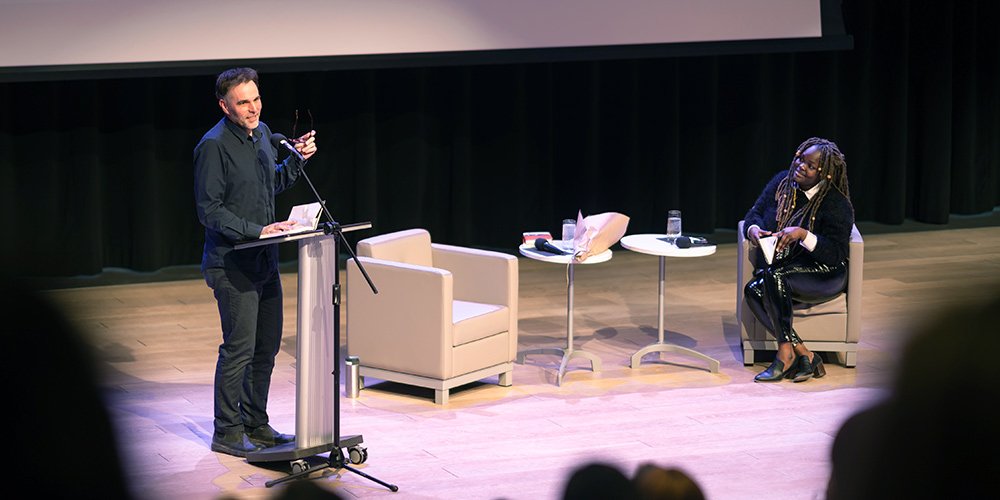
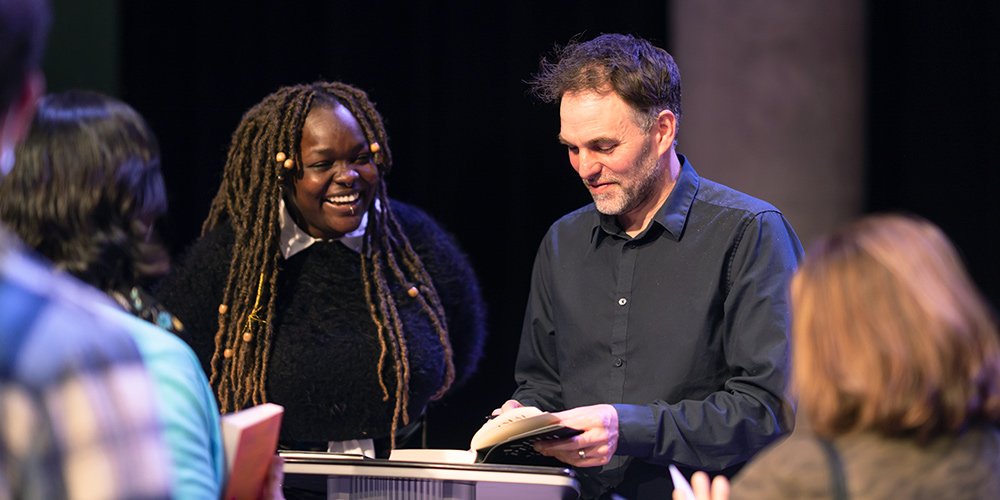
Alexander MacLeod’s long-anticipated new collection of short stories, Animal Person, is finally unleashed and out in the world. The national launch on April 6 was a celebration complete with Cape Breton musicians, drawing several hundred fans and friends to the Halifax Central Library.

“The last time I published a book, we didn’t have this library, that’s how long it’s been,” said Dr. MacLeod, drawing laughs and applause from the crowd. The landmark library’s construction began in 2012, and MacLeod started building these stories back in 2010, soon after his first book Light Lifting was released to wide acclaim.

The musicians were Wendy MacIsaac and Troy MacGillivray, playing fiddle and piano while MacLeod signed books. The event’s co-host was author Francesca Ekwuyasi MA’16, a Saint Mary’s University graduate whose debut novel Honey Butter Pig Bread is earning international praise. She relished the opportunity to pick MacLeod’s brain on behalf of the audience, diving in with perhaps the hardest question first: “Why do you write?”

“I write because I think I’m trying to make sense of experience,” MacLeod replied. “Sometimes my experience, sometimes our experience. And I believe that experience is resolutely resistant to language. It doesn’t want to become a story. I’m fascinated by how much work it takes to process experience and turn it into something interesting … I’m trying to pin it down as best I can.”

Language doesn’t settle easily on animals either, he added: “In this book, there are times when people are contemplating animals and wondering what the animal thinks of them. That animal is not using human language but that animal is definitely having thoughts.” 

The short story genre allows him to focus on the intensity of the situations found in his imagination, and to shed light on them from various points of view.

“I think I may have the first really deep dive on piano recitals and pet rabbits (and) motel rooms with serial killers,” he said of the varied collection of eight stories, published in Canada by McClelland & Stewart.

He mesmerized the room with readings from two of them, selected to show how the book travels great distances in space and time. “Everything Underneath” follows two sisters snorkeling at the beach on the last day of summer, in scenes recognizable to people from Dartmouth to Inverness County and beyond.

California is the setting for his “weirdest” story, which gets inside the mind of a man with a fetish for connecting with the contents of strangers’ suitcases. “What exactly do you think you’re looking at?” was inspired by two photographs taken in the mid-1970s by the late U.S. artist Henry Wessel Jr. The story resulted from an invitation to be part of Henry Wessel: A Dark Thread, a 2019 exhibition at La Maison Européen de la Photographie in Paris. Another photo of Wessel’s is featured on the cover of the U.S. version of Animal Person.

“The book is very much interested in intimacy and connections, and not necessarily the typical ones,” said MacLeod.

Some of the stories are like cats on their second or third lives after appearing in previous anthologies, and it’s good to have them all herded together in this one collection. Anchoring the book’s front end is “Lagomorph,” honoured with a 2019 O. Henry Prize and the 2021 Lieutenant Governor of Nova Scotia Masterworks Arts Award, which MacLeod won with Andrew Steeves of Gaspereau Press for their handbound letterpress collaboration.

“The Closing Date” originally appeared in the Sex and Death anthology (Faber & Faber and House of Anansi Press, 2016). “Once Removed” was featured in a recent issue of The New Yorker magazine, and “The Dead Want” was first published in iLit Modern Morsels: Selections of Canadian Poetry and Fiction (McGraw Hill Ryerson, 2012).

Dr. Alexander MacLeod teaches in the Department of English Language and Literature at Saint Mary’s, and also the Atlantic Canada Studies program. 

Department of English Language and Literature
Atlantic Canada Studies Program


The Power of Poetry in Women and Gender Studies Research

Angela Bowden sitting in a chair with Claire Yurkovich standing beside her.

Angela Bowden and Claire Yurkovich (standing)

 The process of writing poetry may have healing benefits for trauma, especially when the writing happens in a communal setting. That’s what student Claire Yurkovich is hoping to find out through her graduate research at Saint Mary’s University.

“There is something so special about creating in a shared space, and this became very central to my research in poetic healing,” says Yurkovich, who is in the final stretch of her Master of Arts degree program in Women and Gender Studies (WGST).

In February, she facilitated a series of four 90-minute community workshops to explore poetry’s therapeutic benefits as a tool for processing trauma related to sexual violence. Some participants had no prior experience writing poetry, so the first session introduced poetic vocabulary, forms and other writing devices. The next two sessions focused on writing, with a variety of prompts. In the final session, the budding poets shared their creations with the group.

“Writing poetry allows for a processing of your own emotions around difficult topics, but it also creates the potential for other individuals to read and resonate with your words, and space for shared experiences to emerge,” she says.

Poetry is also a central element of Angela Bowden’s graduate work in Women and Gender Studies here at Saint Mary’s. Born and raised in New Glasgow, she is an accomplished author, speaker and activist whose writing draws upon her lived experiences as an African Nova Scotian woman and mother of three sons. She aims to ignite conversations around social justice, systemic racism’s perseverance, and the connections between historical trauma and current inequalities, while also honouring ancestors and inspiring young people.  

Bowden’s first poetry collection, Unspoken Truth – Unmuted and Unfiltered, was published in 2021 by Pottersfield Press, and she’s now working on a children’s book for Black girls. She was recently celebrated in a feature story on the website Amplify East, which aims to “change the voice of Atlantic Canada one woman at a time.”  

“Poetry, much like music, provides a platform for difficult topics to be expressed and received without direct argument or confrontation,” says Bowden. “Poetry is able to take us beyond the cerebral understanding and into a place I like to refer to as ‘innerstanding’; a place where you are touched so profoundly that you are motivated to change. It can result when poetry moves through difficult topics unapologetically in a truth telling that forces a reconciliation and calls for change on behalf of the recipient.”

While writing UnSpoken Truth, she realized that many of her poems were grounded in women and gender issues. Her son was attending Saint Mary’s, and Bowden ended up meeting with Dr. Michele Byers to learn more about the WGST graduate program.

“I learned that it is critical to the understanding, ‘innerstanding’ and healing of Black women and our society to be a part of the larger conversations that are taking place in academia about us and around us; intersectionality and various feminist theories not only apply to us but are us. I am learning, teaching and sharing knowledge,” she says.

Mavis Mainu standing in the sunlight

Mavis Mainu

Mavis Mainu of Ghana was living in Germany when her best friend recommended Saint Mary’s for graduate studies. With her interdisciplinary interests in climate change, migration and gender issues, she felt the WGST program was the perfect fit for her research, and would build on her first master’s degree in Development Studies and Governance from the University of Duisburg-Essen. She lives in Berlin, so the main challenge was juggling a busy work schedule with Halifax classes that sometimes went past midnight with the time zone differences.

Mainu works at Climate Analytics, a non-profit climate science and policy institute where her current role is administrative and operational in nature. Her goal is to shift into a content role that focuses gender and adaptation, climate research and analysis, so she can contribute to the much-needed academic literature in the intersection of these issues.

“Before I undertook this degree, I was working on a lot of projects for women and girls but did not have the academic background to complement the practical skills or experience,” says Mainu. “This program is empowering and preparing me to work in areas that I am passionate about.”

Mainu is a co-founder of the Oak Foundation, an NGO that nurtures young women in education and entrepreneurship in Ghana, and is also a Climate Reality Leader, a Queens Young Leader, Associate Fellow of the Royal Commonwealth Society, and a One Young World Ambassador.

Learn more about the Graduate Program in Women and Gender Studies at Saint Mary’s, and the undergraduate Minor in Women, Gender and Sexuality Studies


Uncovering new twists in the legal history of marriage and divorce in England   

Book cover featuring a decorative trunk. Title: Marriage, Separation and Divorce in England, 1500-1700.

Humans have been falling in and out of love—and marriage—for many centuries. While the legalities of separation and divorce continue evolving today, it’s intriguing to look back and see how ordinary folks managed their breakups in England 300 to 500 years ago.  

“The subject is so large and I keep finding new things,” says Dr. Tim Stretton, a Saint Mary’s University professor whose work focuses on legal and social history, and women’s legal rights.  

While researching Marriage, Separation, and Divorce in England, 1500-1700 (Oxford University Press, 2022), he and co-author Dr. K. J. Kesselring of Dalhousie University found a treasure trove of surprising cases in secular court archives and private litigation records. 

Other historians have relied heavily on records from the church courts, which held the monopoly on marriage and separation in England during this time period. In the wake of the 16th century Reformation, England was the only Protestant jurisdiction that didn’t introduce full divorces allowing remarriage—an option that only became widely available after the passing of the Divorce Act in 1857. In theory, unhappy spouses’ only hope was a church court separation.  

“The single biggest surprise was finding private separation agreements,” says Stretton. “Hundreds of couples in miserable marriages should have gone to the church to get a separation. But that was expensive and shameful, potentially, and church officials often told them to get back together, which in the case of domestic violence was horrific.” 

With the help of lawyers trained in secular law, parting couples quietly made their own arrangements to resolve property matters, safety concerns and other differences. These private separations could be difficult to enforce but for exes who remained cordial, they seem to have provided peace of mind. These private agreements also helped spur the rise of alimony in the 17th century, another unexpected finding detailed in two chapters.  

This is Stretton’s second book with Kesselring. They co-edited Married Women and the Law: Coverture in England and the Common Law World (McGill-Queen’s University Press, 2013) following a conference at Saint Mary’s. Coverture—the term for married women’s rights under English common law—restricted a wife’s ability to control real estate, own movable property, enter into contracts or participate in litigation without the cooperation of her husband.  

A significant number of women in broken marriages defied these limitations in filing lawsuits against their husbands, the new book confirms, illustrating this with case studies and rich biographical detail found in the litigation records.  

“It’s hard to do this work and be sensitive to the memories of these people but at the same time, some aspects of the stories need to be told,” says Stretton. “The fierce independence of the women involved is what struck us throughout, often in surprising ways.”  

More new books from Saint Mary’s History professors:  

Book cover with circle pattern. The Town of Vichy and the Politics if Identity.
 
Book cover with sailing ships. Empire and Emancipation.

Irish President Honours Bridget Brownlow for Peace Education Impact

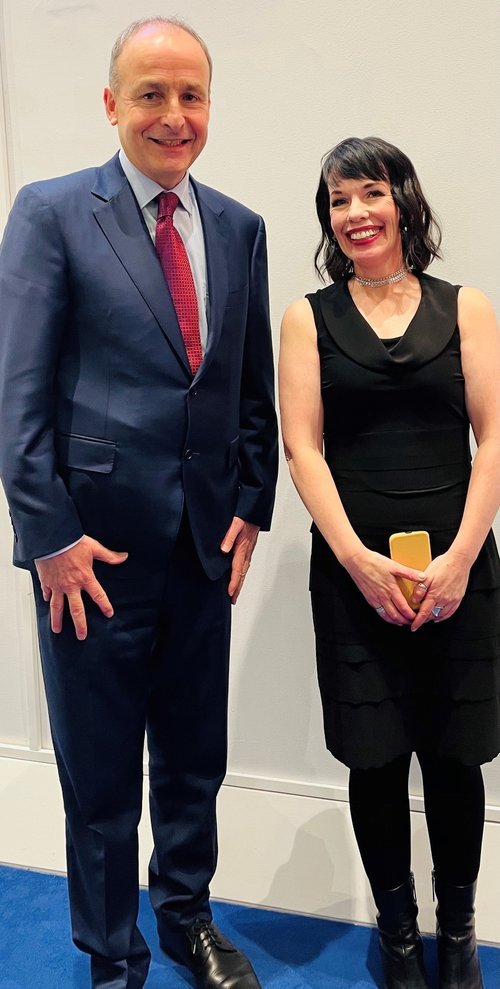
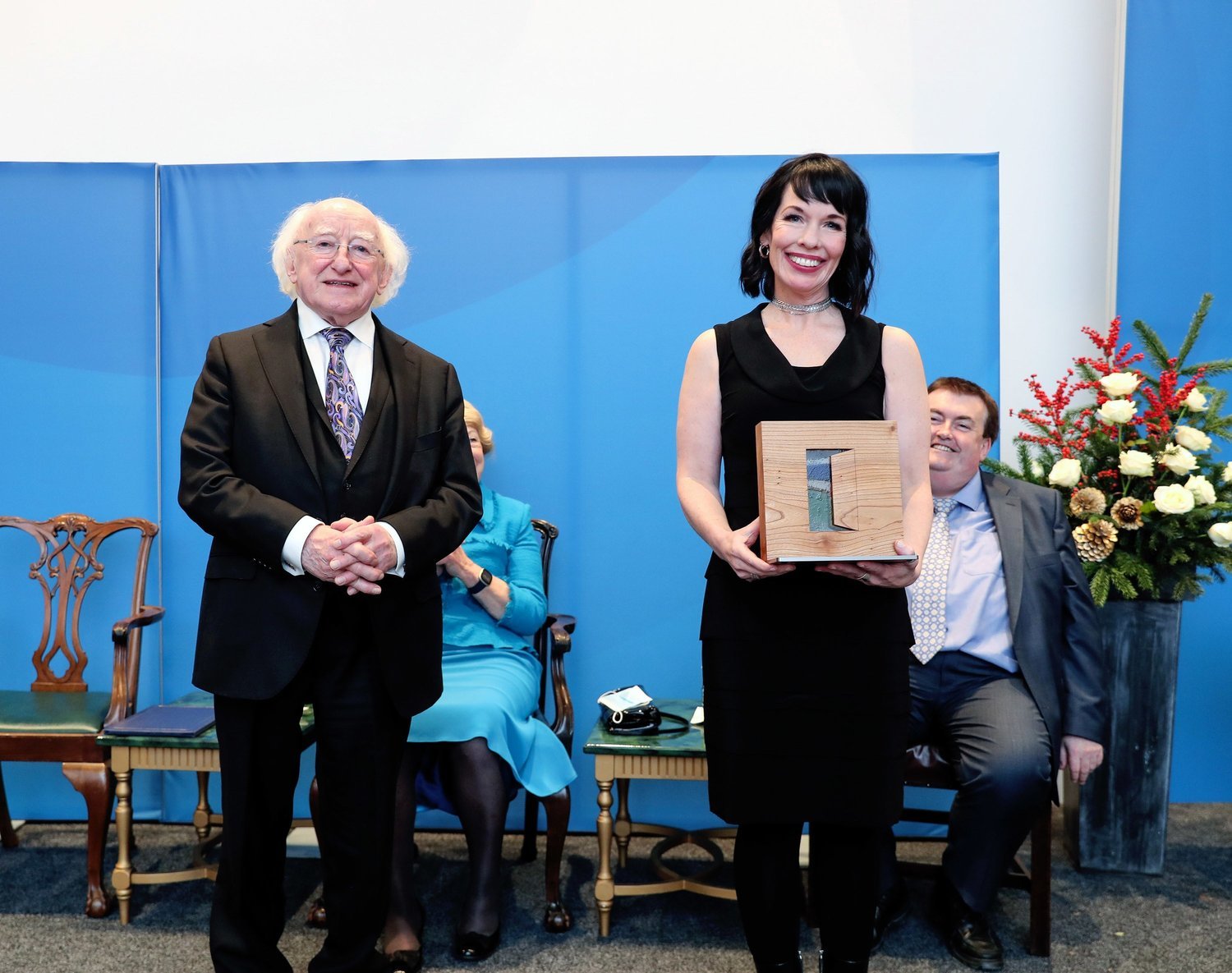
Bridget Brownlow met Ireland’s President Michael D. Higgins for the first time this week, as the recipient of one of his highest honours. She was the only Canadian among 11 people who received his 2021 Presidential Distinguished Service Award for the Irish Abroad.

Brownlow was the sole winner in the award’s “Peace, Reconciliation & Development” category, in recognition of her work with the Northern Ireland / North of Ireland Peace Education and Conflict Resolution Program. The ceremony took place December 2 at Áras an Uachtaráin, the President’s official residence in Dublin. Other Irish dignitaries present were Micheál Martin, Taoiseach (Prime Minister) and Simon Coveney, T.D., Minister for Foreign Affairs and Minister for Defence.

“I was so grateful to represent Saint Mary’s and Canada,” says Brownlow, who is President of Peaceful Schools International, Saint Mary’s Conflict Resolution Advisor and a part-time faculty member. “Many strategic connections were solidified as a result of meeting these senior government officials, which will further support our programs in Ireland and elsewhere going forward.”

Mr. Coveney called the award recipients “some of the finest members of our global family, our diaspora,” in an October 22 announcement. “In the ever-changing world we live in, this remarkable group of individuals have been a constant beacon for Ireland and the values we hold dear.” 

Now in its 18th year, the Peace Education Program is a partnership between Saint Mary’s and Peaceful Schools International. SMU students help to facilitate peace education and conflict resolution workshops with children in elementary schools overseas, and here in Nova Scotia. The program has grown to include conflict management and peace education training, and has established partnerships with colleagues at Yale University and Queen’s University, Belfast.

Brownlow heads to Belfast next to facilitate in-person training with members of the Orange Order, Loyalist and Republican youth, the Irish Republican Socialist Party, Sinn Fein and a cross-community workshop with teachers and parents. Throughout the pandemic, she has continued to offer weekly training sessions overseas virtually.

“The long-term strategy is to continue building on the existing capacity for managing conflict and promoting peace education, which are essential features of the peace process. The fundamental principle of Peaceful Schools International is to ’teach peace’ at the youngest age possible, although it remains possible at any age,” she says.

Planning is underway for the program’s next trip to Northern Ireland, scheduled for late April 2022. For updates, follow Peaceful Schools International on Instagram, Twitter and Facebook, and SMU’s Peace Education / Conflict Resolution Society on Instagram and Twitter.   

Ryan Francis Returns for Two-Year Indigenous Research Fellowship at Saint Mary’s

Ryan Francis

A familiar face to the Saint Mary's University community is back to continue working on projects that foster the potential of sport and recreation to bring people together for intercultural understanding.

Ryan Francis, the university’s first Indigenous Visiting Fellow, recently returned for a two-year fellowship with the Faculty of Arts and the Centre for the Study of Sport and Health (CSSH). His first fellowship was  a four-month term from January to April 2020, coinciding with the onset of the global pandemic.

“A lot of our plans and programs involved people gathering and coming together, so it was very challenging to do that,” says Francis. “We highlighted in the previous fellowship that there is a lot of work that can be done. With a longer runway, we’ll be able to implement a lot more of those meaningful opportunities for the university community.” 

Part of the fellowship includes working with Saint Mary’s and organizers of the North American Indigenous Games, postponed in 2020 but now scheduled to take place July 15-23, 2023 in several locations in Kjipuktuk (Halifax) and Millbrook First Nation. NAIG 2023 will include competitions in 16 sports, bringing together 3,000 local volunteers with more than 5,000 athletes, coaches and team staff from 756 Indigenous Nations.

“SMU’s commitment to being a part of the Games, through facility use and accommodations, is really significant,” says Francis. “It will be really neat to think about how we can play a role, and factor in how to support the participants coming to campus, and make this environment feel especially welcoming to them.”

One idea already in development is the creation of “Brave Spaces” – spaces on campus where athletes and attendees can gather to share and learn more about each other’s cultures, since the Indigenous athletes will be attending from across Turtle Island.

During his first fellowship in 2020, Ryan was also a key player in the university’s inaugural Red Tape Game, working with Athletics and Recreation and the men’s Huskies hockey team. The growing movement across Canada and the U.S. aims to promote inclusion in ice hockey. The initiative was started and inspired by Logan Prosper of Whycocomagh First Nation – now an Arts student at Saint Mary’s – and his father Phillip, to create awareness of racism in hockey and encourage players to take responsibility for combatting racism. SMU’s second Red Tape Game is in the planning stages for this winter. Francis and Dr. Cheryl MacDonald, Associate Director of Outreach for the CSSH, hope to build on the idea and expand it to other teams.

“Ryan has been such a wonderful contributor to the Centre,” says Dr. MacDonald, noting he has provided guest lectures in the Health, Wellness and Sport in Society program, and participated in the international Hockey Conference hosted by the Centre.

“The Centre’s mandate is very much to facilitate and disseminate research on sport and health,” she adds. “We’re also committed to community outreach and interdisciplinary approaches. I think what we are creating here is meaningful opportunities to combine research and education with community.”

The fellowship builds on Saint Mary’s ongoing initiatives to engage with Indigenous communities, strengthen intercultural research and curriculum, and respond to the Calls to Action of the Truth and Reconciliation Commission’s Calls to Action.

Francis grew up in Cole Harbour and is a member of Acadia First Nation. He is currently the Manager of Provincial Outreach & Coordination for the Nova Scotia Department of Communities, Culture, Tourism and Heritage, in its Communities, Sport, and Recreation Division. He has a Master of Physical Education degree from Memorial University, and majored in sport management for his Bachelor of Science degree at Liberty University in Lynchburg, Virginia. Follow him on Twitter at @RyanFrancis58.     

Pet Photos: A Key to Successful Online Dating for Men According to New Study

Dr. Maryanne Fisher

They say a picture is worth a thousand words and in the case of a new research study from Saint Mary’s University, the right picture may be worth a lifetime of love.  The research shows that women see men who care for pets and children as good potential long-term partners, says evolutionary psychologist Dr. Maryanne Fisher.  

The recent study, published in the journal Evolutionary Psychological Science by Saint Mary’s University's Mackenzie Zinck, Dr. Laura Weir, and Dr. Fisher, shows that men who care for dependents are perceived as high-quality mates, displaying the ability to invest in a long-term mate. This investment may be exhibited through financial and social status, and the ability to care for a mate and any resulting children. 

Online dating profiles were used to test the prediction, and as expected, men seeking long-term mates displayed dependents — primarily dogs and children— more than men seeking short-term mates, but both men and women seeking long-term mates displayed dependents similarly. Men, though, showed more dogs while women showed more children.  

“The inclusion of dependents represents a way for daters to advertise that they can, and are willing to, invest in a living being,” said Dr. Fisher.  “Men’s photos are really telling. Those interested in short-term relationships showed their body, their fancy trucks, the big fish they caught in the summer. Meanwhile, those seeking a relationship posted photos with their dogs and children. Whether or not women show the same difference remains to be seen. There weren’t many women dating online in the summer of 2020 openly advertising that they were seeking short-term relationships only.” 

Dr. Maryanne Fisher, a researcher and professor of Psychology at Saint Mary’s, is an expert on the evolutionary foundations of human interpersonal relationships. Her primary research areas include the evolutionary foundations of human interpersonal relationships and women's mating strategies and indicators of female physical attractiveness. 

Dr. Fisher recently discussed the study in an article she wrote for the Conversation.

Wicked problems of food insecurity

Dr. Mathew Novak, Geography and Environmental Studies, Faculty of Arts

How can Geographic Information Systems (GIS) help support people experiencing food insecurity across Nova Scotia? Made possible by gifts from the Windsor Foundation, the Hewitt Foundation and alumnus Dr. Daniel McCarthy, the lab is a hub where faculty and students collaborate on solving issues using geospatial software.

Partnering with the province’s largest food assistance organization, the Wicked Problems Lab at Saint Mary’s University is bringing a world of expertise to facilitate data-driven food distribution.

“Food insecurity is a crisis in our province,” says Nick Jennery, executive director of Feed Nova Scotia. “While we advocate for much-needed change to address systemic issues, we need to ensure people have food today and that they can access that food in a dignified way. An important piece in making food support more accessible is understanding where gaps exist in our current food distribution program.” In September 2020, Feed Nova Scotia began working with the lab to better understand food accessibility. Led by Dr. Mathew Novak, an expert in retail geography and GIS, the lab mapped out current food bank locations and paired them with regional census data to predict where demand for services is high.

The result? The data clearly identified locations that could benefit from greater food distribution. “Our research allowed us to make recommendations for more effective distribution of resources,” says Dr. Novak.

“For instance, we found areas of suburban Halifax with high potential demand but limited access to food banks and other food support programs. GIS allows us to combine a variety of data sources and perform sophisticated analysis to reveal spatial patterns that may have otherwise remained hidden.” Feed Nova Scotia distributes more than 2 million kilograms of food to 140 food banks and meal programs each year.

“We’re excited to see where this project will take us, knowing that good data is a critical factor that contributes to better decision making,” says Jennery.

Recently, Dr. Novak made presentations to Feed Nova Scotia’s leadership and community connections teams, outlining the first findings of the analysis. Moving forward, more analysis will be performed on the organization’s needs and distribution locations. This continuation opens the door to endless possibility, with opportunities to partner with other not-for-profit organizations to better match needs and resources.

Learn more about supporting Saint Mary’s students who are struggling with food insecurity.

New SMU Scholarship Supports Aspiring Writers of African Nova Scotian Descent

Saint Mary's University is launching an innovative new scholarship to support aspiring writers of African descent upon graduation.  

“I thought of this as a way to encourage Black Nova Scotians who want to pursue a career in writing,” says Floyd Kane BA’92, a writer, filmmaker and TV producer from East Preston, whose philanthropic gift makes the new award possible for students in the Faculty of Arts.  

“A lot of people’s dreams are limited by their financial backgrounds, and I just wanted to remove that barrier from the equation. So if you have the drive and ambition to pursue your dream, you can go and do it and not have to worry about where your next meal comes from or how you’re going to pay your rent.”

The new Edna and Velma Thomas Kane Writers Award is open to students who self-identify as being of African descent, with first priority to students of African Nova Scotian descent. Award recipients will receive $30,000 upon graduation to help mitigate the burden of financial debt; to support them in further post-secondary studies or training such as internships, apprenticeships or self-directed projects; and to advance their aspirations for careers in writing. Find the application form here.

"Saint Mary's recognizes the importance of diverse voices and perspectives in all fields of research and study, including the creative arts and industries," says President Dr. Robert Summerby-Murray. "Writing and storytelling are essential tools for sharing our province's unique histories and experiences. This award will help us support African Nova Scotian students by reducing financial barriers as they embark on their next steps toward careers in writing. We are committed to creating possibilities for our students, celebrating their creative talents, and working together toward a World without limits."     

Floyd Kane BA'92

Floyd Kane BA'92

After graduating from Saint Mary’s, Kane’s next steps were a law degree then working as legal counsel and a production executive on such notable film and TV projects as This Hour Has 22 Minutes, Shake Hands with the Devil, and the Oscar-winning documentary Bowling for Columbine. But writing was always his first love so he eventually chose to make it a more central aspect of his career, starting with his drama series North/South. He has since written for numerous TV shows and produced the 2015 feature film, Across the Line, his story about a North Preston hockey player aiming for a professional career on the ice.

“One of the things I realized as I got into the industry is that I never saw Black Nova Scotians portrayed in Canadian film and television, so that was a goal I wanted to accomplish, to be able to bring those stories to the screen,” says Kane.

Those stories are resonating widely with audiences, not just in Canada. His acclaimed series Diggstown, which shot its third season in Halifax this summer, airs nationally on CBC-TV and will soon be seen in the U.S. on the FOX network. The show’s central character Marcie Diggs is a legal aid lawyer from North Preston who surfs in her spare time and works hard for her clients, challenging social injustices that strike a universal chord far beyond Nova Scotia. 

Kane recalls local tourism ads from the time he was growing up: “It was all these people who were sailing and surfing and having lobster dinners. And they were all white. What I love about Diggstown is that it’s an opportunity to recast the Nova Scotia narrative but it puts Black and Indigenous people at the centre of it.”

That sense of possibility in storytelling ignited for him as an undergrad at Saint Mary’s. Kane started out as a Commerce major, switching to Arts after producing a play at age 19. In a pivotal course in 19th century literature, one of his projects was tackling an update to the 1847 classic, Wuthering Heights. “I just loved the idea that I could take this book and put Black people into the narrative in a textual way. There has always been talk that Brontë may have intended Heathcliff to be Black.”

Kane maintains a close connection with Saint Mary’s by serving as a member of the Board of Governors, and he’s thrilled to help create this opportunity for aspiring writers, to reduce financial roadblocks as they graduate.

“I really hope it’s transformational for those who will receive it. I hope it helps them to continue to pursue whatever dreams they have,” he says.

The award is named for his mother Edna and his late aunt Velma, who always supported his dreams. 

“Everything starts with them,” says Kane. “Even though we were poor, my mother made sure we never wanted for anything. My aunt bought me a Smith Corona typewriter when I was in Grade 7, and I taught myself to type. The first things I ever wrote were on that machine. Professionally, she’s the reason why I’m here and personally, my mom inspired the ambition that got me here. So I wanted to honour those two great Black Nova Scotian women who never had the opportunities I had.”

A writing career isn’t limited to writing novels, poems or film scripts, he adds. For award eligibility, it could be anything from creative writing to non-fiction history books, digital communications, or continuing an academic path in an Arts and Humanities discipline. As part of the application process, available soon on the website, students will submit a personal statement essay outlining their career goals.

Kane’s main advice for young writers?

“Don’t give up,” he says. “Don’t be dissuaded by naysayers. Keep doing the work. Put your head down and just persevere …. In all honesty, this is the only thing I could ever see myself doing.”

For information on the Edna and Velma Thomas Kane Writers Award, including the online application form, see Faculty of Arts Awards and Funding

News release: New SMU Scholarship Supports Aspiring Writers of African Nova Scotia Descent

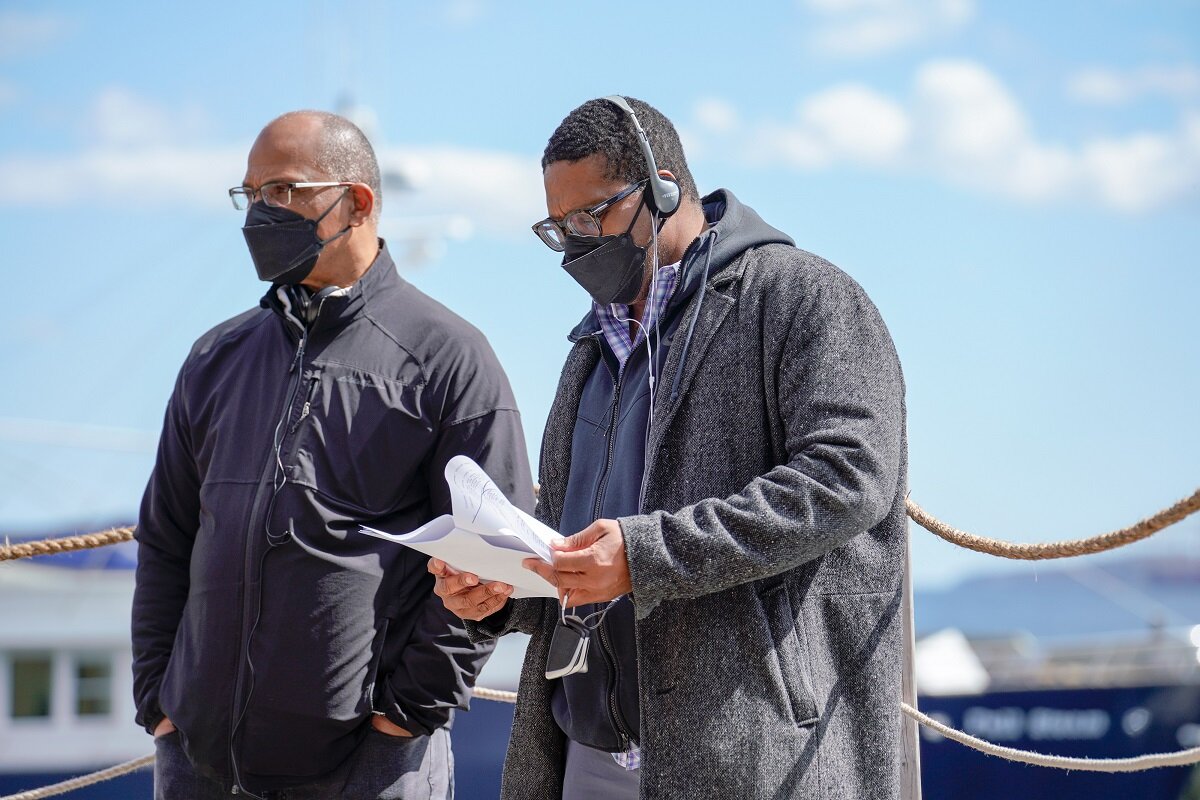
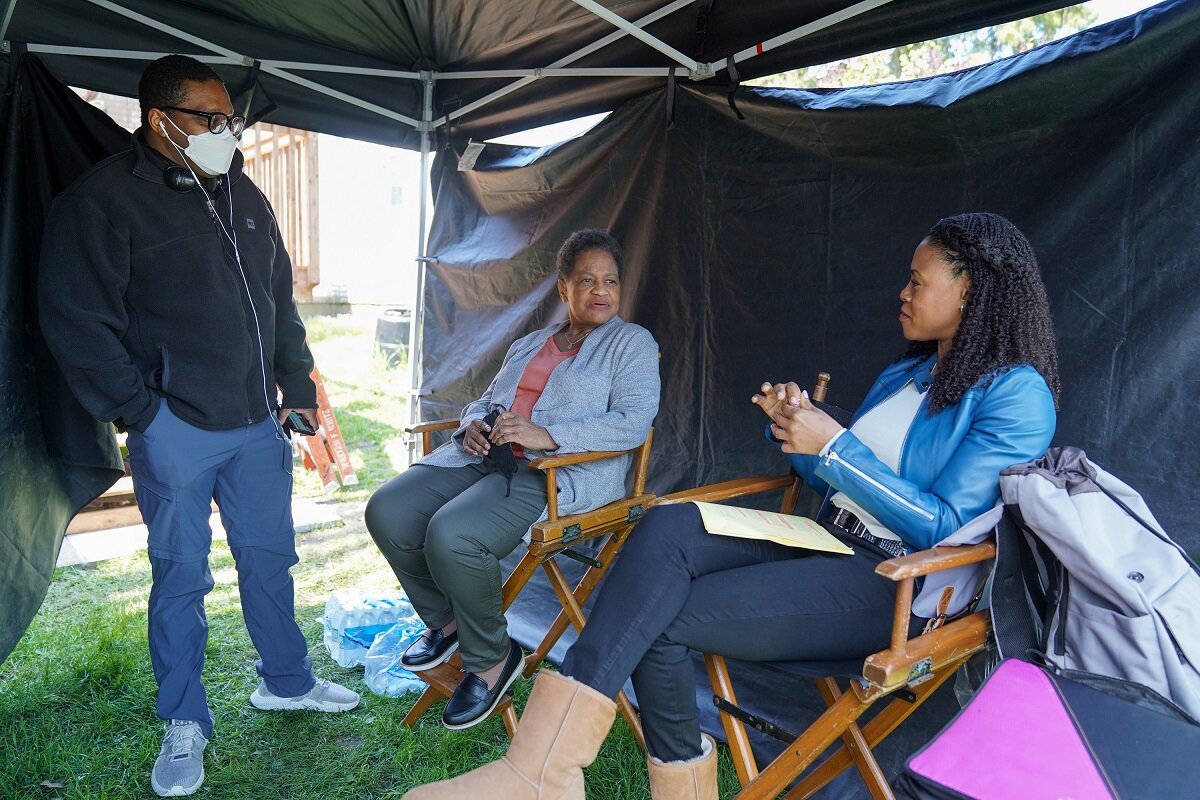
Floyd Kane BA'92, on the set of the show he created, DIggstown.

Floyd Kane BA'92, on the set of the show he created, DIggstown.

Saint Mary's University is launching an innovative new scholarship to support aspiring writers of African descent upon graduation.  

"I know the challenges and barriers that face aspiring writers of African Nova Scotian descent because that’s my lived experience," says Floyd Kane BA'92, the person behind this generous philanthropic gift. "This award is named in honour of my mother and aunt—two women who supported my dreams from the beginning.  I am proud to have the opportunity to pass along that support to the next generation of African Nova Scotian writers via an award that bears their name." 

The Edna and Velma Thomas Kane Writers Award has three main goals. To mitigate the burden of financial debt and insecurity for undergraduate students of African Nova Scotian descent in the Faculty of Arts. To support them in pursuing further post-secondary studies or training such as internships, apprenticeships, self-directed projects. And lastly, to advance their aspirations for careers in writing. The award recipient will receive $30,000 in support of these goals.

"Saint Mary's recognizes the importance of diverse voices and perspectives in all fields of research and study, including the creative arts and industries," says Saint Mary's University President Dr. Robert Summerby-Murray. "Writing and storytelling are essential tools for sharing our province's unique histories and experiences. This award will help us support African Nova Scotian students by reducing financial barriers as they embark on their next steps toward careers in writing. We are committed to creating possibilities for our students at Saint Mary's, celebrating their creative talents, and working together toward a World without limits."   

A member of the Saint Mary's University Board of Governors, Kane is a successful writer, filmmaker and television producer with numerous projects shot internationally – and in Nova Scotia, such as the feature film Across the Line (2014) and current hit TV series Diggstown, airing nationally on CBC-TV and soon in the U.S. on the FOX network. Kane grew up in East Preston and currently resides in Toronto. He was inspired to establish the award as a result of seeing talented fellow African Nova Scotian writers face challenges in pursuing careers in the arts and culture sectors due to barriers such as limited access to financial support.

The Edna and Velma Thomas Kane Writers Award is available for applications this academic year. For details and the online award application form, see Faculty of Arts Awards and Funding.