Five tips for faculty and staff to support wellness 

As we prepare for the fall 2023 academic term, we are mindful that changes in routines, increased noise and traffic throughout campus and a busier season can often mean challenging impacts to health and wellness.

To support faculty and staff through this transition, The Counselling Centre has developed five tips for looking after yourself this fall.  

  1. Sleep 

A consistent sleep schedule will help you regulate your energy and emotions throughout the day. Keep up with your bedtime routines as much as possible, avoid caffeine and screens before bed and try to relax for a while before you turn out the lights. 

2. Healthy boundaries 

In the first few weeks of the term, you may be balancing many competing priorities (including those unplanned tasks that seem to pop up at the worst moments!). It’s important to be realistic with yourself about what you can accomplish, what you might need help with and what you simply can’t do. Set boundaries where you can and be compassionate with yourself and others. 

 3. Self-care 

We all have different activities we do regularly that help us feel good, whether that’s getting out for a walk, journalling, painting, reading, going to the gym, meditating and more! During stressful times, it’s easy to let those activities slide and a couple of missed days can quickly turn into a couple weeks or more. Try to prioritize self-care activities where possible to help mitigate burnout and reduce stress. 

 4. Take care of your basic needs

Eat foods that make you feel good and provide you with energy. Move your body regularly to help regulate your mood. And remember to stay hydrated! If you need help figuring out nutrition that works for your needs, remember that BlueCross coverage includes dietician services. 

 5. Stress management strategies 

This is the time of year to practice those stress management strategies we hear about: break big tasks into small, manageable tasks; try to slow down situations if they become too intense; talk about what’s bothering you even if it won’t solve it. Remember, stress impacts all aspects of your well-being, including your emotions, your physical health and your behaviour. If you’re experiencing a particularly challenging moment, consider a grounding exercise like the 5, 4, 3, 2, 1 method or try a breathwork practice like box breathing. These strategies will help to slow your breathing, calm your mind and improve your focus.  

Want to take a deeper dive into supporting health and wellness? The Counselling Centre’s Mental Health Series will be returning in September. This four-part workshop series explores topics including how to identify and support a student in distress, coping strategies for anxiety and depression, how to talk about suicide with students, and international student mental health. Contact Counselling@smu.ca to be notified when the fall dates are finalized. 

For health and wellness tips, information, upcoming events and more, be sure to check out The Counselling Centre and sign up for the bi-weekly Healthy Minds Newsletter! Contact Counselling@smu.ca to be added to the email list. 

SMU hosts Provincial Sexual Violence and Harassment Investigation Training 

The group of newly-trained Sexual Violence, Harassment, Discrimination, and Bullying Investigator's include representatives from each of Nova's Scotia's ten universities and the Nova Scotia Community College.

As part of the work of the Nova Scotia Provincial Sexual Violence Prevention Committee (NSPSVPC) and the Council of Nova Scotia University Presidents (CONSUP), Saint Mary’s was proud to host the Internal Investigator’s Sexual Violence and Harassment training last month.  

The training is part of a multi-pronged approach to improving sexual violence and harassment prevention, response, and policy at Nova Scotia post-secondary institutions, as outlined in key documents that emerged through the work of the Nova Scotia Sexual Violence Strategy.

Representatives from each of the ten universities and Nova Scotia Community College attended the training, including Saint Mary’s Sexual Violence Advisor, the Director, Student Accessibility, Wellness and Success, the Human Resources Officer (OHS & Wellness) and the University Secretary and General Counsel, to learn how to facilitate fair and thorough investigations using reliable and respectful techniques in cases of sexual violence, harassment, discrimination and bullying. 

“Both the Changing the Culture of Acceptance: Recommendations to Address Sexual Violence of University Campuses report and the Development of Survivor-Centric Sexual Violence Policies and Responses report have shaped much of the work to prevent and respond to sexual violence on Nova Scotian campuses,” says Tom Brophy, Associate Vice-President, Student Affairs and Services. “The associated efforts to implement the recommendations and guidelines addressed within the reports have provided a strong foundation for improving institutional responses to sexual and gender-based violence within Nova Scotia.” 

Facilitated by Hill Advisory Services, the five-day intensive training included theory-based education and experiential learning related to conducting investigations, taking statements, preparing interviews and writing final reports. 

Lynn Cashen Basso, Director of Student Accessibility, Wellness, and Success (left) and Dee Dooley, Sexual Violence Advisor representing the Nova Scotia Provincial Sexual Violence Prevention Committee at the Investigator's Training, hosted at Saint Mary's University in July 2023.

SMU’s Sexual Violence Advisor, Dee Dooley, coordinated the training on behalf of the NSPSVPC. “It was wonderful to see this training come together,” says Dooley. “The training is based on the vision of a dedicated group of survivors, front-line staff, senior administrators, faculty and students who have been advocating for improved sexual and gender-based violence response on Nova Scotian campuses. A key component of this vision is ensuring institutions incorporate a transparent policy response and investigation process into post-secondary strategies,” elaborates Dooley. “This training is a crucial step in moving that forward.” 

The newly-trained investigators will participate in a Community of Practice group, coordinated by Dooley, where they will engage in continued training, networking and knowledge-sharing to support consistency in responses, which are rooted in best practices. 

For more information on related resources and initiatives at Saint Mary’s, visit the SMU Sexual Violence Support Centre

Assistive technologies available to the SMU community

July is Disability Pride Month, and, although it is not yet recognized by the Government of Canada, Saint Mary’s is pleased to take the opportunity to recognize and celebrate those within the SMU community who experience disability.  

In recognizing the societal and institutional barriers that many face, the Fred Smithers Centre for Student Accessibility (FSC) has created a round-up of assistive technologies available campus-wide or directly through the FSC. These technologies can help reduce many barriers faced by those who experience cognitive disabilities, physical disabilities impacting certain mobility, and more. 

Notetaking is a vital part of academic and professional success. It allows people to retain and review information from lectures, discussions, meetings and more. The FSC has procured a number of assistive technologies to support those, particularly students, who may experience barriers in notetaking. 

Glean 

Glean is a web-based app designed to help students achieve their academic and personal goals through supported notetaking. The technology allows users to record lecture audio, import slides, add brief notes and highlight key points with simple clicks. It also creates a visual and interactive outline of notes to support reviewing content. 

Glean is designed to be simple, accessible and cognitive-friendly. It has a distraction-free interface that focuses on the content rather than the tool. It also has a transcription feature that converts audio recordings to text. Glean is currently available as a pilot program to students who have an academic accommodation to do with Notetaking Support. 

 Google Read and Write 

The FSC has also purchased a campus-wide license of Google Read and Write (R&W), which is a Chrome extension that provides assistive technology tools to support reading, writing and studying.  

 Some of the R&W features include: 

  • Text-to-speech to hear words, passages or whole documents read aloud with dual color highlighting. 

  • Speech-to-text to dictate words and create documents with the user’s voice. 

  • Word prediction to suggest the current or next word as the user types. 

  • Text and picture dictionaries to see the meaning of words explained with text or images. 

  • Highlighters to collect and organize information from web pages or documents. 

  • MP3 maker to convert text into audio files for listening on the go. 

  • Spelling and grammar check to correct errors and improve writing quality. 

  • Simplify and summarize to reduce the complexity and length of web pages or documents. 

Google Read and Write is available for Windows, Mac and Chrome OS devices. It can be used with Google Docs, PDFs, ePubs and other common file types in Google Drive. It is also compatible with screen readers. This extension is available for the entire Saint Mary’s community. Visit The Studio for Teaching and Learning to learn more about and access the extension download.  

Dragon 

Dragon is a speech recognition software that allows users to control their computer, create documents, send emails and search the web by using their voice. It is a form of assistive technology that can benefit people with physical disabilities, learning difficulties or repetitive stress injuries that make typing difficult or impossible. 

Some of the features of Dragon include: 

  • Fast and accurate transcription of up to 160 words per minute 

  • Customization and personalization of vocabulary, commands, and preferences 

  • Compatibility with popular applications, such as Microsoft Office, Google Chrome, and screen readers 

 The Dragon software is available on most of the computers in the FSC’s test and exam area and is available as an academic accommodation for students.  

 Kurzweil 3000 

Kurzweil is a company that provides assistive technology products and resources for students with learning disabilities, such as dyslexia or visual impairment. They also have supports for English language learners. The FSC has the Kurzweil 3000 software installed on all the exam and test computers, which offers features such as text-to-speech, word prediction and spell check. Kurzweil 3000 is currently available to students as an academic accommodation.   

Saint Mary’s is pleased to offer a number of resources and supports to students, faculty and staff to support various disabilities and reduce barriers, as well as resources for faculty and staff on how to implement accessibility best practices into their work.

For student-related accommodations and supports, visit the Fred Smithers Centre for Student Accessibility or, for those students already registered with the FSC, contact your Accessibility Advisor. For staff and faculty resources related to improving accessibility at Saint Mary’s, visit The Studio for Teaching and Learning

Touchdown Atlantic: what to expect on campus

Touchdown Atlantic will bring the CFL’s Toronto Argonauts and Saskatchewan Roughriders to Huskies Stadium on Saturday, July 29! This exciting event is expected to draw more than 10,000 people to campus to enjoy the game and pre-game festivities, and viewers across the nation will tune in for the televised game.

The Saint Mary’s organizing team has been working diligently with the CFL and other partners to ensure a safe, enjoyable and smooth-run event.

Here’s what to expect on campus on July 28 and 29:

Friday, July 28

  • Media load-in/out: Two TSN semi-trucks will park in the Homburg Lot at approximately 10 a.m. on Friday, July 28. They will travel via Gorsebrook Avenue into the Rice Lot and through to the Homburg Lot. The vehicles will leave by the same route on Sunday, July 30.

  • A Youth Football Clinic will run from noon–2 p.m. at Huskies Stadium.

Saturday, July 29

  • Pre-game entertainment and food trucks from 1:30–4:30 p.m.

  • A flyover from a Canadian Armed Forces plane is planned for approximately 5:02–5:06 p.m. 

  • The game will run from 5–8:30 p.m. Any delays (e.g. due to weather) could extend this running time.  

Touchdown Atlantic event map. Click image to open online.

Security presence

  • There will be security overseeing access to campus for the event, with security and police personnel at various entry points. Please refer to the event map to see which parts of campus will be closed off for the event (Gates 1-4).

  • If you need to come to campus on Saturday, July 29, please complete this form so the organizing team can assist if needed.  

Access to stadium grounds

  • Accreditation will be required on Friday, July 28 and Saturday, July 29 to access the fenced-in stadium grounds.

  • Access to the stadium grounds for all, including volunteers, accredited pass holders and ticket holders, will be restricted to the four designated gates as indicated on the event map.

  • Anyone entering the stadium grounds is subject to security screening before entering the designated gates (e.g. metal detector wand and bag check).

  • If you are not a ticket holder and require access to the fenced area, you will need a Touchdown Atlantic credential. Please reach out to your department lead to inquire or email greg.knight@smu.ca.  

SMUfit facilities

  • SMUfit facilities will be closed to the public from Friday, July 28 until Sunday, July 30. Re-opening on Monday, July 31 at 6 a.m.

Parking  

  • Campus parking lots will be closed on Friday, July 28 at 9 p.m. and re-open Sunday, July 30 at 9 a.m.

  • Permit holders for the underground parking lot are to be advised that access to this lot will be very challenging between noon and 10 p.m. on Saturday, July 29, due to pedestrian traffic.

  • Rice Residence parking lot will be open for residence permit holders and conference overnight accommodations guests only. 

  • Vehicles parked on campus without a CFL event pass may be towed.  

 Public/guest Wi-Fi

  • SMU-Guest Wi-Fi will be deactivated on Saturday, July 29 and will be re-enabled on Sunday, July 30.

 Increased activity and noise

  • Traffic in and around campus will be very heavy, and there will be increased noise and activity.

Increased light levels

  • Due to broadcast/set-up requirements, lighting levels on the football field will be brighter (Level 2 – varsity game lights) and on until 12:05 a.m. on July 29 and 30.  

If you have any questions about the event and the above details, please contact Greg Knight (greg.knight@smu.ca) or Janelle McNulty (janelle.mcnulty@smu.ca) for assistance.
 
For more details about Touchdown Atlantic (e.g. additional game-day transit service information), please visit www.cfl.ca/tda23.

Volunteer opportunities are still available for game day, if interested, please register here.

Sobey School recognized again for positive impact on Nova Scotia and the Atlantic Region

The Sobey School of Business, the largest business school in Atlantic Canada and one of the top business schools in Canada, has received the Business School Impact System (BSIS) designation for a second time in recognition of its intellectual and social impact on Nova Scotia and beyond. 

 “We were advised today that we have again received the BSIS designation confirming that the Sobey School’s impact reaches far beyond its economic contribution and also influences the business and cultural life of the Atlantic Region,” says Saint Mary’s University President, Dr. Rob Summerby-Murray.

“Saint Mary’s University is known for our research that addresses real-world problems and for our strong partnerships with local businesses and communities. The BSIS designation demonstrates the role of the Sobey School in fulfilling these key strategic priorities for the University.” 

In 2016, the Sobey School was the first business school in North America to be awarded the BSIS label for its economic impact, and now is the only one to receive a second affirmation, this time for its intellectual and societal impact.  An international review team using a methodology developed by the European Foundation for Management Development (EFMD), the leading international network in the field of management education, re-examined the business school over a three-year period (2020-2022).  

Sobey School professor Ather Akbari with students on the Halifax waterfront

“This BSIS reassessment has seen SSB confirm its position as a strong and highly visible business school, firmly embedded in the business and cultural life of the region. The impact demonstrated on the impact zone since the first BSIS  assessment in 2016 is compelling in terms of scope and ambition. The commitment of the leadership team, faculty and staff has ensured that the school continues to make significant impact gains across the intellectual and societal impact dimensions.”  BSIS Final Report, July 2023 

The BSIS external review is a comprehensive and multi-dimensional assessment process that evaluated a business school's impact on its region. Reviewers examined the Sobey School faculty’s scholarly publications and a pre-visit report and then conducted a campus visit in March 2023. In their Impact Report, reviewers noted key accomplishments related to intellectual impact.

  • An impressive 94% of faculty are active researchers; 70 Sobey School faculty members have produced 223 journal papers in 173 different journals. 

  • Research topics are based on regional problems with a national or global relevance.  

  • Conferences profile the intellectual impact of the School with significant number of conference papers and presentations and two large academic conferences hosted on campus.  

  • Local managers are enthusiastic about the professional development benefits they gain from collaboration with the Sobey School. 

  • The School has demonstrable strength in developing and sustaining research partnerships with regional companies and organisations (32 over the past 3 years).  

The BSIS review team also noted that the School has a growing reputation for its societal impact through research and teaching as well as its own Corporate Social Responsibility (CSR) and sustainability initiatives. Evidence of the School’s commitment to CSR includes: 

  • 92% of business students receive instruction in CSR and sustainable development and have the opportunity to work with businesses. 

  • The Sobey School is one of the Principles of Responsible Management Education (PRME) signatories since 2014 and PRME champions since 2020. 

  • CSR and sustainability are attractive to actual and potential students.  

  • There is wide evidence of activity mapping against the UN’s Sustainable Development Goals (SDGs) (teaching, research and engagement activities).  

  • Societal research is growing in impact and visibility with 48 professors focused on societal research through four research groups.  

  • Service learning is a clear differentiator for the school and its students. 

  • Saint Mary’s University reduced carbon emissions by an impressive 40% in 2022 and is installing one of North America’s tallest solar arrays on its path to green energy production. 

Infographic outlining statistics which are repeated on the web page

“It is gratifying to receive external validation that our commitment to social responsibility and sustainability is a distinguishing hallmark for the Sobey School. We know that this differentiator attracts students, and helps faculty and students stay connected, says Acting Dean, Mark Raymond. “Service learning is now embedded in our renewed BComm Program – it’s another example of the School’s impact on business and society.” 

In 2016, a BSIS review found that the Sobey School had a financial and economic impact of $329 million on the Province of Nova Scotia. 


 About BSIS 

The Business School Impact System (BSIS) scheme is designed to determine the extent of a school’s impact on its local environment – the city or region in which it is located. The BSIS process is offered in collaboration between EFMD Global and FNEGE (Fondation Nationale pour l’Enseignement en Gestion des Entreprises), as a service to EFMD members in any part of the world. The impact of the business school is analysed based on the following seven areas of impact: financial, educational, business development impact as well as intellectual, societal, image, and impact within the impact zone selected by the school and its regional ecosystem. 

There are currently 63 schools across 19 countries that have received the BSIS label. 

Crunching the numbers: student-led project uses open data to improve the lives of Nova Scotians

Matthew and Tasneem sit at a picnic table while Rahul stands behind them, they all look at a laptop screen. They are seated on the waterfront.

Sobey School of Business Professor Dr. Matthew Boland and Master of Business Analytics students Tasneem Quazi and Rahul Kashyap.

Earlier this year, professor Matthew Boland and a team of graduate research assistants at Saint Mary’s University embarked on a new data analytics project. 

Armed with open data from the Nova Scotia government, the team had a simple but shared goal—to use that data to better the lives of Nova Scotians.

Matthew Boland sits on a blue chair in the lobby of the Sobey School building. He has cropped dark hair and wears a striped button up shirt.

“It's really important to try to make some local impact” - Matthew Boland.

Boland is an accounting professor at the Sobey School of Business at Saint Mary's University. He created the project for his students in the Master of Business Analytics program to show the local importance of data analytics. 

“It's really important to try to make some local impact,” says Boland. “That's what this project was about for me and our students.” 

The inspiration for the project struck last year when Boland stumbled across the Nova Scotia Open Data Portal. This website was launched in 2016 to make government data more accessible to the public. It includes information on everything from crime statistics to Crown land in the province.

The website presented an opportunity for Boland, who specializes in advanced data analytics. Although the Open Data Portal is available for free to everyone, he knew most people wouldn’t have the time or resources needed to make sense of the data. 

He decided to bring the website to his students.

“I asked them to start looking through the data…and think about a research question that this data could answer that would be of interest to Nova Scotians,” says Boland, who is from Berwick in the Annapolis Valley. 

Boland invited the students to use that data to study topics of their choosing, so long as they related to the province. He also asked students to combine their data with other available data sets to find new insights into these topics. 

The resulting studies covered a range of issues. One used data on fishing and aquaculture to predict the migratory patterns of invasive fish species in the province. Another looked at the relationship between air pollution and rates of asthma in Nova Scotia counties. 

Boland says he hopes these studies will help lawmakers and regulators find new ways to safeguard health and well-being in the province—from protecting native fish to keeping the air clean.

The students plan to make their findings and methodologies available for free to the public. Those interested will be able to use the code the students created to analyze the data, allowing them to replicate the study. 

Boland’s project is happening amidst a larger push toward better data analytics solutions in the province. In March, the Nova Scotia government announced it would spend $25 million to expand healthcare data analytics and management programs at Saint Mary's.

Moving forward, Boland’s project will be formalized as a class offered to graduate students. He hopes it will inspire others to pursue their own research, using data analytics to better the world around them.

“If some of this someday could help inform regulation or just be one small piece to a larger puzzle that helps…I think that would be pretty awesome,” says Boland. 

Building confidence in chemistry: Dr. Mary Sheppard’s research supports how students learn in her lab

Dr. Mary Sheppard wins the Father William A. Stewart Medal for Excellence in Teaching. Her PhD research focused on how students learn chemistry.

L-R: Alumni Association member Fiona King BComm’93, SMU President Dr. Robert Summerby-Murray, and Dr. Mary Sheppard at Spring Convocation.

First-year chemistry classes introduce students to an exciting field of science—with new terminology and research methods, and the opportunity to study in a university laboratory setting for the first time.

Arriving at Saint Mary’s from Halifax or homes around the world, students’ first university classes can be an exciting, eye-opening experience—and a big adjustment.

Luckily, these new students at Saint Mary’s have an award-winning professor who understands the challenges they face. As a first-generation university graduate from Taylor’s Bay, Newfoundland and Labrador, Dr. Mary Sheppard still remembers leaving her small community for Memorial University.

“Leaving my family behind and going to the ‘big city’ of St. John’s was huge for me, and I understand what our rural students, and those from close-knit communities, are missing,” said Dr. Sheppard.

Finding the right path in her academic career meant being flexible and open to new paths.

“At first I wanted to be a pharmacist,” explained Dr. Sheppard. “When I was growing up in rural Newfoundland there was no access to career counseling. If you got good grades you were told you should be a pharmacist, nurse or doctor…I didn’t want to be a nurse or doctor—too much blood.”

It was her first-year chemistry professor who suggested that pharmacy might not be the best fit for her, and offered a chance to do a summer project that led to more than two decades studying and teaching chemistry.

“Growing up, I didn’t even know that a career in chemistry was a possibility,” said Dr. Sheppard. “I tell my students to keep an open mind. You don’t have to stick with what you first thought you wanted to be—I wouldn’t have been happy as a pharmacist.” 

Along with teaching first-year classes as a senior lecturer, for the past five years, Dr. Sheppard was also a student, pursuing a PhD at the University of New Hampshire.

Dr. Mary Sheppard

Dr. Sheppard’s PhD research has made her uniquely qualified for her role teaching at the university level. Her interest in how students learn led her to pursue the topic of chemistry education research for her doctoral degree. She explains that during the first few weeks of classes, she intentionally slows the pace to let students adjust to the environment.

“For some students, the lab can be very daunting because they didn't have a lab in high school—coming from a big city high school is not the same as any rural area in the world,” she says. “As part of our student success program, their first experience in that room isn’t an experiment—they go into the space as part of a scavenger hunt around campus…it helps them get oriented first.”

Once the term is underway, students will look forward to performing guided inquiry experiments along with a more traditional curriculum of procedural experiments. Guided inquiry prepares students for real-world work by challenging them to design an experiment to tackle a problem, tweaking it in the lab and submitting their group’s finalized experiment.

“Learning how to approach a problem teaches creative thinking— if the procedures don’t all work out perfectly, they learn more from that,” she says.

In her PhD research, Dr. Sheppard looked at how students learn about pH buffers, a chemistry topic that many find difficult to grasp. “I was trying to figure out why is this so tough for students—what are the roadblocks,” she explained. First, she interviewed students at the University of New Hampshire using a “think out loud” approach, recording them as they worked through problems. A qualitative analysis followed, allowing her to design teaching strategies that matched students’ successes and challenges.

“It was interesting to see that while the American students might have different backgrounds, they have the same or similar challenges that our students have.”

Her last goal for her PhD was to design a teaching strategy that addresses those challenges, setting students up for success. After many years of teaching, the instinct to help students is strong.

“You have to separate yourself from the student, you can’t help them because you want to see what they’re thinking and what the issues are,” she explained. “I think I ground the enamel off my teeth because I kept wanting to jump in and help.”

This research is beneficial to students in the classroom and lab and may lead to changes in how the topic is introduced in textbooks.

“Textbooks come from an expert point of view, but if you’re not an expert yet, that approach can be frustrating,” she explained. “One of the tenets of teaching pedagogy is that it’s not about knowing the topic, it’s about knowing how to teach it.”

Dr. Sheppard explained that like most PhD topics, hers was very narrow in focus. But she says it also exposed her to literature and people at conferences who are talking about different ways to teach.

“Understanding better how students learn at a higher level, it’s easier to transfer that knowledge to other areas of chemistry,” explained Dr. Sheppard.

Dr. Sheppard’s history of successful teaching and her drive to continuously build on that success have been recognized. This spring she won the Father William A. Stewart. S.J. Medal for Excellence in Teaching, the top teaching award at Saint Mary’s. The award is determined by nominations from alumni, students and colleagues and is awarded to a professor who has made significant contributions to the education of Saint Mary's students through excellence in teaching and service.

Father Stewart was known for his strong beliefs in promoting accessible education to marginalized communities and was also very much involved in promoting teaching innovation and excellence on campus. The award honours this legacy.

After receiving the award at the May convocation ceremony, Dr. Sheppard travelled to the U.S. where she received her PhD at the University of New Hampshire.

Congratulations Dr. Sheppard!

Embracing the power of writing with new Kane Award

Trayvone Clayton BA’23 is well versed in the power and impact of words as a young leader in his Halifax community of Uniacke Square. During his time as a student at Saint Mary’s University, he also discovered the power of writing as tool for healing, self-reflection and mental health. So it means the world to him to be the first recipient of the university’s new Edna and Velma Thomas Kane Writers Award. 

“Writing keeps me balanced,” says Clayton, who carries a notebook around much of the time. “Just writing down daily thoughts and ideas, things that have been on my mind all day. It takes so much pressure off and gets the negative thoughts out of your head. If you ever want to look back, it’s all right there in the book.” 

He got a rousing standing ovation upon receiving the inaugural Kane Writers Award during the spring graduation ceremony for the Faculty of Arts. Valued at $30,000, it’s one of the most substantial student awards in the university’s history. Launched in the fall of 2021, it was created through the generosity of donor Floyd Kane BA’92, a writer, filmmaker, lawyer and TV producer from East Preston. 
 

Stephanie Johnson BComm’93 and Edna Kane

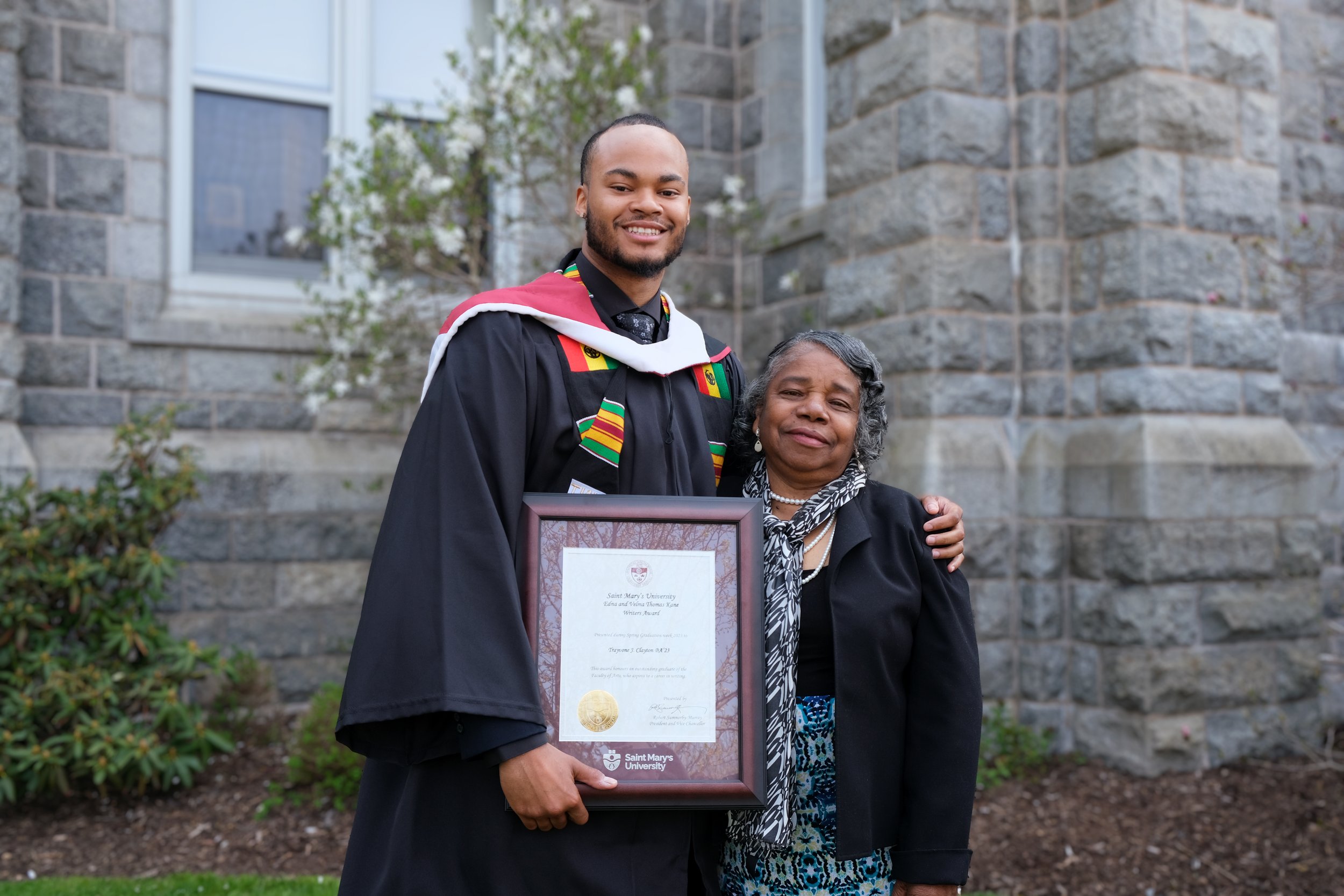
Kane’s mother Edna and his cousin Stephanie Johnson BComm’93 (daughter of his late aunt Velma) were on campus to take part in the May 19 award presentation. Kane was away but watched the graduation live stream

“I’m really proud of my son Floyd,” Edna Kane said after the ceremony. “He went through a lot but he’s a super guy, that’s all I can say. He’s a super son.”  

Johnson, a self-described “Husky for life,” added that her cousin is best known for his creative work but his spirit of philanthropy is just as strong. “To be able to give someone in the community this type of opportunity that will help them live their life and pursue their dream, it’s brilliant. So I’m proud to be part of it. It’s a legacy for my mom and my auntie here, and we’re just really proud of Floyd,” she said. 

Trayvone Clayton is the first recipient of the Edna and Velma Thomas Kane Writers Award

Clayton hopes to go on to law school for his next chapter, the same path Kane took after Saint Mary’s. A former SMU Huskies basketball player, Clayton majored in Criminology with a minor in Social Justice and Community Studies, themes that reverberate throughout Kane’s hit TV series, Diggstown. Shot largely in Nova Scotia, the legal drama wrapped last year after four seasons. Since then, Kane has been hard at work developing another legal show, shooting two movies and filming a documentary about Black music in Canada.  

The two men had a chance to meet each other for the first time on June 2. In many ways, Clayton is the type of student Kane had in mind with his gift to the university, which aims to remove financial barriers to education for African Nova Scotian students.  

“I identified with a lot of his story,” Kane said after their lunch meeting on campus. “Although I grew up in the country and he grew up in the city, we both grew up with relatively modest economic means. We both grew up in African Nova Scotian communities where there wouldn’t be a lot of Black men going to university and pursuing post-secondary education, mainly because of economic circumstances.” 

Working several jobs to pay his tuition while he was a full-time student, athlete and volunteer, Clayton faced other big hurdles along the way, including learning to live with epilepsy. He was devastated by the 2019 shooting death of his younger cousin Triston Reece, who was also a promising athlete. Processing his grief from that loss prompted Clayton to start carrying the notebook around. 

Said Kane: “We talked about loss, the commonalities of experiencing significant losses early in life. I kind of always reverted to fiction. When I try to write something personal, I have a hard time doing anything autobiographical. But telling a story, that’s way easier for me. Writing got me through some tough times.” 

Another life-changing experience in 2019 cemented Clayton’s commitment to social change and the movement against anti-Black racism and discrimination. He was in Ottawa attending the National Black Canadians Summit, and his group encountered racial profiling by an employee in the Parliament buildings. That’s when he started speaking out; the incident made national headlines and led to a meeting with Prime Minister Justin Trudeau.  

“I guess I always had it in me about doing the right things, and it took off from there,” Clayton says. “With GameChangers902, we’ve built a platform and we’re trying to create opportunities for youth. My whole purpose in wanting to go to law school is to lead by example. I want to build a legacy for other young people. When they see I can do it, they’ll realize they can do it too.”

Clayton in his community of Uniacke Square

Clayton feels a responsibility to be a good role model, coach and mentor. Last December, he helped organize a community Christmas for African Nova Scotian youth, which raised more than $20,000 so that each youngster at the event received a $500 gift card. “It just made me feel like you can do anything you really put your mind to,” he says.  

His community work has seen him honoured with other awards, including the 2019 Peace Medal from the YMCA of Greater Halifax/Dartmouth, and two 2019 Nova Scotia Human Rights Awards. The advocacy work gave Clayton the confidence to work hard at his academic studies, “to show people in my community that we belong here, that we do have something to say and that our voice matters.”  

Read more in our Q&A with Trayvone Clayton.


Edna and Velma Thomas Kane Writers Award

Students planning to graduate in 2024 have until November 30 to apply for the Edna and Velma Thomas Kane Writers Award. Kane stressed that the term ‘writer’ can mean everything from poetry or screenwriting to wanting to write a master’s thesis.  
 
“This award keeps ‘writing’ broadly defined because writing is the foundation to so many things,” said Kane. “We’re all writers in some way, it’s a key part of what you do and learn in a Bachelor of Arts degree. I had a great time at law school but Saint Mary’s is where my path was first taken. I had amazing professors who gave me the confidence to embrace the power of writing.”

Dr. Ethan Pancer receives Teaching and Learning Innovation Project grant

Dr. Ethan Pancer stands in front of the Sobey School building. He has light skin, wears a dark suit, has cropped hair and a short beard.

Dr. Ethan Pancer

Congratulations to Dr. Ethan Pancer on being the recipient of this year’s grant for a Teaching and Learning Innovation Project.

As a professor of Marketing in the Sobey School of Business, Dr. Pancer will engage students in service-learning experience about how consumers make decisions when they join programs designed to cultivate positive behaviour changes. As the teacher steering such learning, Dr. Pancer expects to develop a general and transferable teaching strategy for helping students to connect community experience with concepts from entrepreneurship and marketing.

NAIG 2023: What to expect on campus

Saint Mary’s is set to welcome hundreds of young Indigenous athletes as well as their supporters to campus for the 2023 North American Indigenous Games — the largest sport and culture event in Atlantic Canada’s history since contact.

Below are some helpful details about what to expect during this exciting event:

  • Athletes will start arriving on July 14 and will be on campus until the Games finish on July 23. Close to 700 will be staying in Loyola and Vanier Residences.

  • Teams will be arriving from 18 locations:  Minnesota, Alberta, British Columbia, Saskatchewan, Northwest Territories, Ontario, New Brunswick, Nunavut, New Mexico, Manitoba, Eastern Door & the North, PEI, Washington, Wisconsin, Haudenosaunee, Colorado, Yukon & Michigan.

  • The Inglis Street Pay & Display parking lot will be used as a transportation/drop-off zone for buses.

  • We are hosting male and female wrestling and basketball events on campus, and as such there will be limited access to the following areas:

    • Homburg Lobby: Spectators entrance for Basketball

    • Dauphinee Lobby: Spectators entrance for Wrestling

    • Pedway: Access control for staff, volunteers and other internal Games staff

  • In addition to young athletes, fans and supporters, you will see many NAIG volunteers on campus, with a variety of roles including signage, transportation, event and game support, webcasting and more. All NAIG volunteers will be wearing their NAIG accreditation around their necks and their volunteer t-shirts.

  • Hours of operations for Dockside Dining Hall (NAIG only), C-Store, Tim Horton’s will be extended each day between July 15-22. Be sure to check https://smuca.campusdish.com/LocationsAndMenus to see what is open, when!

  • Information tables will be set up in Loyola Colonnade and in the Courtside Lounge at the Homburg Centre. The tables will be staffed by the Recruitment team, who will help guests with questions about campus, Halifax, and of course, the university.

  • The NAIG organizing team is providing Indigenous artwork for display in the Loyola Colonnade.

Help our visitors feel welcome!


Community Food Room full after record-setting contributions

A group of people standing in front of shelves filled with food.

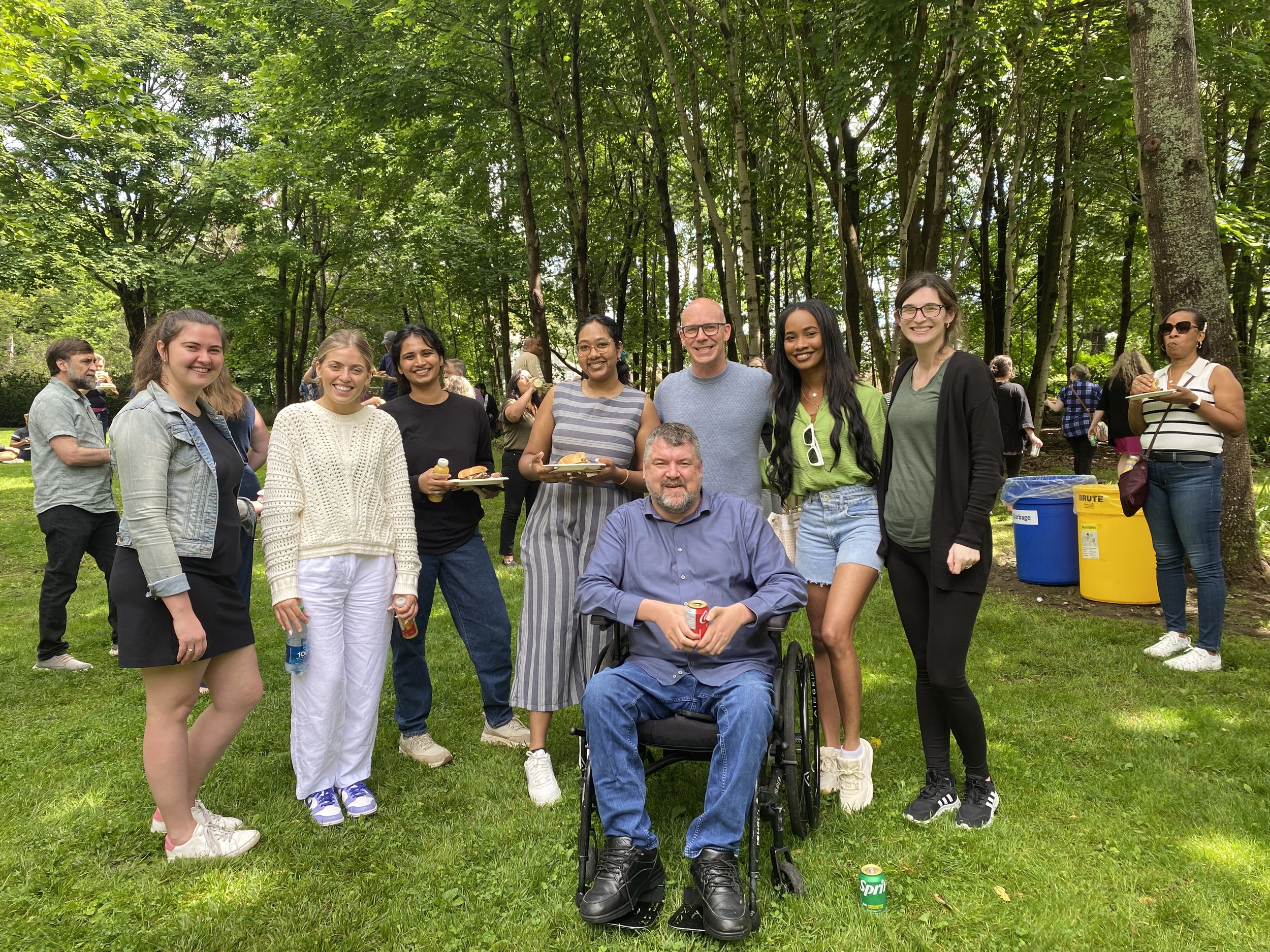
Thanks to the faculty, staff and alumni who participated in the annual Food Drive Competition hosted by the Alumni Office. As a community, we exceeded last year's record and raised more than 2,100 lbs of food and $1,475 in monetary donations—the shelves in the campus Food Room are full! 

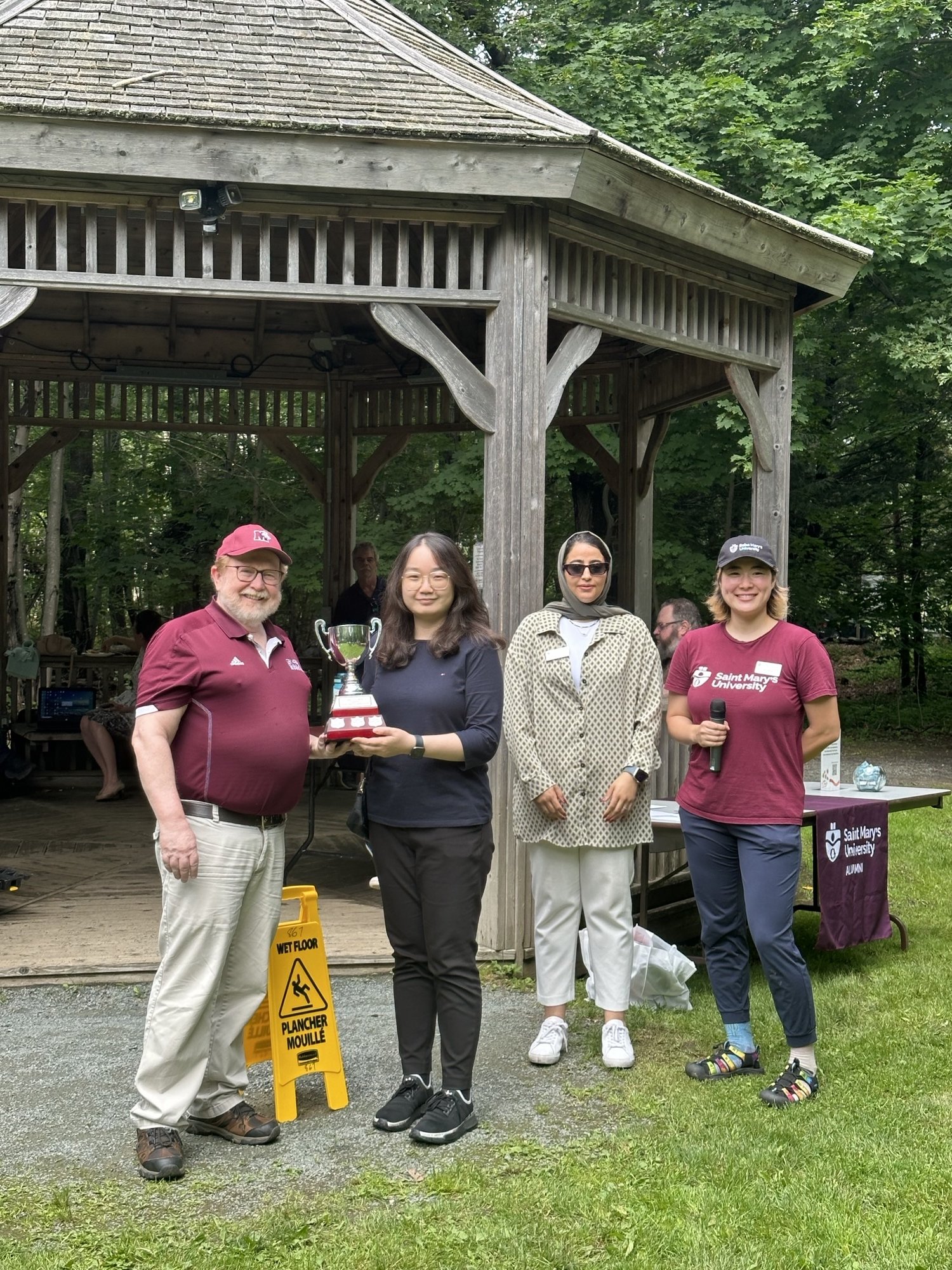
Congratulations to the Sobey School of Business ‘Accounting Matters’ team who won the competition by contributing 455 lbs of food with just eight members! They received a trophy and pizza party. Special shout-out to the Arthur L. Irving Entrepreneurship Centre for the most creative team name—’The IncrEDIBLES’.

Thank you to faculty, staff and alumni who made financial contributions during the competition allowing the Food Room to have some flexibility in making purchases of much-needed items. Members of the SMU community can donate to the Food Room anytime and receive a tax receipt for your donation.  

“I am thankful to every department that enthusiastically participated in the Annual Alumni Food Drive. Each participant’s passion and excitement in supporting this important cause was extremely motivating. I would want to express my heartfelt gratitude to the volunteers from the SMU Community Food Room, whose outstanding assistance was critical to the food drive’s exceptional success. Their commitment to collecting, weighing, and stacking the amazing 2,100 pounds of food was remarkable. Despite the huge workload, the persistent dedication and hard effort paid off magnificently.” 
— Tarim Faress Alsaquaf, the Community Food Room Coordinator

Stats: 

  • 13 teams (141 people including alumni) participated. 

  • Food donations raised: 2,138 lbs 

  • Monetary donation from faculty, staff and alumni: $1,215 

See more photos published in an Alumni Facebook album