Unique Education

Students collaborate with ADDvocacy to strengthen support for neurodivergent communities

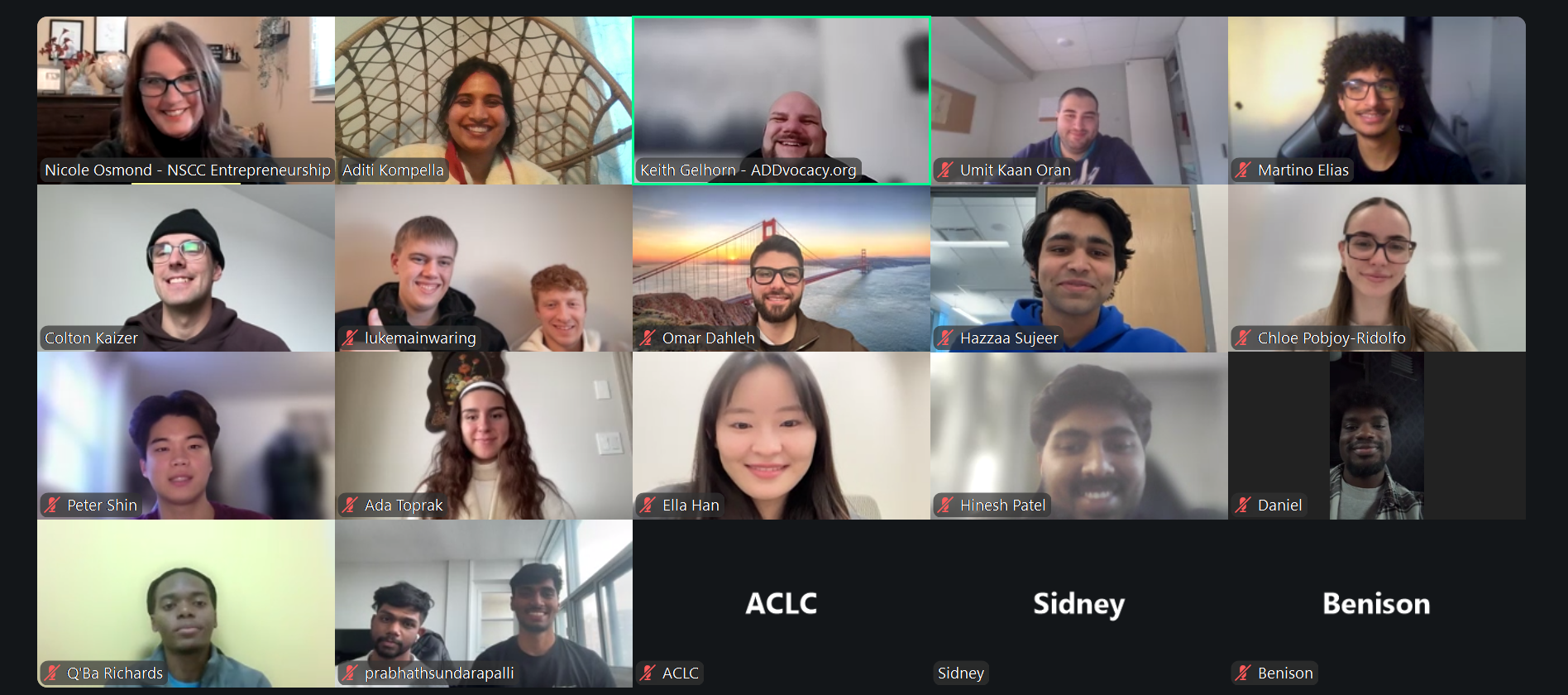
A screenshot of a zoom meeting with 20 participants

Students from universities across Atlantic Canada participated in the online Innovation Sprint

ADDvocacy began with a personal turning point. In 2009, NSCC Truro alum Keith Gelhorn received a series of late diagnoses of ADHD, anxiety, depression, dysgraphia, dyscalculia and challenges with processing and executive functioning. This reshaped how he understood both his past and his future. Just a few years later, in 2012, he founded ADDvocacy to ensure others navigating similar experiences would not have to do so alone.

Keith’s story became the foundation for a recent Innovation Sprint hosted by the Arthur L. Irving Entrepreneurship Centre and NSCC Entrepreneurship. It brought together 19 students from Memorial University, University of Prince Edward Island, Mount Saint Vincent University, Dalhousie University and Saint Mary’s University. Working alongside ADDvocacy, students were challenged to explore practical, forward-thinking ways to strengthen supports for neurodivergent individuals at a time when many services are facing growing demand and tightening resources.

Students approached the opportunity with enthusiasm and a clear sense of purpose. Ideas ranged from forming partnerships with large corporations and leveraging Lifestyle Spending Accounts to reduce financial barriers for young professionals, to integrating AI tools that could streamline administrative work, automate intake and check-ins and improve billing efficiency. Other teams focused on sustainable growth, proposing tiered revenue models, refined marketing strategies, student co-op engagement across campuses and detailed roadmaps outlining achievable goals over the next one, two and three years.

“The Innovation Sprint was an incredible four hours,” said Keith Gelhorn, founder of ADDvocacy. “I gained insights I hadn’t considered in my business and really valued the students’ ideas and perspectives. I’d highly recommend it to any entrepreneur, at any stage; it’s a powerful way to see your business through fresh eyes.”

Top teams were recognized for their contributions. First place and a $1,000 prize went to Saint Mary’s students Hazzaa Sujeer and Chloe Pobjoy-Ridolfo. Second place, earning $700, was awarded to Umit Kaan Oran from Mount Saint Vincent University, Martino Elias from Saint Mary’s University and Erick Batista from Memorial University. Third place and $300 went to Dalhousie students Prabhath Sundarapalli, Hinesh Patel and Benison Amirvin.

While the sprint marked a single moment in time, its impact extends further. For students, it demonstrated how classroom learning can translate into tangible, community-driven outcomes. For ADDvocacy, it offered fresh insight and momentum shaped by the next generation of problem-solvers.

If you’re interested in being part of a future Innovation Sprint, click here.
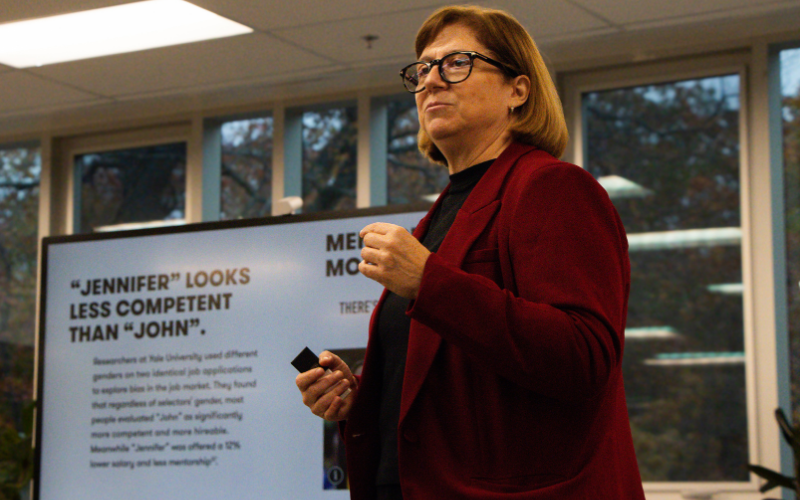
Students tackle solutions for gender inequity in pro sports

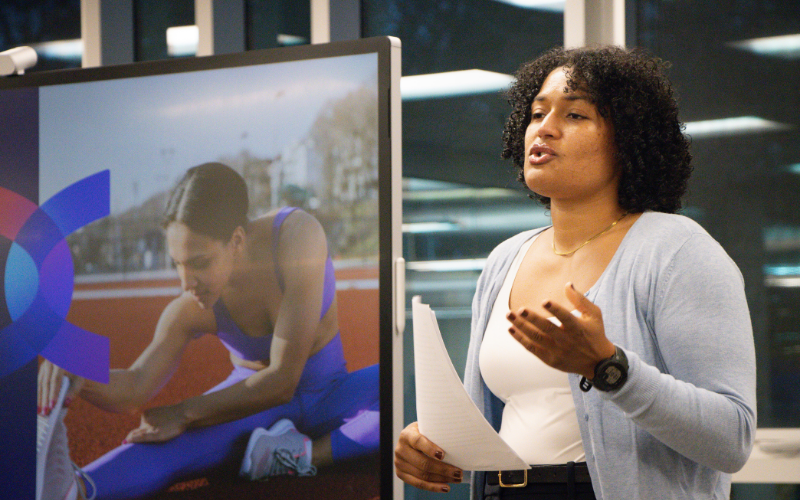
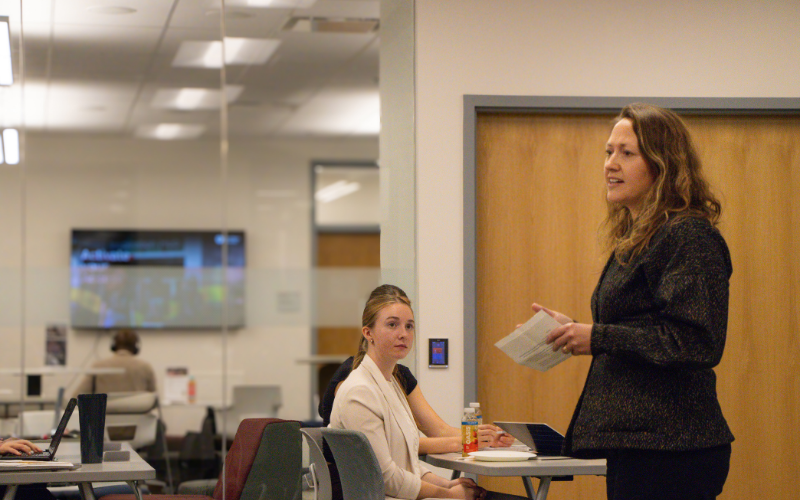
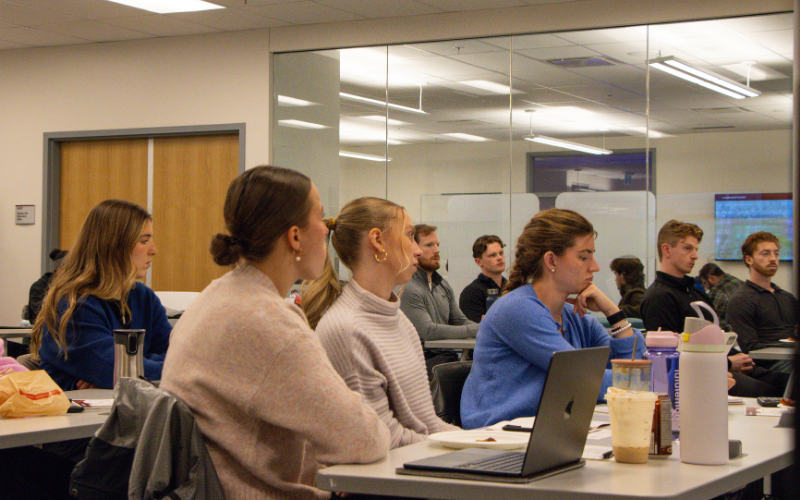
The Scott McCain & Leslie McLean Centre for Sport, Business and Health hosted its inaugural case competition last fall, bringing industry experts together to let student-athletes pave the way for a new generation of professional coaches.  

Systemic barriers for women in coaching positions still exist, and according to a 2023 report by Women’s Sports Foundation, “women in head coaching positions at the collegiate level had fallen from 90% to 41% since the implementation of Title IX [in the United States].”  

This competition was born out of a clear and necessary mission: to give students and student-athletes a dedicated space to tackle ongoing gender disparity in professional and collegiate coaching. This wasn’t just an academic exercise; it was a chance for the next generation of leaders to make a direct, tangible impact on the industry they love. 

The competition 

Dr. Annika Voltan of Saint Mary’s University, Dr. Ann Pegoraro from the University of Guelph and Maura Martina of Canadian Women & Sport briefed students on the case and provided the foundational insights needed to navigate the complex realities of gender inequality in professional coaching.  

This thorough brief ensured that when the competition day arrived, the solutions presented were grounded in real-world knowledge and experience.  

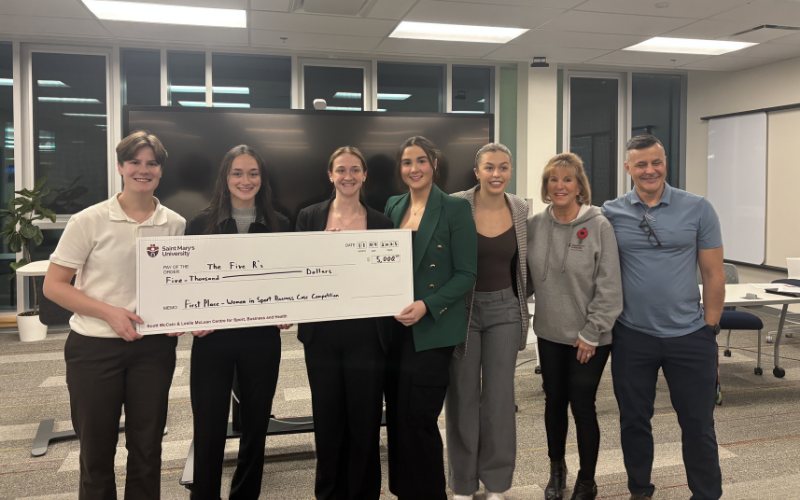
Taking the top spot with their pitch was "The Five R's," composed of Sophie Scully, Jill Duggan, Ashley Penney, Kara MacLean, Keyara Nelson and Leslie McLean.  

“We propose that the AUS help address systemic barriers affecting the underrepresentation of women in coaching and leadership roles by creating an AUS-wide assistant coach apprenticeship that prioritizes the recruitment of varsity women and alumnae seeking to further their education.

In this program, we envision collaborative work between the faculty of graduate studies at AUS schools and their athletic departments to provide cohorts of 10-12 graduating student athletes the opportunity to be mentored as assistant coaches while completing a master’s degree at their respective schools. Our mission aligns directly with the AUS mission: creating extraordinary, personal, and memorable student-athlete experiences – the kind that build belonging.”

We envision a future where young women watching the bench can look at the staff and finally see themselves there too, not by exception but by expectation.
— The Five R's team

Team The Five R’s took first place in the pitch competition

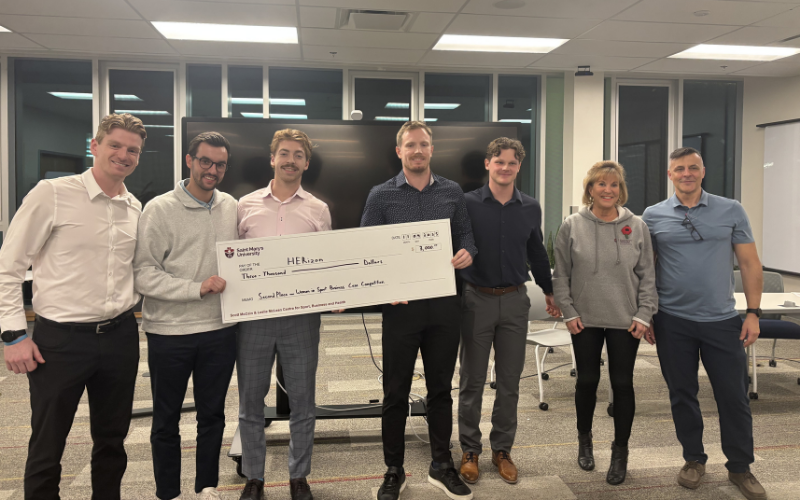
They were followed by "HERizon" in second place, featuring Charlie DaFonseca, Reid Valade, William Thompson, Mathew MacDougall and Josh Wainman, who created a solution that brought support pieces such as childcare stipends, scholarships and paid work experience into the fold.  

“Our two-year program combines rotational coaching experience, mentorship, NCCP training and access to a regional Women in Coaching Network.” 

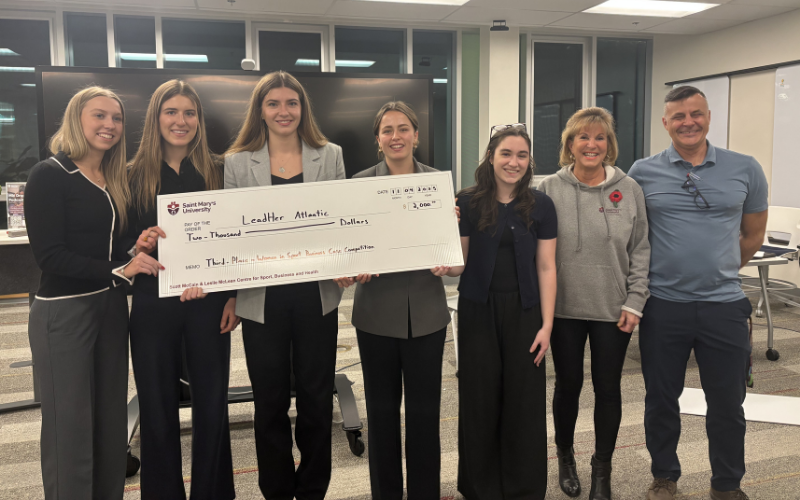
Third place went to the team "LeadHER Atlantic", represented by Taylor Lougheed, Marisa McClocklin, Mackenzie Beggs, Jacquline Moore and Lianne Rogers. 

“Our team proposed a coaching certification and leadership advancement pathway designed to elevate women in sport. Within five years, the program aims for all women student-athletes to graduate with entry-level coaching certification in their respective sports, while each female varsity team is paired with a community woman mentor.” 

Team HERizon took second place

Team LeadHER Atlantic took third place

One of the Centre’s benefactors, Leslie McLean, was on-site to award the prizes. Key members from SMU’s Athletics & Recreation department, the Faculty of Arts, the Sobey School of Business, and local and provincial sport organizations participated on the adjudication panel.  

Looking ahead 

By inviting student-athletes into the conversation, the Scott McCain & Leslie McLean Centre for Sport, Business and Health bridged the gap between those who play the game and those who will eventually manage it–demonstrating the importance of having a diverse range of voices at the table where industry-changing decisions are made.  

To get involved with sports-business initiatives that have a real impact on the world, connect with the Scott McCain & Leslie McLean Centre for Sport, Business and Health and check out our Sports Business program

Balancing the books and the runway: Chrissy Potter’s dual path from commerce to couture

Chrissy is a Black woman with shoulder length curly brown hair. She looks directly into the camera.

Chrissy Potter BComm’24

By Jennifer Ashton

When Saint Mary’s University alumna Chrissy Potter BComm’24 talks about balance, she isn’t just referring to her work as a universal banker at CIBC. She’s also speaking from experience, managing photo shoots in New York and runway shows in Paris. It’s a balance between precision and poise; one she’s learned to navigate with confidence.

Originally from Antigua, Chrissy learned more about Saint Mary’s through a recruiting visit to her island. Through this meeting, the choice became even clearer. Her father was an alumnus, as were several friends and family members. “The pull of family and friends led me here,” she said. “I knew it was a safe space to navigate and figure out what I wanted to do.”

Like many students entering the field of commerce, she initially thought she would pursue accounting. But it didn’t take long for her professors to open her eyes to the wider world of finance. “My great professors cultivated my love of finance. They made it interesting and easy to understand,” Chrissy recalled. That curiosity for financial systems became a launching pad for her professional life, both in the banking sector and beyond.

While her career in finance satisfies her analytical side, modelling gives Chrissy an equally important creative outlet. Signed with Soli Management in Halifax in 2023, she has since walked runways in Halifax, New York and Paris. “My work in banking has encouraged me to find a creative outlet, which I get in fashion and modelling. Each side feeds a different part of me.”

Chrissy is quick to point out that the world of personal banking isn’t as rigid as people might think. “I can tailor my meetings to the personalities of the people I’m dealing with,” she explained. “I get to be myself, and that helps make people feel comfortable talking to you.” This ability to adapt and move easily between corporate offices and fashion studios is a strength.

Her time at Saint Mary’s helped sharpen the practical skills that make this dual career possible. “Time management is a critical component of everything I do. SMU gave me the willingness to learn and encouraged me not to be afraid to ask questions.” That openness, she says, has been key to growing in both industries.

Beyond the classroom, Chrissy found community in the Black Students’ Society, where she served as finance representative on the board. “During the pandemic, it was a great way to connect with people and make friends. It was also a great way to see other Black students and build unity.”

Now, as she looks ahead, Chrissy sees both her career paths continuing to evolve. “Both can take me all over the country, and both offer excellent support systems. As far as intersecting goes, I’d love to share my financial literacy skills with other models. I think they’d see great benefits.”

Her advice to students or alumni with more than one passion is simple: “Just do it. Life is for living. Do what makes you happy. If you pursue your passions, the money will follow.”

It’s a philosophy that has guided her through international opportunities and new creative challenges.

Looking back, she’s proud of the path she’s carved, one that blends professionalism, creativity and authenticity. “Always be reflecting on the things that you’ve done while also keeping an eye on the things you want to do.”

To current business students, Chrissy offers practical advice:

“Take advantage of every opportunity given to you. Take the Canadian Securities Course while in school; it’s a great accomplishment. Network with professors, ask questions, and attend office hours—they welcome this interaction and are great people. Be kind, be authentic and build relationships.”

From balancing accounts to walking catwalks, Chrissy Potter is proof that there’s no one formula for success. With curiosity and courage, she’s showing that you can thrive in more than one world and look good doing it.

Chrissy poses during a photoshoot

This story was featured in the Fall edition of the Maroon + White alumni magazine. Visit the online magazine to read more alumni stories!

From Pugwash to the World Cup stage: BComm student champions community, entrepreneurship and global impact

Olivian is a white woman with long dark hair. She speaks into a microphone on a stage

BComm student Olivian Sanderson presents at the Enactus World Cup stage in Bangkok, Thailand

Olivian Sanderson grew up in Pugwash, Nova Scotia—a rural, picturesque fishing village with approximately 800 full-time residents. In just a few short years since coming to Saint Mary’s, she’s had the chance to travel the world and make a meaningful impact in the community through her involvement with Enactus Saint Mary’s and the Arthur L. Irving Entrepreneurship Centre.

Growing up, Olivian learned from her parents the importance of hard work, community and seizing opportunities. She made an impression during her high school years as Chair of the Cumberland County Youth Council, Student Council President, Ambassador for the Nova Scotia International Student Program and recipient of the Lieutenant Governor of Nova Scotia Award (2022) and Governor General’s Academic Medal of Canada (2023).

Olivian poses in front of a building in Thailand

When considering universities, Olivian knew she wanted to experience city life and find a program that would allow her to pursue her passion for business and community building. Knowing its reputation as one of Canada’s best business schools, she applied to the Sobey School of Business at Saint Mary’s.

She was the successful recipient of a Sobey National Innovator Scholarship, including on her application: “Looking to the future, I have big dreams and aspirations. I am passionate about understanding how the economy works and plan to use my skills to be involved in projects that support the community, as it has provided so much for me. I want to make the best world for myself and the people around me.”

Now a third-year accounting and management student, she’s made great strides toward her goals as the Co-Founder of the Sociable start-up and presenter for the global award-winning Enactus team.

Launching Sociable

Despite being very involved in high school, Olivian found the first few weeks of university difficult and lonely. Determined to find her place at Saint Mary’s, she dove headfirst into everything – trying out multiple societies and volunteering. Ultimately, it was Enactus and the Arthur L. Irving Entrepreneurship Centre where she found her place among people who shared her passion for big dreams and doing business for good.

During a session with Enactus Saint Mary’s, the idea for the Sociable start-up was formed. Sociable is an online community platform that helps students connect, get peer support and gain access to campus events. It builds student engagement, boosting student retention, wellness and success. Olivian and co-founder of Sociable, Jason Phonchareon BSc’25, developed the start-up to address student loneliness and mental health concerns, something they both experienced.

In 2024, Sociable won the Dream Chaser Change Maker (DCCM) Foundation Social Impact Award, which included a $10,000 prize to support business development – bringing Olivian one step closer to making a positive impact on students’ lives.  

Seeing the world with Enactus

In 2024, Enactus Saint Mary’s won the National Enactus Championship for the first time. As a member of the presentation team, Olivian had the opportunity to travel to Astana, Kazakhstan, to represent Canada in the World Cup competition. While they didn’t win in Kazakhstan, it was an incredible learning experience for Olivian and her teammates.

In 2025, during Olivian’s second year as presentation team captain, the Saint Mary’s team earned their second National Championship win. This time, they travelled to Bangkok, Thailand, to compete against 28 of the best teams from around the world in the Enactus World Championship.

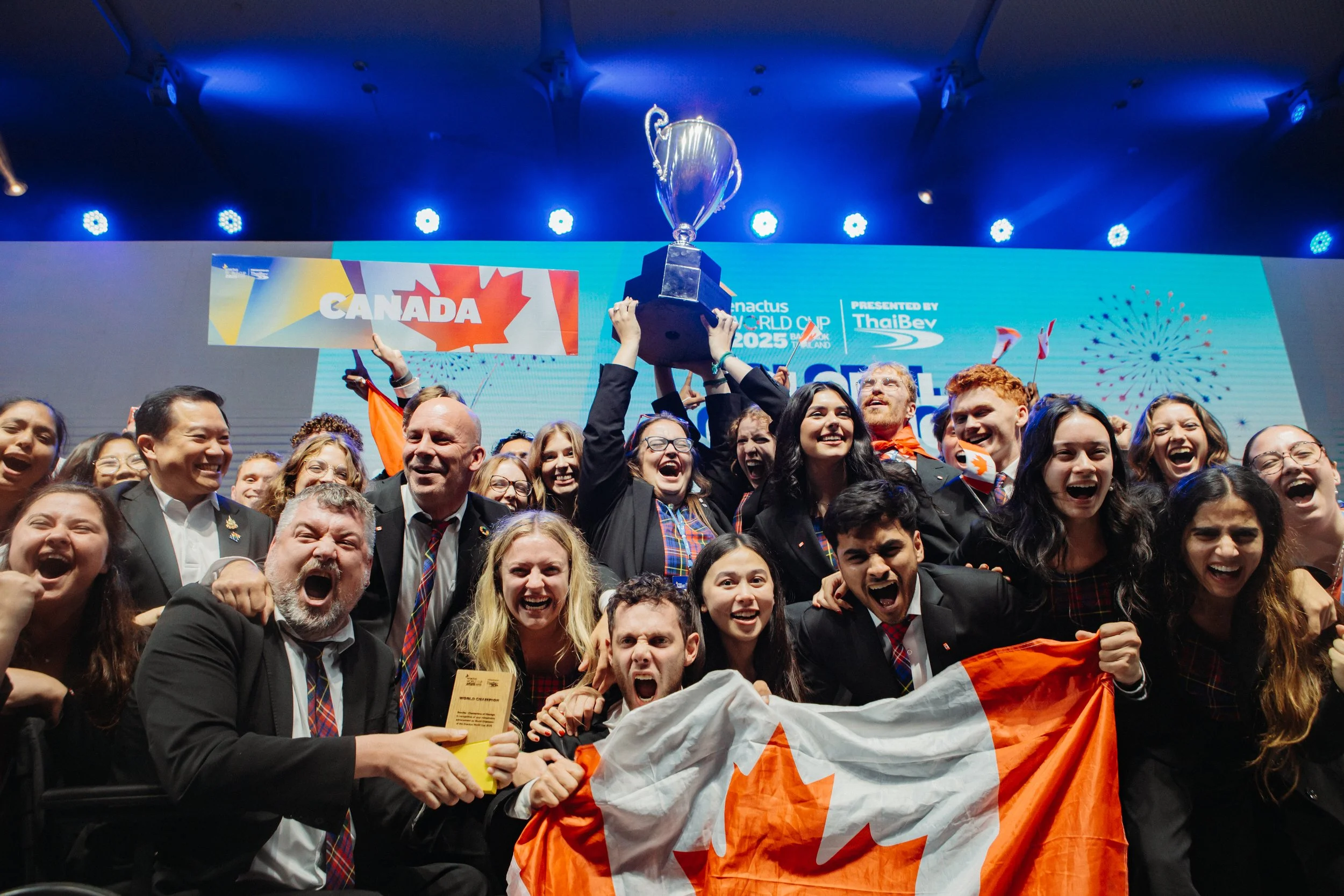
The team worked around the clock on their presentation about two student-run social enterprises—Alaagi and Square Roots—practicing, editing and preparing to answer questions. Olivian applied her work ethic and passion to the Enactus presentation, sharing the inspiring work being done by students at Saint Mary’s. Facing finalists from Zimbabwe, Tunisia and Germany, their presentation wowed the judges, and the team was crowned Enactus World Champion – the first world title for Saint Mary’s University.

Olivian with two presenters on stage

Olivian on stage at the Enactus World Cup in Thailand

Enactus team holds a trophy and Canadian flag

Enactus Saint Mary’s celebrates winning the World Cup

Reflecting on her first two years at Saint Mary’s, Olivian sometimes shakes her head at how much she has experienced. Her advice to new students: get as involved as you can.

“Classes are great, but you will have life-changing experiences in extra-curricular activities. The mentorship, the soft skills, and the network – so very valuable. It’s thanks to those experiences that I’ve been able to see the world.”


Opportunities at the Arthur L. Irving Entrepreneurship Centre are open to all Saint Mary’s students – check out their programs and events here.
New social innovation field course includes travel to Ghana

An aerial view in Accra, Ghana

Accra, Ghana

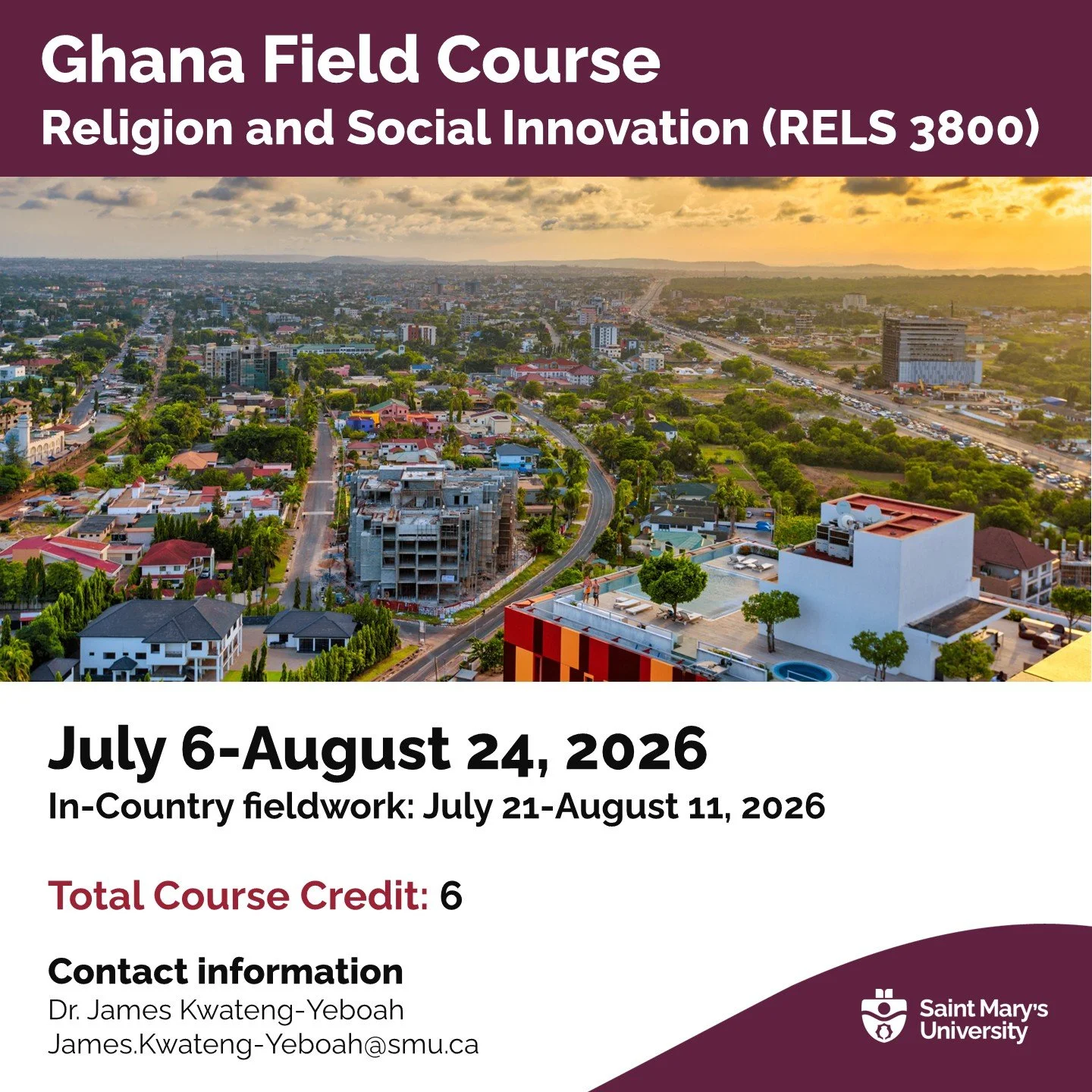
Launching at Saint Mary’s in 2026, a new field course will help students build career-ready skills in non-profit leadership, community-based research and intercultural communication. The Ghana Field Course: Religion and Social Innovation (RELS 3800) will take learning far beyond the classroom this summer, as students explore how culture and religion help drive social innovation in the West African nation.

Field course promotional poster

“This isn’t a typical study abroad experience,” says Dr. James Kwateng-Yeboah, who developed the new course. “Students will spend three weeks working alongside Ghanaian community leaders, NGO practitioners and religious organizations to understand how spiritual values drive real-world social change. They’ll visit Indigenous shrines, historic mission sites and contemporary social enterprises, while building practical competencies that employers and graduate programs value.”

The course will examine how African Indigenous and religious traditions are shaping social innovation in education, entrepreneurship and cultural heritage in Ghana—one of Africa’s most vibrant centers of creative enterprise. The course also invites reflection on how African communities transform histories of slavery and colonialism into new models of resilience and social impact.

Combining pre-departure preparation, three weeks of immersive fieldwork in Ghana and post-return synthesis sessions, the course will give students the contextual knowledge, field experience and reflective space to truly integrate their learning. In just seven weeks (July 6 to August 24), students will earn six credit hours.

Though the course is offered by the Department for the Study of Religion, it’s designed to be interdisciplinary in nature. It will appeal to students interested in Black and African studies, religious studies, history, intercultural studies, global development studies and sociology. The course is particularly valuable for students considering careers in global development, nonprofit management, community organizing and social entrepreneurship, or graduate work in African studies, religious studies or history, as the structured fieldwork is designed to build transferable professional skills.

“I designed this course because students need more than abstract theories; they need to see how communities actually create change,” says Dr. Kwateng-Yeboah. “Ghana offers a living laboratory where you can trace how communities have transformed centuries of colonial exploitation into new models of resilience, creativity and entrepreneurship.”

A man stands with three students in a SMU classroom

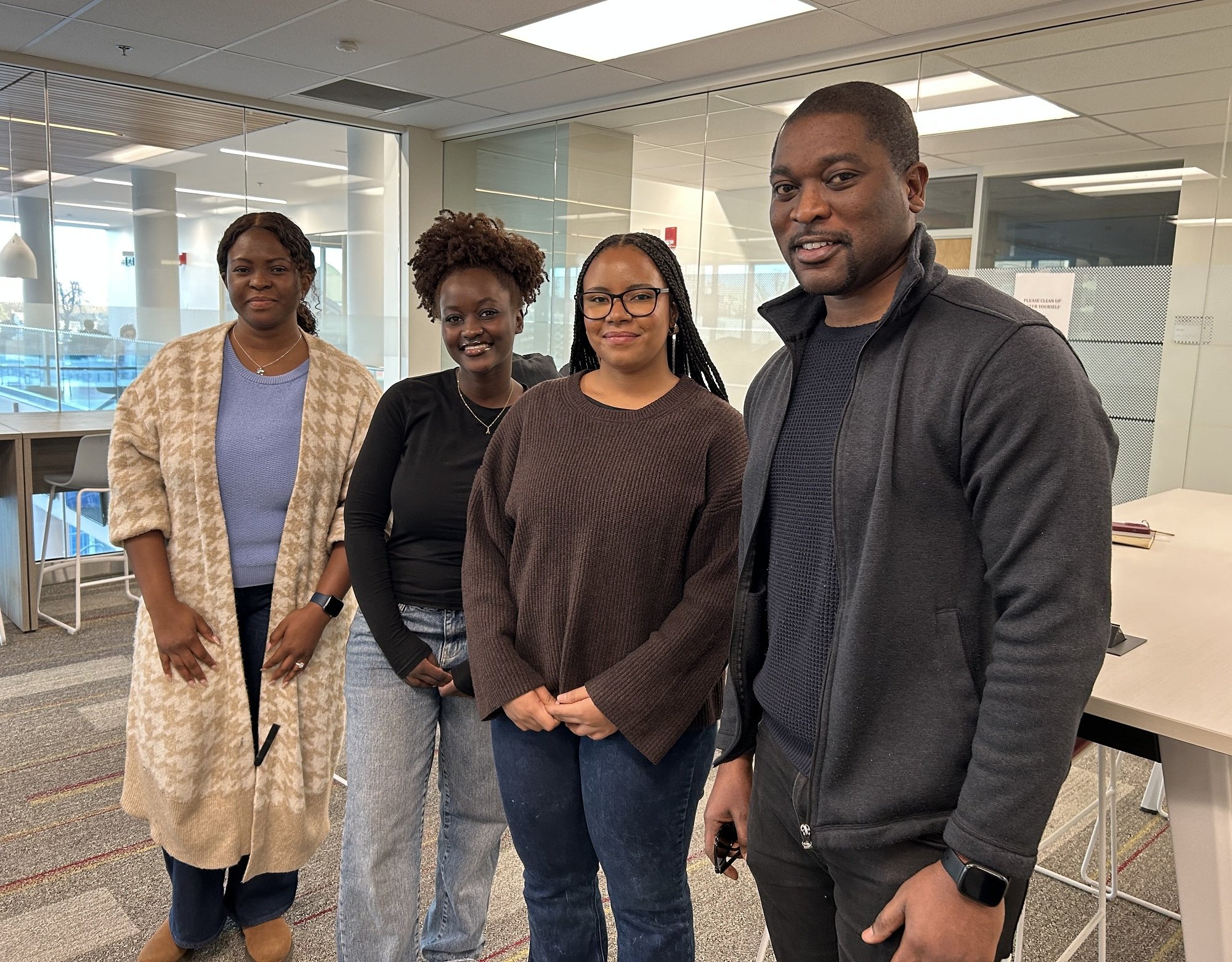
Dr. James Kwateng-Yeboah (far right) with Ebun Oladele, Black Student Advisor (far left) and two students at the Ghana Field Course information session during International Education Week

During International Education Week in November, Dr. Kwateng-Yeboah held an information session in the Black Student Commons. He has also produced a brief video to promote the new course.

Spots are limited to ensure meaningful engagement with community partners. Interested students should complete the expression of interest form as soon as possible. Dr. Kwateng-Yeboah will contact applicants for interviews before final registration. For more details, contact him at James.Kwateng-Yeboah@smu.ca.

Kwateng-Yeboah completed his own undergraduate studies at the University of Ghana before coming to Canada for his graduate studies. At Saint Mary’s, his primary areas of research and teaching are African Christianity, migration, and development.

The new course adds to SMU’s study abroad offerings in Africa that have also included several Geography field courses in The Gambia, most recently in Winter 2025. Saint Mary's also maintains an academic exchange partnership with Uganda Martyrs University in Africa, through the Global Learning & Intercultural Support office. 

Related

The Arena 2026—Canada’s premier national pitch competition for student entrepreneurs—now open for applications!

The Arena promotional image

Applications are now open for The Arena 2026, with a chance to compete for the $10,000 grand prize.  

Hosted by the Arthur L. Irving Entrepreneurship Centre at Saint Mary’s University, The Arena returns for its sixth year, bringing together 64 student entrepreneurs from across Canada for a fast-paced, high-energy pitch competition. Participants go head-to-head for the title of National Champion, with prizes awarded to the top four competitors. The winner will take home $10,000, second place will receive $5,000 and third- and fourth-place finishers will each earn $1,000. All prize money is awarded to support the student’s idea or business. 

Inspired by the NCAA March Madness tournament, The Arena takes place in a bracket-style format throughout March. Selected students compete in live, head-to-head pitch matchups, advancing round by round as judges make real-time decisions. Throughout the competition, participants receive coaching and mentorship to help refine their pitches and strengthen their ventures. All matchups are held online and live-streamed, allowing audiences across the country to tune in. 

Image of an Arena competitor and judges in an online presentation

“The Arena pushes students to think on their feet and clearly communicate their ideas,” says Michael Sanderson, Director of the Arthur L. Irving Entrepreneurship Centre. “It’s exciting to watch their confidence grow as their ideas start to take shape in a real competitive environment.” 

To be eligible, applicants must be current undergraduate, graduate or PhD students or recent alumni (within one year of graduation) from a recognized Canadian post-secondary institution. Participants must own or co-own a business idea that has generated no more than $10,000 in annual revenue and has received no more than $10,000 in external funding or investment. 

The Arena is proudly sponsored by Metronomics, a business growth system founded in 1995 by CEO Shannon Susko BComm’89 BSc’92. Metronomics helps leadership teams build clarity, alignment and momentum to drive sustainable growth. Susko has been widely recognized for her leadership, including being named one of Canada’s Top 100 Most Powerful Women multiple times and receiving the Universal Women’s Network Game Changer Award. 

People are encouraged to follow the competition live via the Centre’s Facebook and LinkedIn channels. For more information, please contact Fatima Zohora at fatima.zohora@smu.ca

Learn more about The Arena and apply today. 

Turning a diagnosis into impact: How Emma McGill is building community through Gluten Free Living

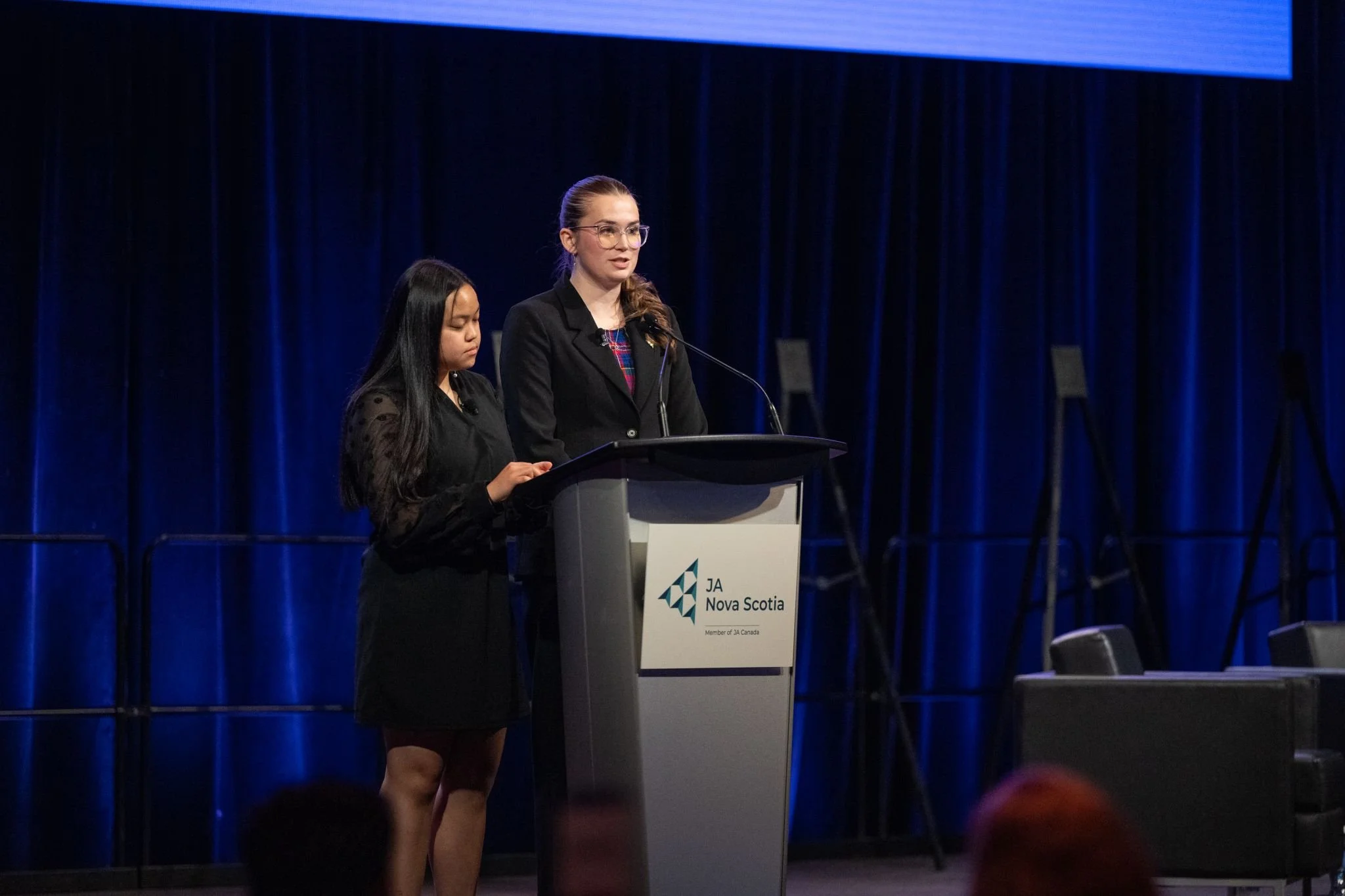
Emma stands behind a podium

Emma McGill presents at a JA Nova Scotia event

Emma McGill sits comfortably between two worlds, science and entrepreneurship. An astrophysics and anthropology student, Emma is also the founder of Gluten Free Living. With support from the Arthur L. Irving Entrepreneurship Centre, the growing initiative focuses on supporting people with celiac disease and gluten intolerance.

Emma’s journey into entrepreneurship began long before she ever thought of starting a business. At 12 years old, she was diagnosed with celiac disease, a moment that quickly reshaped everyday life for her and her family. Suddenly, grocery shopping became expensive and time-consuming, with gluten-free alternatives costing significantly more and often falling short in quality.

“I was told by my doctor that celiac disease was one of the easiest illnesses to live with because you just have to change your diet,” Emma recalls. “But that doesn’t mean it’s easy.”

As she grew older, Emma became more aware of how isolating the condition could be. Eating out with friends, attending work events or finding reliable information often came with stress and uncertainty. What stood out most was the lack of accessible, centralized support for people navigating similar experiences.

This gap is what inspired Gluten Free Living, with the platform currently growing through community events and social channels. It aims to create safe spaces where people can connect, share information and find trusted gluten-free options. In the long term, Emma envisions Gluten Free Living as a fully developed app that brings together verified health information, restaurant resources and practical financial tools, including an AI-powered assistant to help users navigate Canada’s complex celiac-related tax credits.

“The cost of gluten-free food can be two to five times higher than regular food,” Emma says. “I wanted to build something that helps people not only protect their health, but also manage the financial reality that comes with it.”

While entrepreneurship might seem far from astrophysics, Emma sees more overlap than expected. Skills such as problem-solving, communication, teamwork and proposal writing transfer easily between the lab and the business world. Her involvement with Enactus Saint Mary’s has further strengthened those skills, connecting her with a community of students who are driven to create a meaningful impact.

That sense of momentum has only grown following Enactus Saint Mary’s recent World Cup win in Bangkok, Thailand, which Emma believes has energized the broader entrepreneurial community both on campus and beyond. “There’s this excitement now,” she says. “People feel encouraged to build things that matter.”

For Emma, Gluten Free Living is about more than food. It’s about visibility, connection and reminding people that they’re not alone.

“You shouldn’t have to struggle quietly just because something is labelled as ‘manageable,’” she says. “Community makes a difference.”

Interested in learning more about how entrepreneurship can blend with other areas of study? Explore programs and events here.

Watch Emma’s interview on CTV News

Celebrating 50 years of Geography and Environmental Studies

With 2025 in the rearview mirror, it’s timely to look back at the year’s highlights marking the 50th anniversary of the Department of Geography and Environmental Studies.

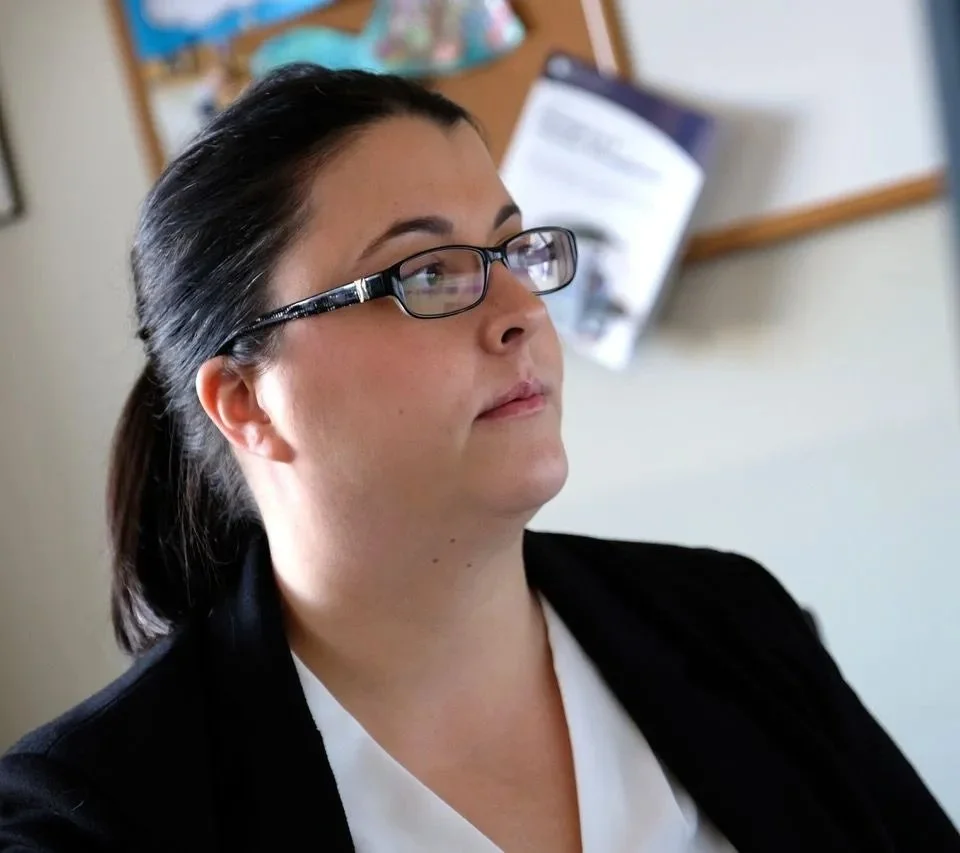
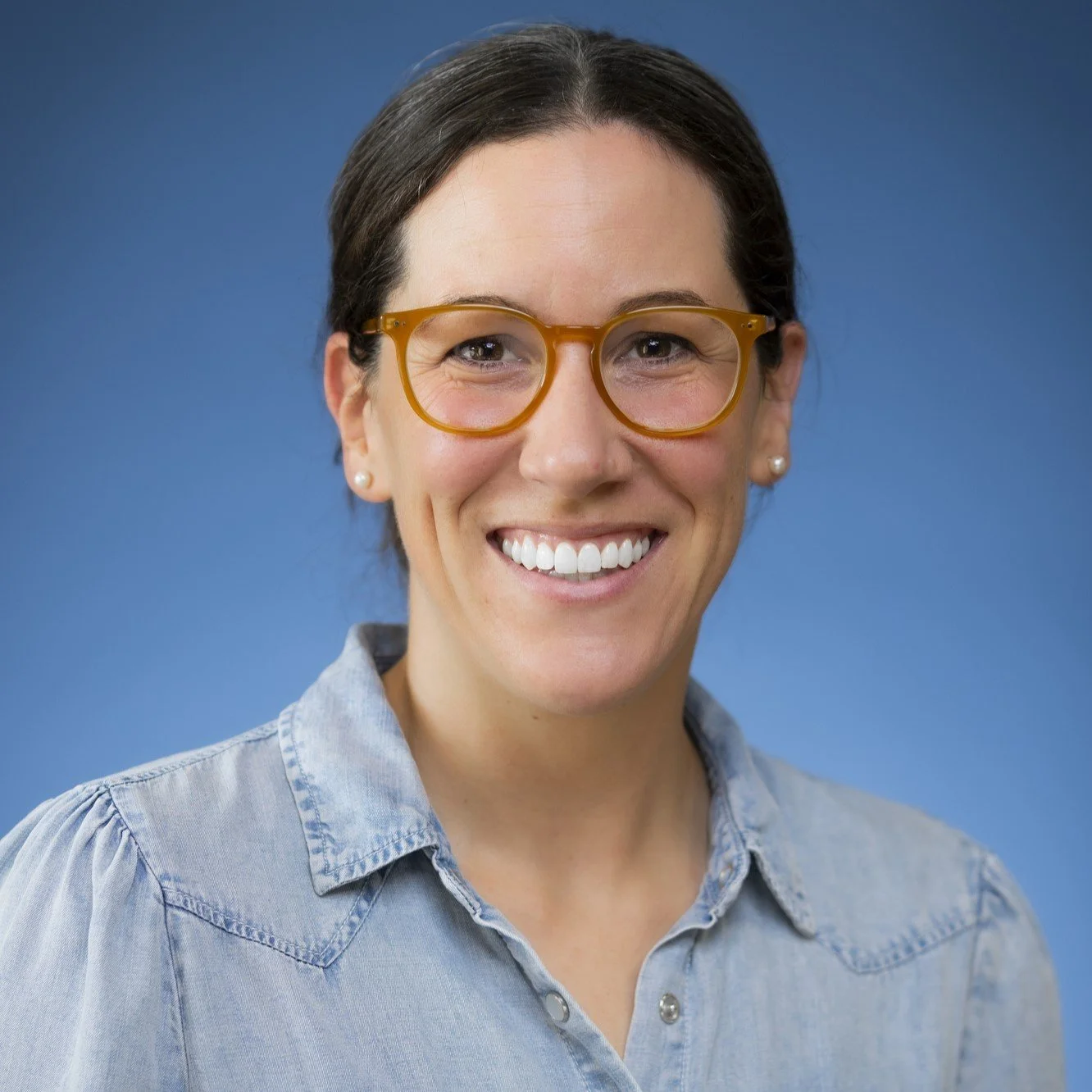
Amber is a white woman with brown hair and glasses

Dr. Amber Silver BSc’10

Dr. Amber Silver BSc’10 was the alumni guest speaker for the department’s special anniversary event on November 20, delivering an Arts With Impact lecture on “Hazardous Weather in Atlantic Canada: Public Perceptions and Responses.”

During her talk, she recalled how studying geography got her back on track as a student and put her firmly on the path toward her dream job. Her first year at another Halifax university hadn’t worked out, so she ended up leaving school. During a break one day on her shift at a Halifax call centre, she flipped through a coworker’s Saint Mary’s University academic calendar.

A course on natural hazards jumped out, “and everything just clicked into place,” she said in a recent interview for Maroon + White. “In that moment, I decided to return to university, but this time to geography.”

Silver had loved geography in high school, but didn’t realize it was available as a university program. She was also fascinated with natural disasters and severe weather such as hurricanes. From the very first class at SMU, she knew she was in the right place. With the program’s focus on experiential learning, she has fond memories of field studies on saltwater marshes and Minas Basin mudflats with Dr. Danika van Proosdij, as well as transformative field trips to Boston and Washington.  

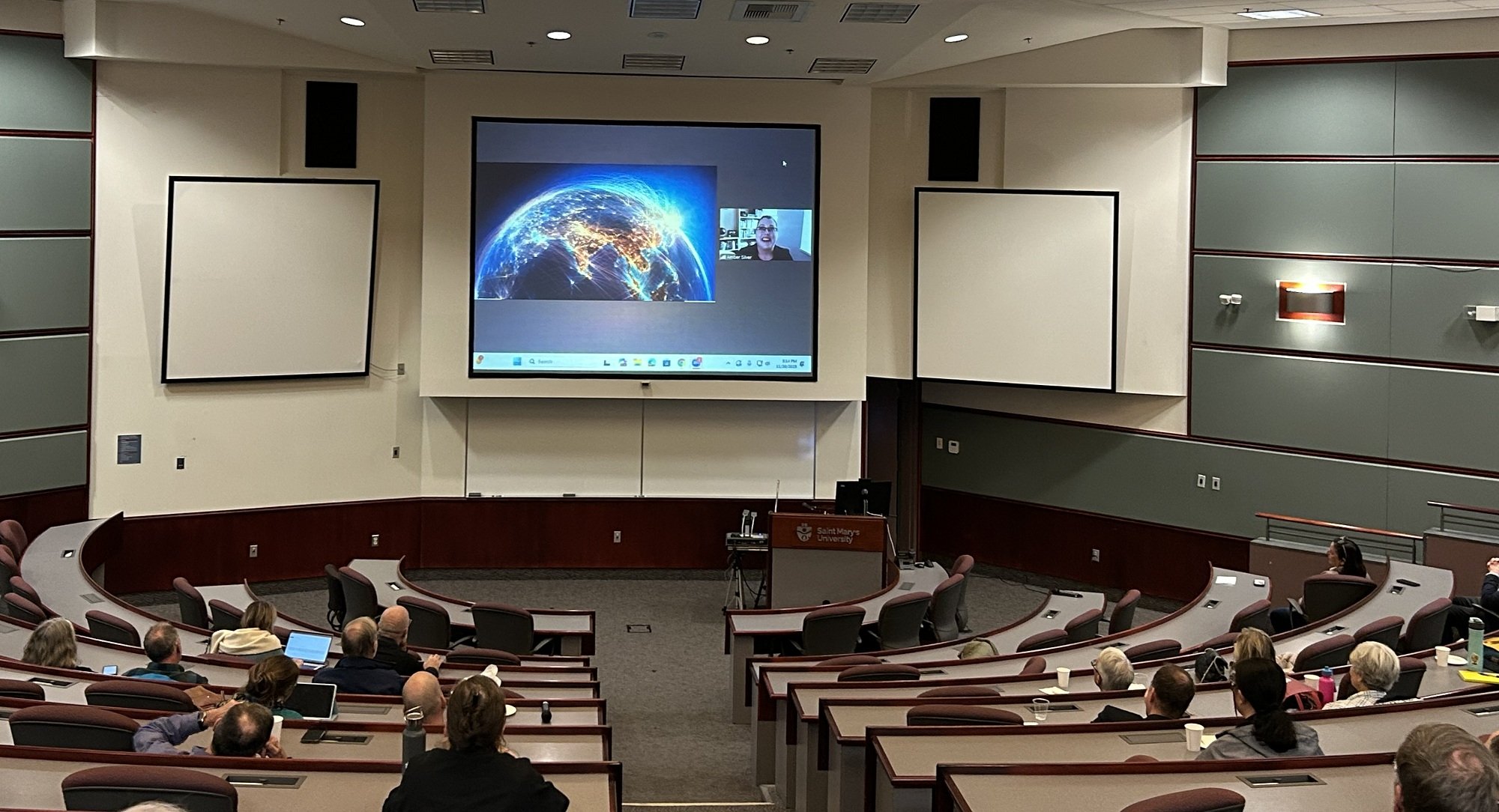
Amber shown on a projector screen in a lecture hall

Dr. Amber Silver presented ‘Hazardous Weather in Atlantic Canada: Public Perceptions and Responses’ at SMU

Now Silver works in the U.S., teaching students about the human dimensions of natural disasters as an Associate Professor in the College of Emergency Preparedness, Homeland Security and Cybersecurity at the University at Albany in New York. Her current research focuses on the role of misinformation and disinformation in the public’s understanding of natural hazards and disasters.

Stephanie is a white woman with brown hair and glasses

Dr. Stephanie Rogers BA’07

Dr. Stephanie Rogers BA’07 also shares fond memories of how she stumbled into the geography program and found her passion. She had been exploring various academic interests when a schoolmate recommended a course taught by a “rockstar instructor,” Rogers recalled in a recent article, Mapping the future from the ground – and the sky. “Once I took that class, I was hooked.”

The rockstar instructor was Dr. Cathy Conrad, and Rogers remembers working with her on a river-related Nova Scotia Youth Conservation Corps project. She encourages students to get involved in research early. “Don’t be afraid to reach out and ask if a professor has openings in their lab. Without that hands-on experience I obtained in university, I wouldn’t be where I am today,” she said. 

For Rogers, what began as a curiosity about maps evolved into a career exploring how technology can deepen our understanding of the environment. She is now an Associate Professor and runs the GeoIDEALab in the Department of Geosciences at Auburn University in Alabama. Some of her research uses geospatial data from drones and satellites to study water quality, which offers faster and more flexible methods than traditional field sampling.

Dr. Cathy Conrad is a Saint Mary’s alumna (BA’93) and the mother of a current SMU student and a SMU alumnus. She was in the spotlight during Homecoming Week in October, at a Faculty Author Reading event celebrating 50 years of both Geography and the Patrick Power Library. Conrad’s talk offered a personal autoethnography of her own lived experiences as the mother of a migrant, wife of a migrant and daughter of a migrant, and how that has influenced her own migration research.

Cathy stands at a podium with a projector showing a family photo

Dr. Cathy Conrad presented a Faculty Author talk during Homecoming

Through geography field courses, students can explore physical and human geography in other parts of the world. In March, Conrad brought a class to The Gambia to learn about the West African nation's history, culture and geography. In 2027, the Geography and Environmental Studies department teams up with the History department to offer the “Difficult Heritage – Europe” field course, featuring a 10-day trip to Berlin and Paris to explore heritage sites associated with the Second World War.

Coming up this winter, a new international field course is heading to South Korea, with Dr. Min-Jung Kwak at the helm. The learning starts in seminars here on campus and the field trip will enrich students’ understanding of South Korea's physical and cultural landscapes. The course is a collaboration between the geography and Asian studies programs.

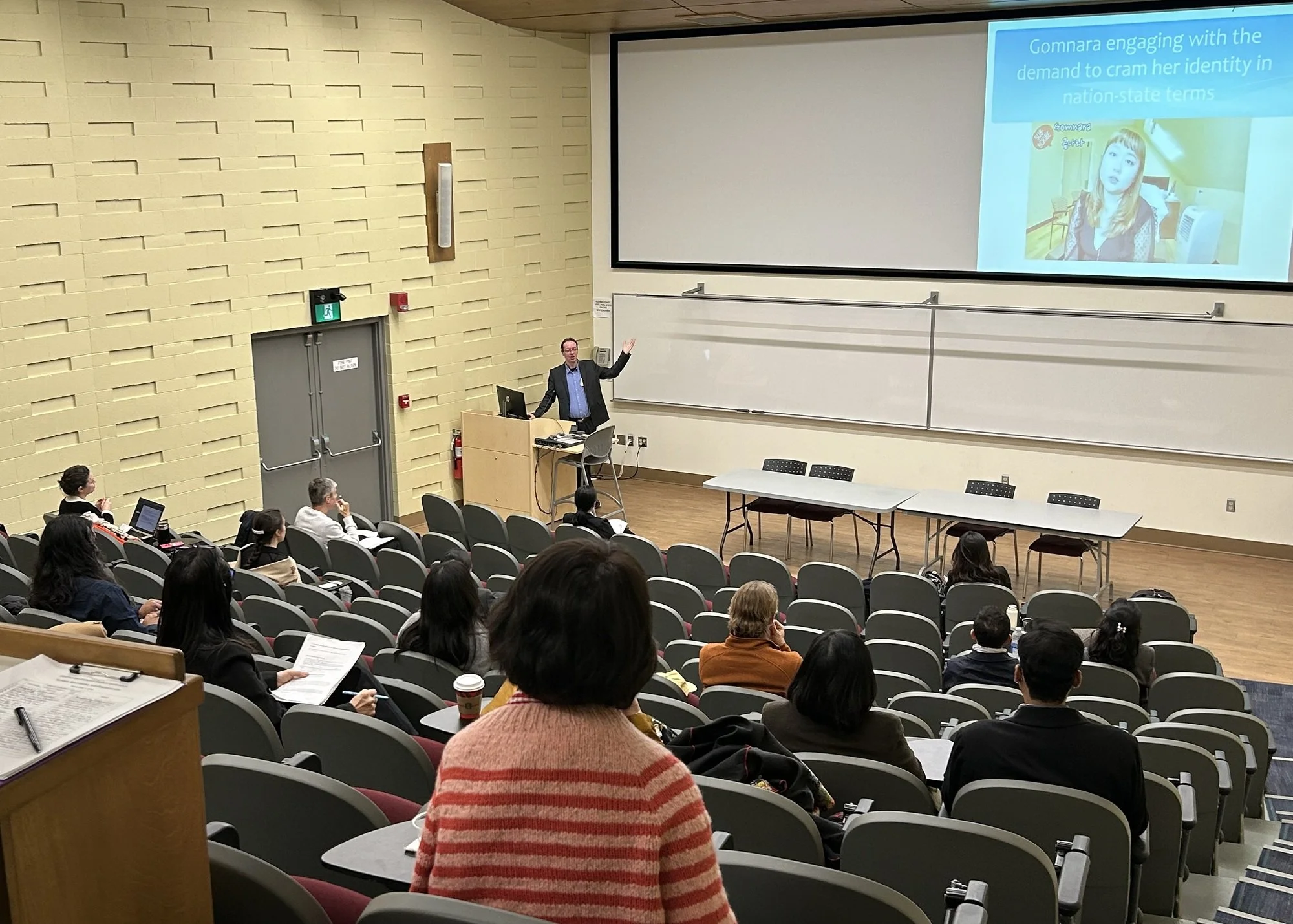
On November 7, Kwak marked Geography’s 50th anniversary by hosting Nova Scotia’s first Korean Diaspora Studies Conference, on the theme of Borders, Boundaries and Displacement. Open to the public, the event included panels and keynotes, plus a film screening and special talk on “The Predicament of (Korean) Diasporic Cinema: An Exploration of Past Lives“. The conference highlighted the growing importance of South Korea and Asia as key economic and political partners for Canada, as well as the rapidly changing demographic landscape in Nova Scotia.   

A man presents in a lecture hall

A speaker at the Korean Diaspora Studies Conference at SMU

Over the past five decades, one of the geography program’s greatest features has been the diversity it offers. Students can study geography as a major or honours in both the BA and BSc programs, and as a minor in a BA, BSc or BES degree. Geography also offers electives and concentrations to students in any program across the university. The program is closely connected to specialized research labs and institutes, such as the Wicked Problems Lab, the Maritime Provinces Spatial Analysis Research Centre, and TransCoastal Adaptations: Centre for Nature-Based Solutions.

It also offers co-op options with government agencies, consulting firms and environmental or planning organizations, such as the Canadian Space Agency (CSA), as students learned at a GIS Day event planned by student Miranda Frison, who is doing a Master of Arts in Geography.

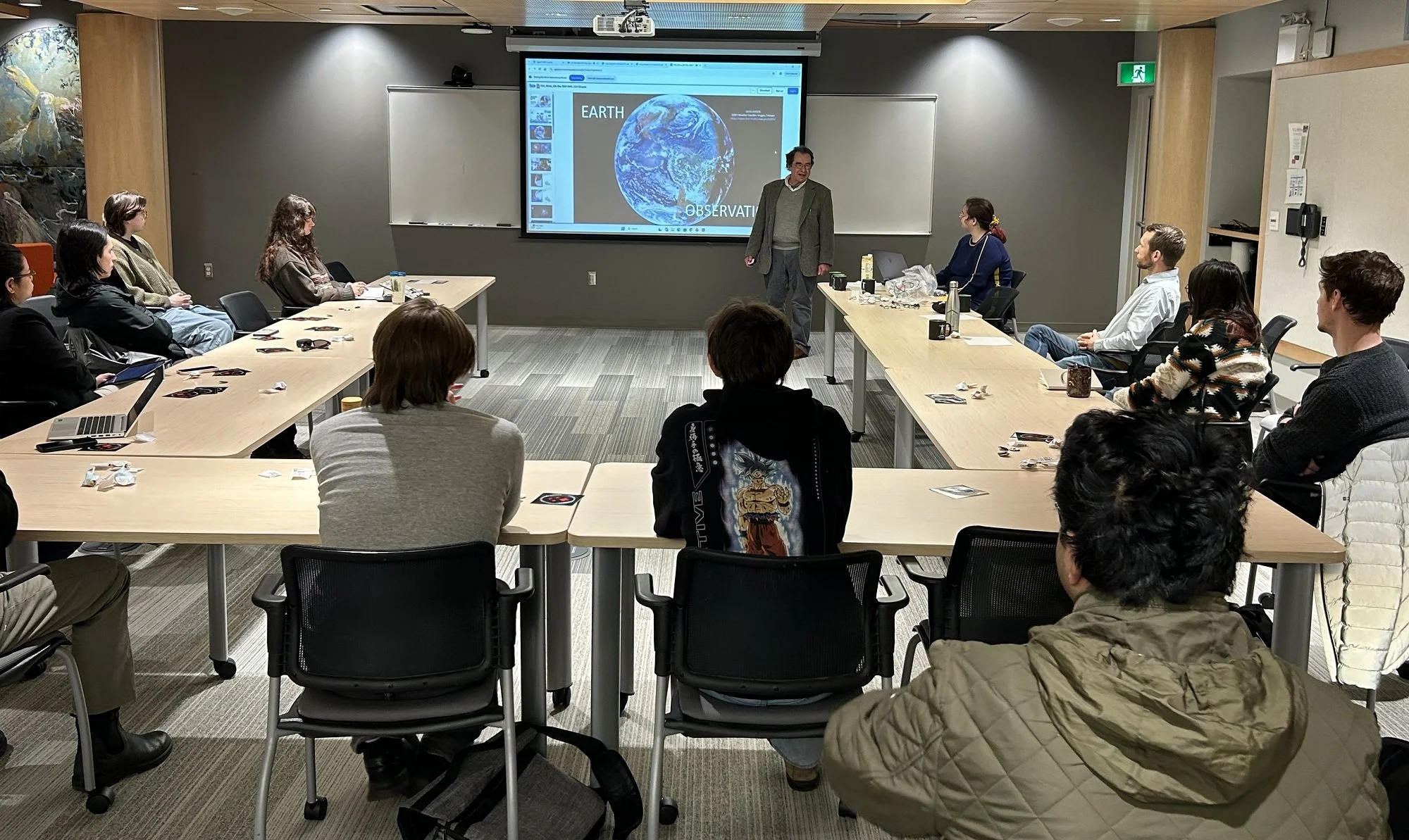
GIS (Geographic Information Systems) is digital mapping with both human and environmental applications across disciplines. Two guest speakers from CSA shared their perspectives on career possibilities for students with GIS experience: Jean Bergeron, Mission Scientist for Sun-Earth System Science, and Dirk Werle, Senior Expert in Earth Observation, Utilization, and Services. 

A man presents in a classroom with students

GIS Day at SMU

“GIS Day can introduce people to the subject and how it is used in every industry in some shape and form,” said Frison. Her own thesis research focuses on threatened lichen species in Atlantic Canada; learn more in this Esri Geographical Thinking podcast. As a teaching assistant at SMU and current president of the Geomatics Association of Nova Scotia (GANS), Frison encourages students to learn how to use GIS software to expand their research horizons.

“It has been very rewarding seeing when it clicks for students and as they get excited about possible future projects,” she says.

In her lecture, Dr. Silver emphasized how geography opens up versatile career paths in public health, transportation, urban planning, education, research, policy development and so much more. She said she was honoured to acknowledge the geography program’s many accomplishments in her lecture.
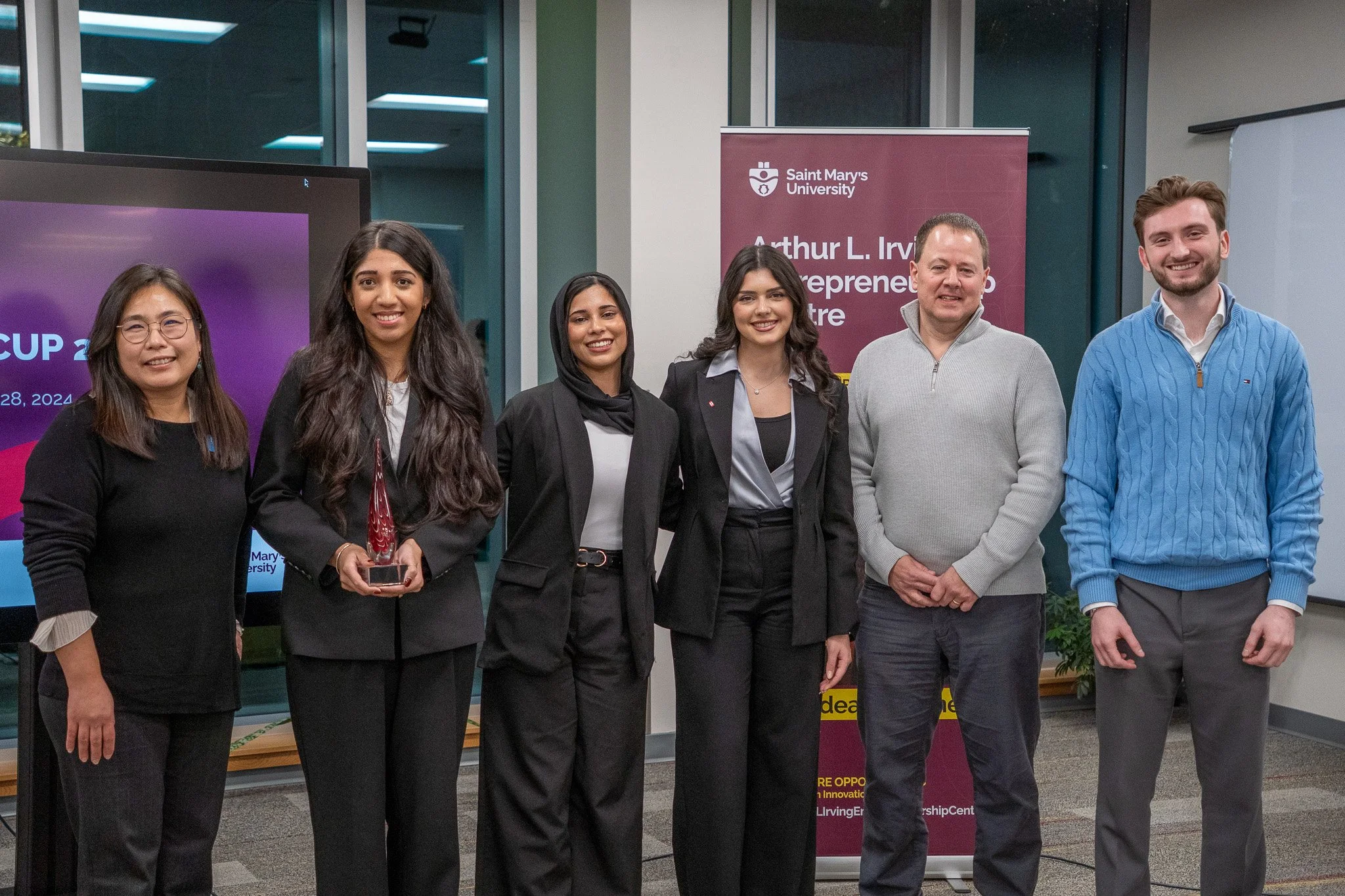
“To say [the program] does a phenomenal job of preparing students for the interesting, dynamic and unique discipline of geography is an understatement. It expects a lot of its students—but it gives students so much in return,” said Silver.
Related

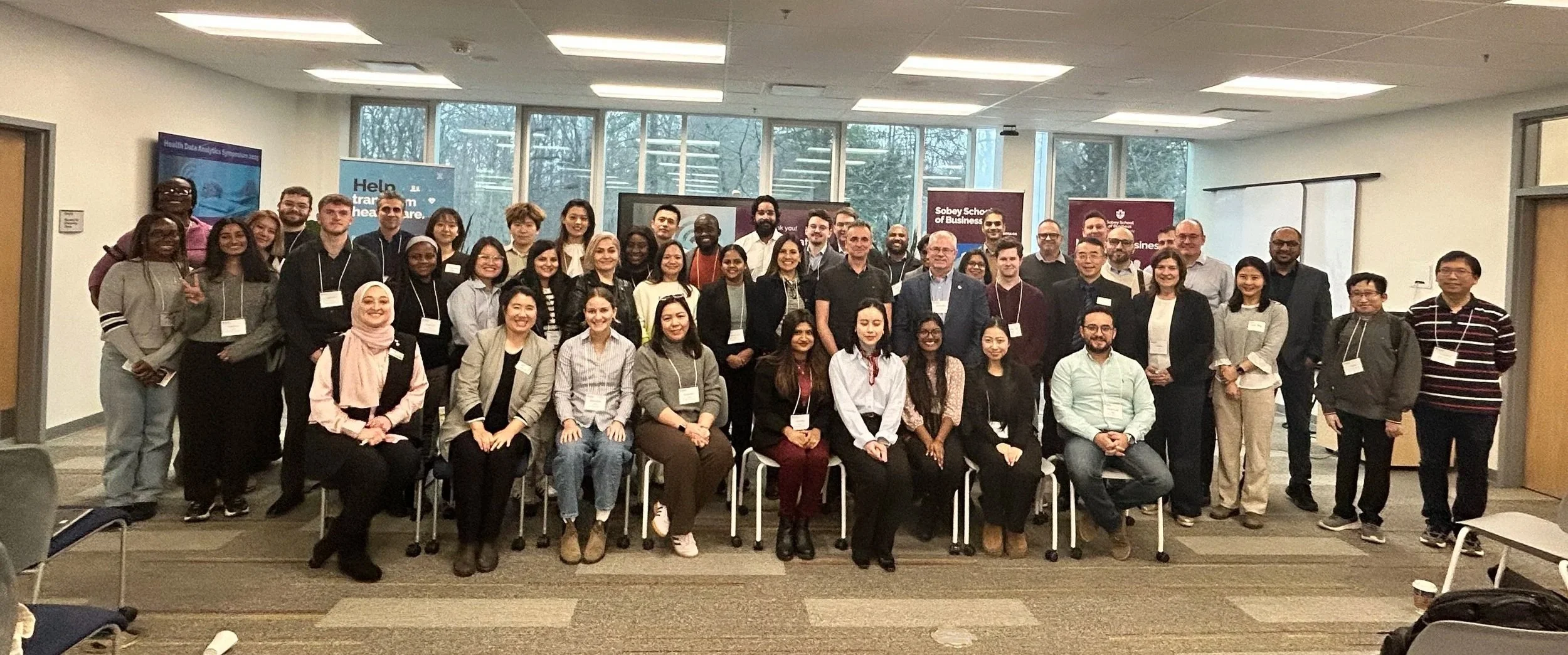
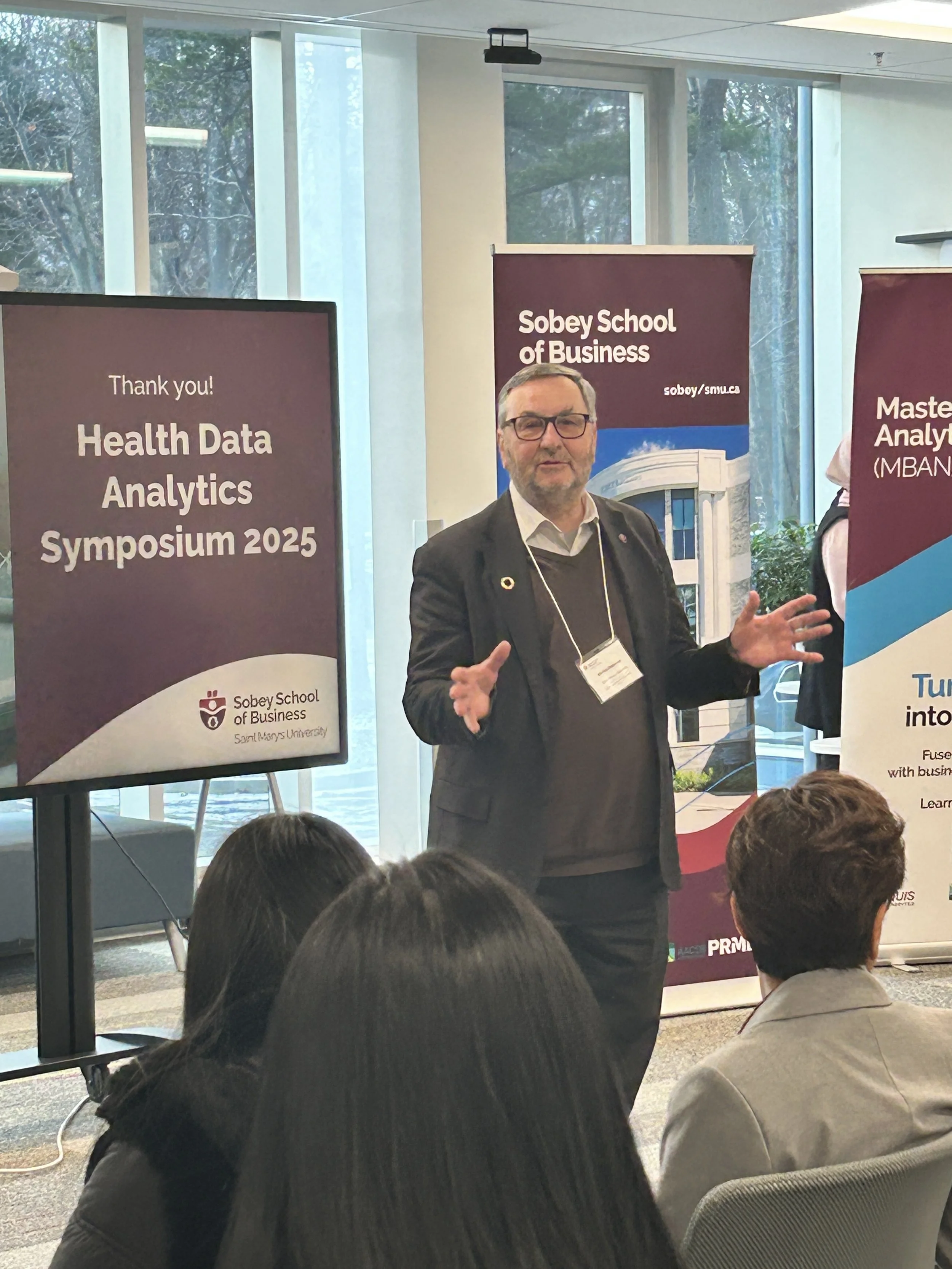
Health Data Analytics Symposium demonstrates the power of applied analytics in healthcare

As healthcare systems face increasing operational complexity, the ability to translate data into clear, actionable insight has become essential. The second edition of Saint Mary’s University’s Health Data Analytics Symposium brought this challenge into focus through applied analytics projects developed inside Nova Scotia Health, offering a practical view of how data can support decision-making in real clinical and operational environments.

The Symposium showcased work completed by Master of Business Analytics (MBAN) students during their internships with Nova Scotia Health. Embedded within teams across the system, students worked with live data, real constraints and active problems to explore issues such as workforce planning, scheduling fairness, emergency department flow and patient experience. The projects were not theoretical exercises, but responses to questions the health system continues to actively grapple with.

Building on the momentum of its inaugural year, the Symposium demonstrated how applied analytics can bridge the gap between academic learning and system needs. The student presentations reflected not only technical capability but also an understanding of the healthcare context, collaboration and the human implications of data-informed decisions.

For healthcare leaders in attendance, the relevance of the work was evident.

“Watching a master’s student take a theoretical concept and move it into an applied project that speaks directly to workforce risk is incredibly powerful,” said Matthew Murphy, Vice President, Organizational Support and Readiness at Emergency Medical Care Inc. and former Chief Data Officer at Nova Scotia Health. “That kind of work is important not only for Nova Scotia Health, but for healthcare systems more broadly.”

Several projects focused on workforce sustainability and operational resilience, areas of growing concern across the healthcare sector. Others examined patient flow and experience in high-pressure environments such as emergency departments, highlighting how thoughtful use of data can support more timely decision-making and improved outcomes.

Scott McKenna of Nova Scotia Health noted that the partnership with Saint Mary’s continues to evolve, reinforcing its value for both organizations. He emphasized that the collaboration supports talent development while also helping the health system explore new analytical approaches to complex challenges.

For students, the opportunity to work inside the health system provided learning that could not be replicated in the classroom alone.

“Working within Nova Scotia Health helped me understand how analytics can reduce bias, support staff, and improve decision-making while keeping care human-centered.”
— Yilong Wu, MBAN student

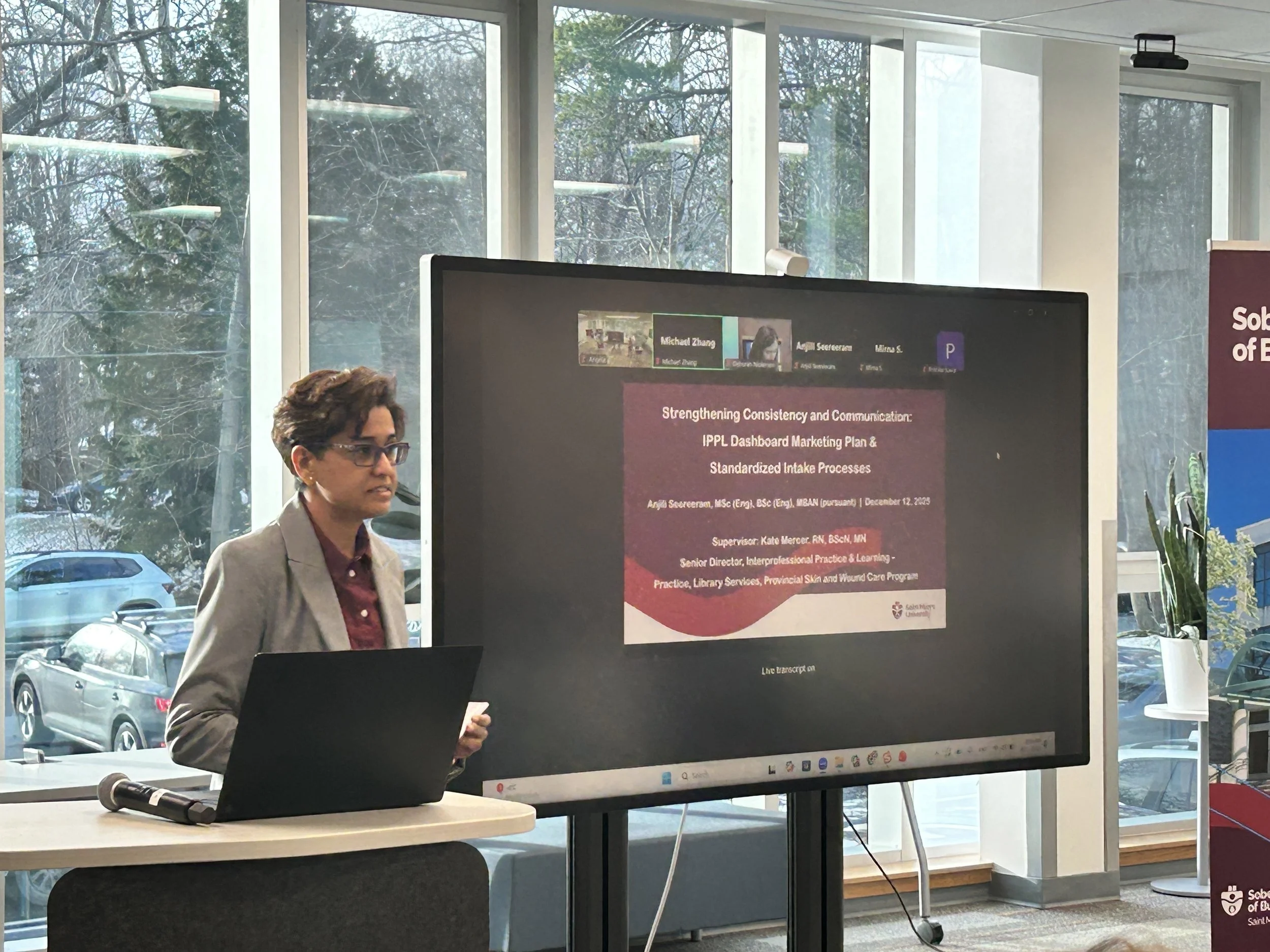
MBAN student Yilong Wu, who presented an intelligent scheduling system for MRI staff, described the experience as transformative. “Efficiency matters, but people matter more,” he said.

Another student presenter, Abhinethra Rajamoorthi Gangamani, focused on a predictive analytics system using data to identify risk factors associated with patients leaving without being seen. The project required in-depth engagement with operational workflows and a clear understanding of how healthcare data is processed from raw inputs to the dashboards used by clinicians and patients.

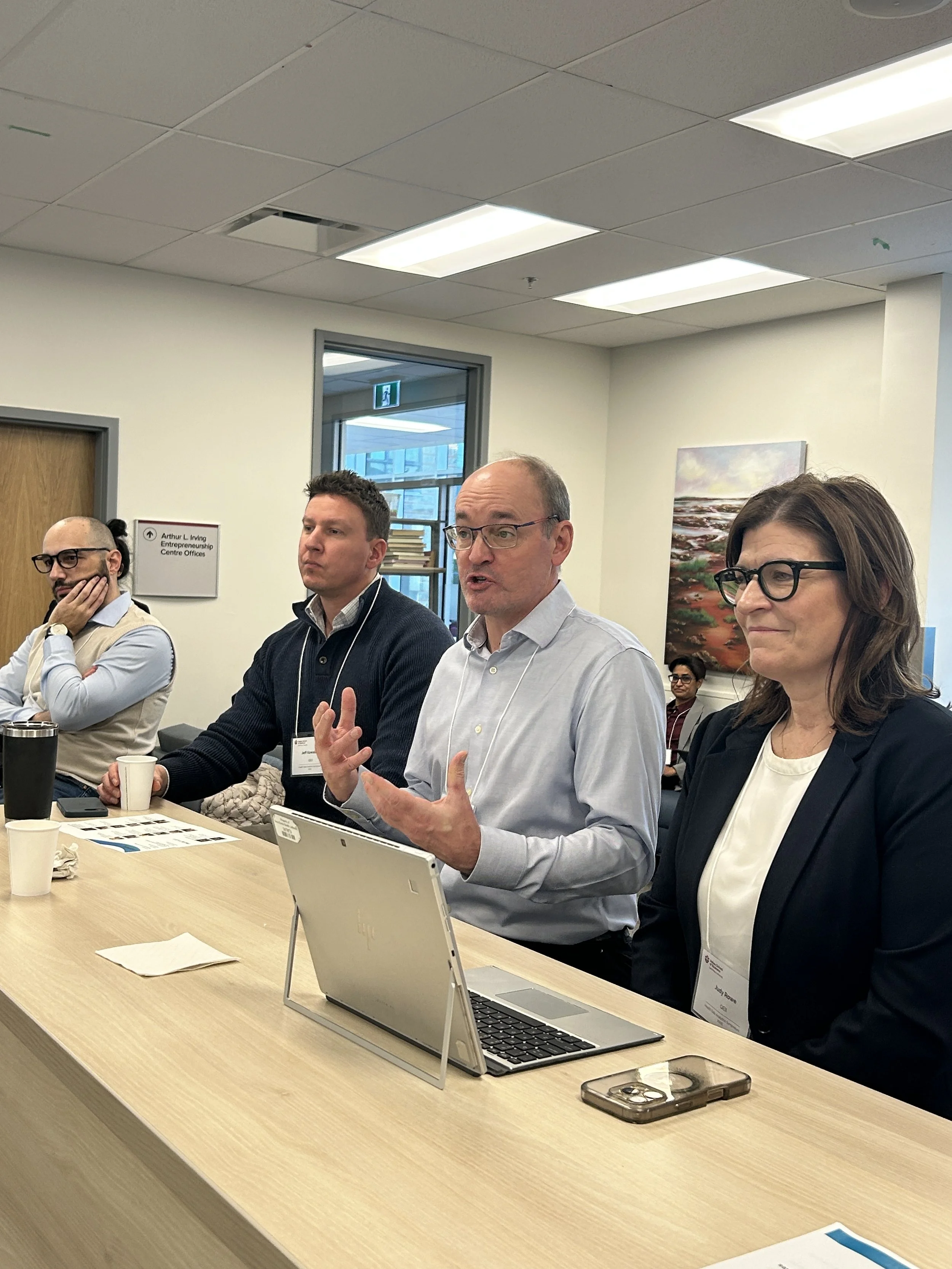
Industry partners in attendance emphasized that grounding analytics in real environments is critical. Kevin Fournier of Microsoft highlighted the importance of strong data foundations and clarity of purpose.

“In today’s world, data is the foundation of decision-making,” he said. “What stood out was how clearly students understood the problem, the data behind it and how their solutions could support better outcomes.”

From the Sobey School of Business perspective, the Symposium reflects a deliberate approach to applied learning and system engagement. Faculty leadership emphasized that embedding students within complex organizations strengthens both analytical capability and professional judgement, helping graduates contribute meaningfully from the outset of their careers.

Dr. Michael Zhang, MBAN Program Director, noted that working directly with Nova Scotia Health enables students to develop a deeper understanding of context, constraints and impact, leading to more relevant and responsible analytical work.

In her opening remarks, Susan MacDonald, Vice-President, Finance and Administration at Saint Mary’s University, underscored the broader institutional importance of partnerships like this one. She emphasized that universities play a critical role not only in educating students but also in contributing to provincial capacity by supporting workforce development and system improvement.

Together, the student work and partner perspectives demonstrated how applied analytics, developed through close collaboration between academia and the health system, can support better decisions, stronger operations and improved patient experience. As healthcare continues to evolve, the Health Data Analytics Symposium offers a growing platform for aligning education and practice in the service of complex, real-world challenges.

Saint Mary’s is offering a new Graduate Diploma in Health Data Analytics program starting in September 2026. Apply now!

Being There wins $11,000 for innovative approach to senior care

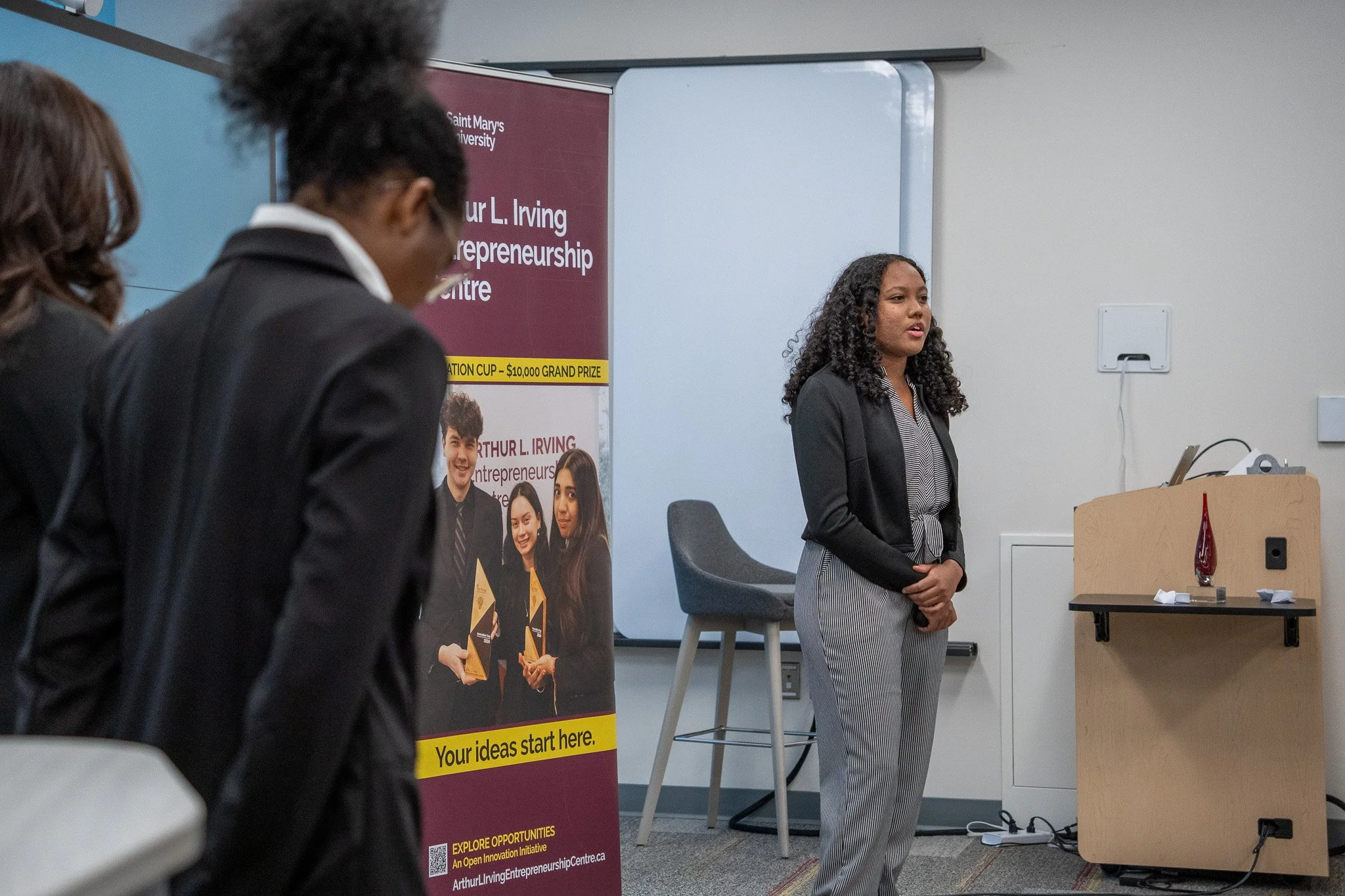
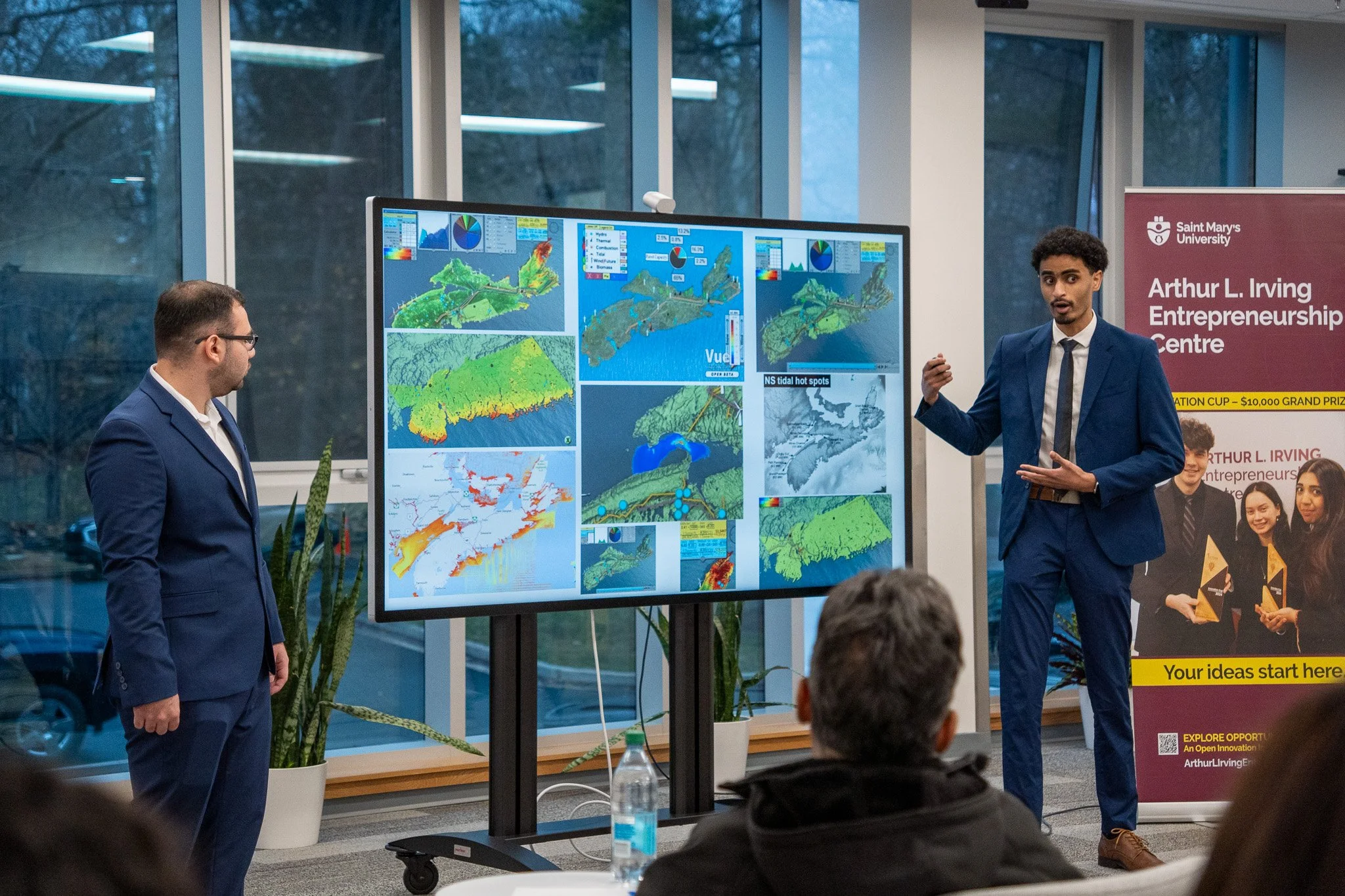
This year’s Innovation Cup hosted by the Arthur L. Irving Entrepreneurship Centre brought together students from Science, Arts and Business for one goal: to turn bold ideas into solutions that can make a real difference. Over ten weeks, participants pushed themselves through hands-on training, weekly eliminations and mentorship from industry professionals, all for the chance to win $10,000 in funding that they can reinvest in their business.

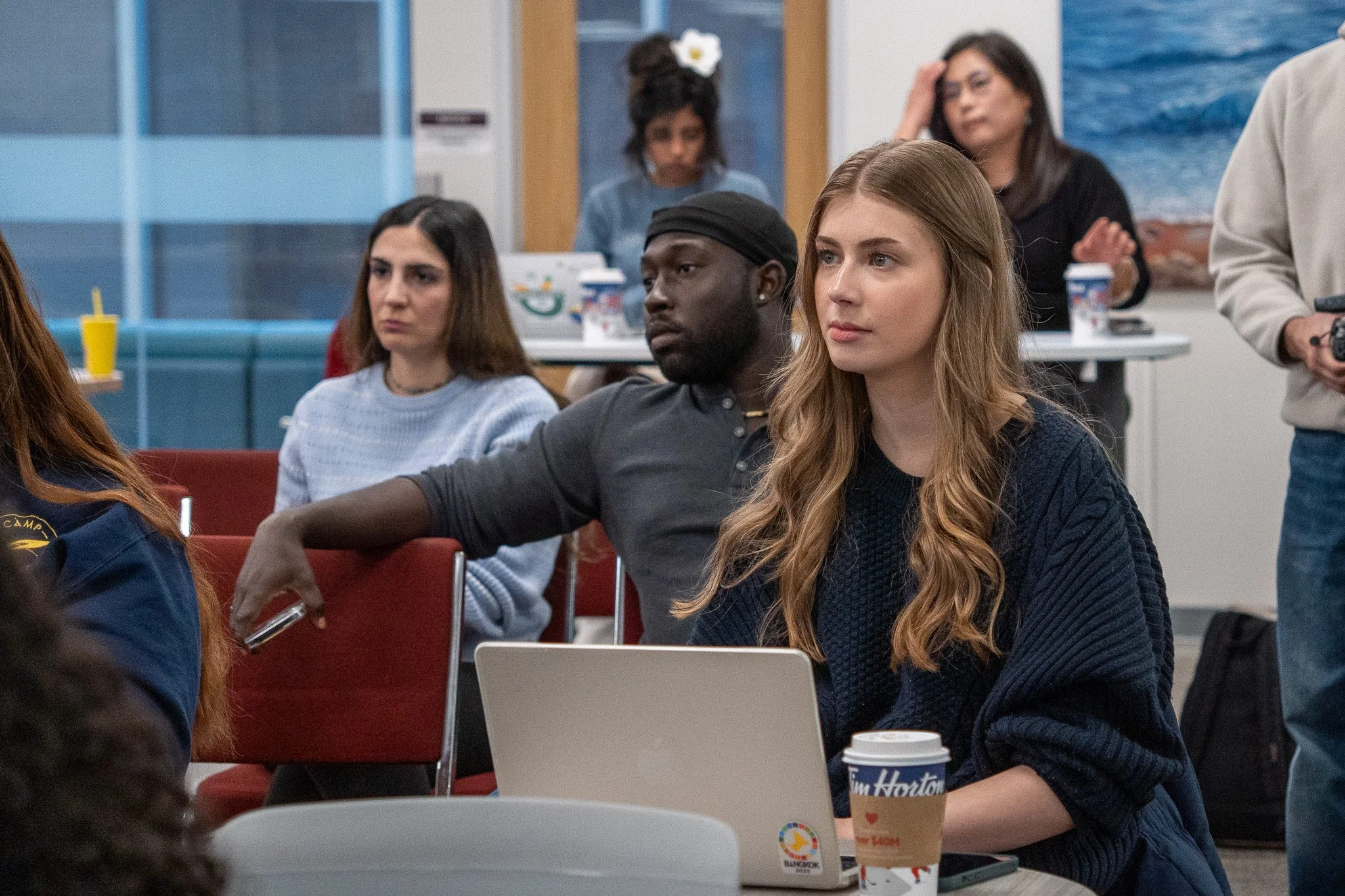
The Innovation Cup is built around collaboration, creativity and learning by doing. Through sessions focused on customer discovery, problem identification, ideation, concept development, financial planning and funding strategies, students were challenged to think critically and put their ideas to the test. What started with nine teams was narrowed down to four standout finalists who presented in front of a packed room of judges, community members, alumni and past Innovation Cup winners.

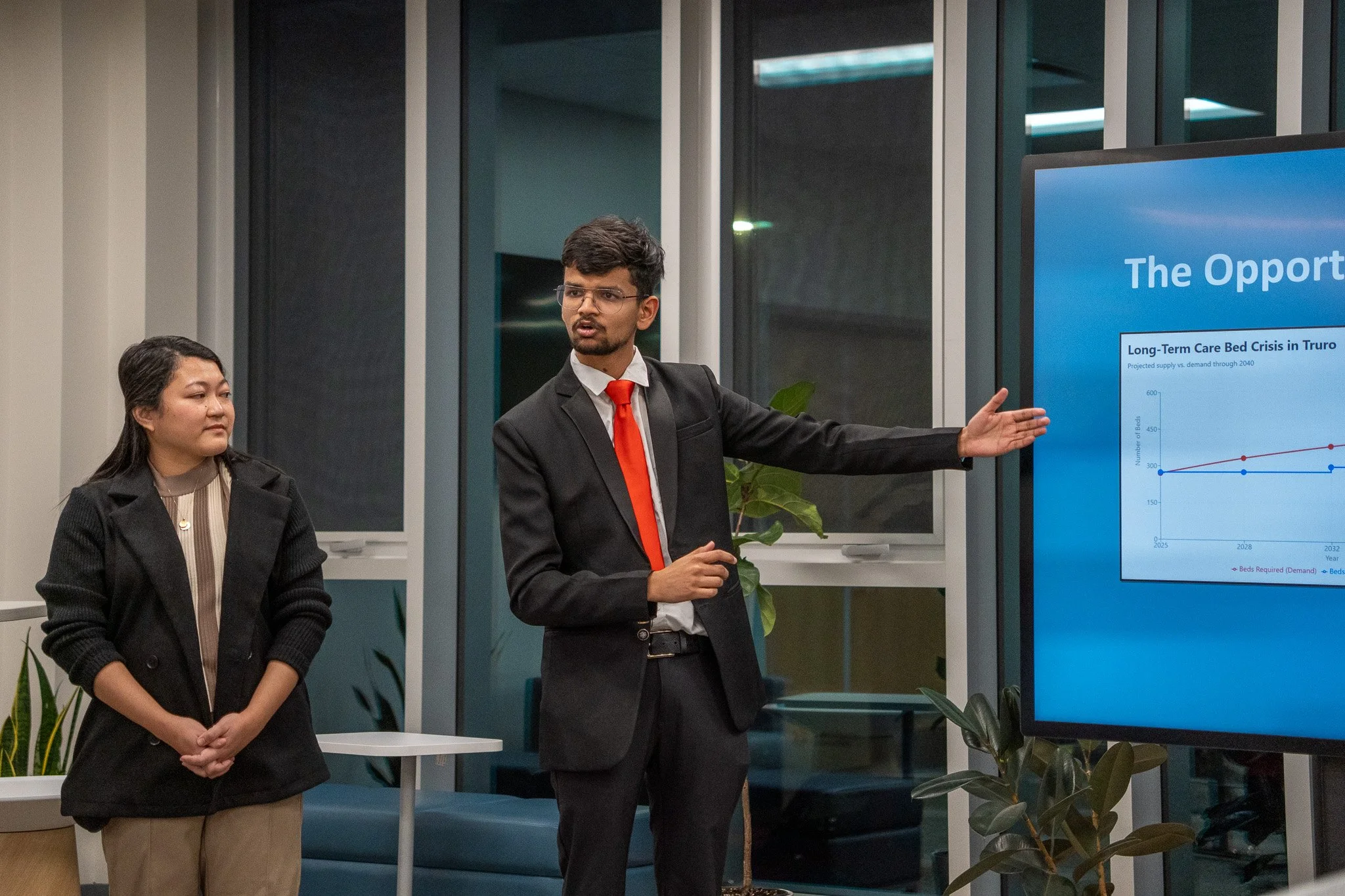
The top four teams tackled issues across health, food security, renewable energy and long-term care. Being There is a non-profit using preventative care to help older adults stay safe, stable and independent, while avoiding unnecessary emergency room visits. The Good Foodie pitched a food-exchange app that connects grocery stores with excess food to those within their neighborhood who need it. RMap introduced an AI-powered geospatial platform to simplify renewable energy site selection. Lastly, Gladsome Longterm Care proposed a warm, community-based alternative to traditional dementia care.

Throughout the competition, teams received mentorship from guest judges and professionals, including semi-final judges Kim Dixon, Director of Learning & Workforce Transformation (COVE) and Minder Singh, Senior Account Executive (Halifax Partnership). Their insights helped students refine their ideas, strengthen their business cases and build confidence heading into the final presentations

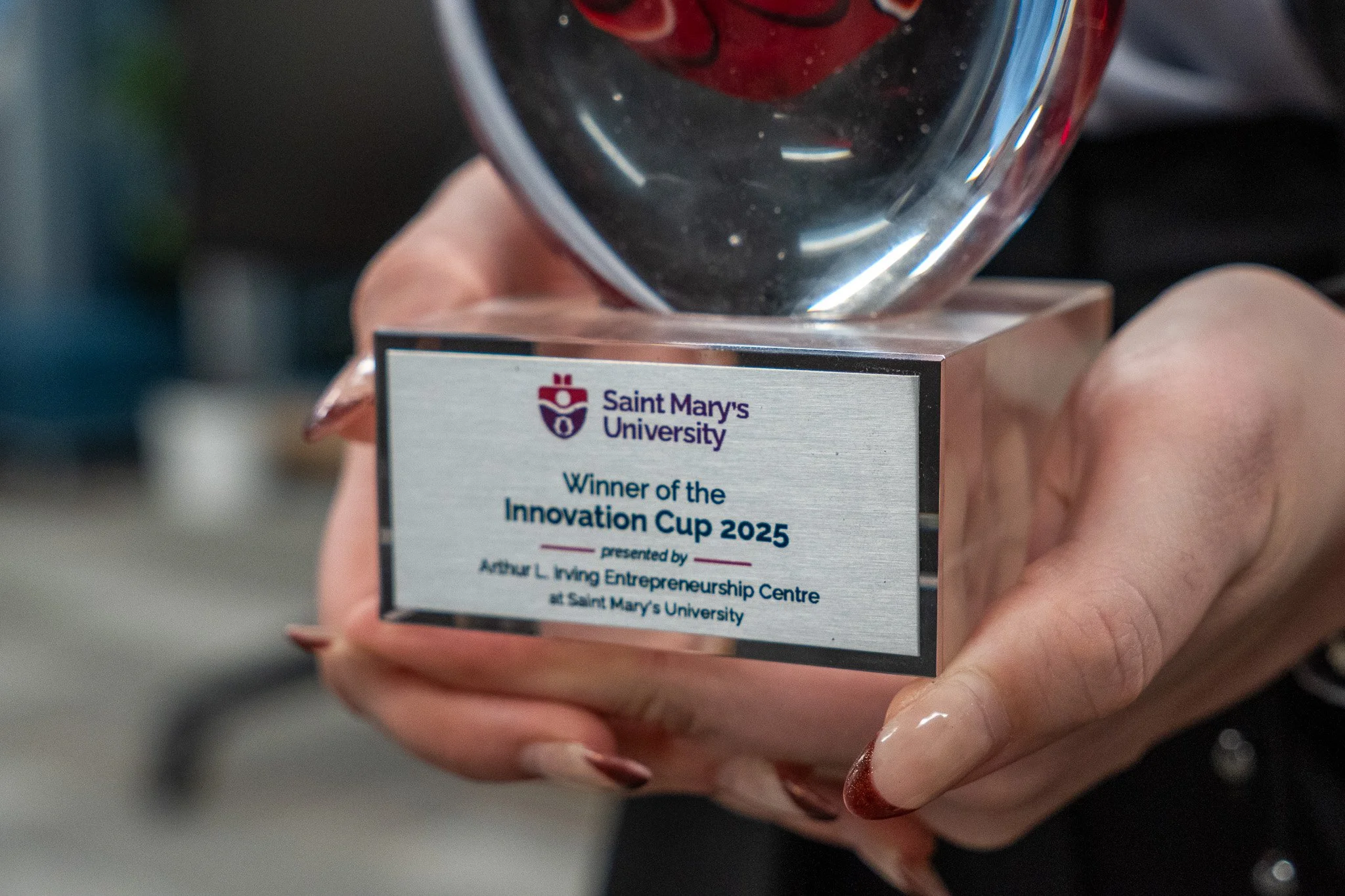
Adding to the excitement, members from the 2024 and 2023 winning teams, Olivian Sanderson (Sociable) and Courtney Dingle (EmerAlt), returned to cheer on this year's finalists. The Innovation Cup trophy itself came from a local business, Nova Trophy, reinforcing the Centre’s commitment to supporting community partners.

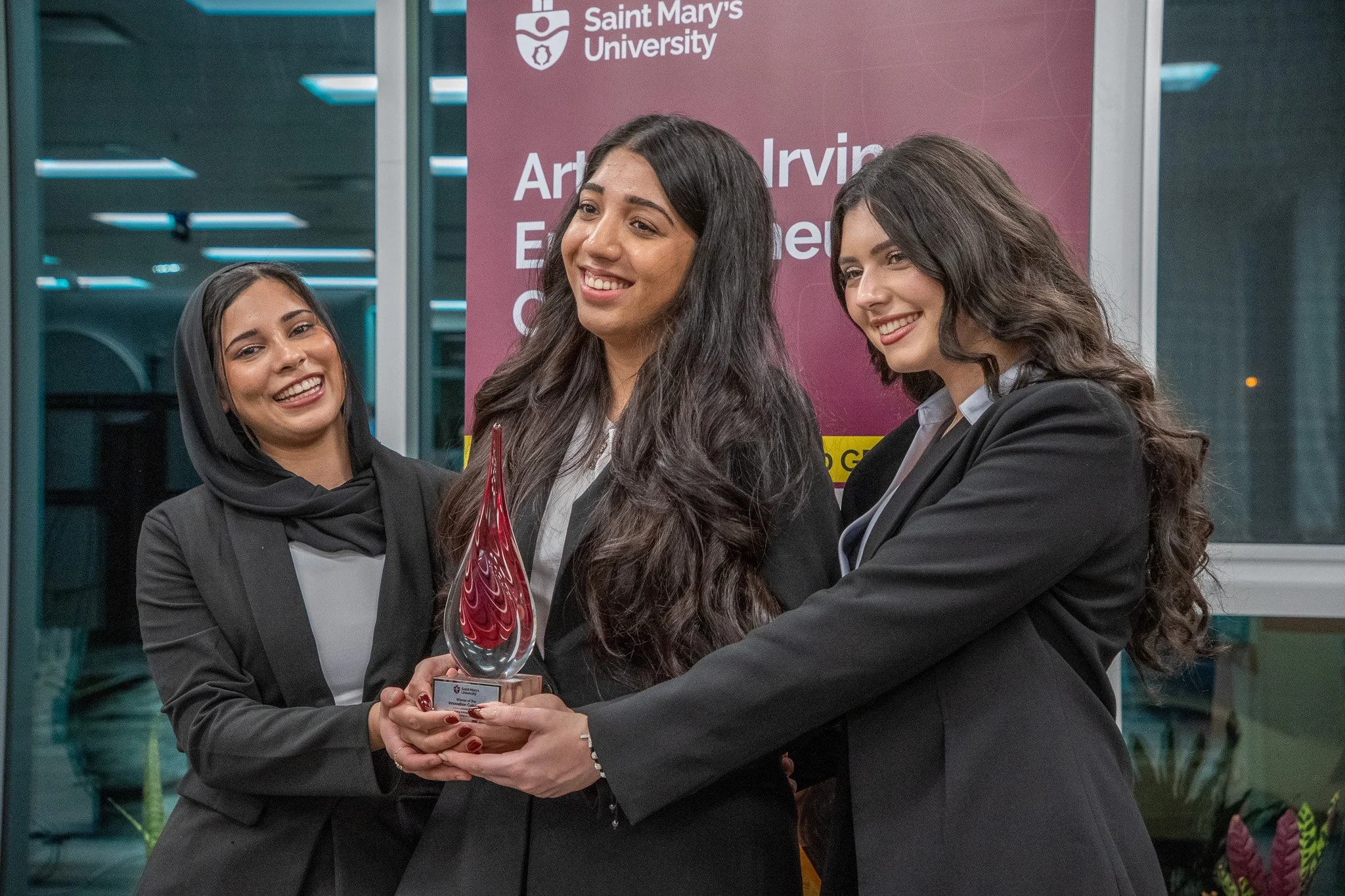
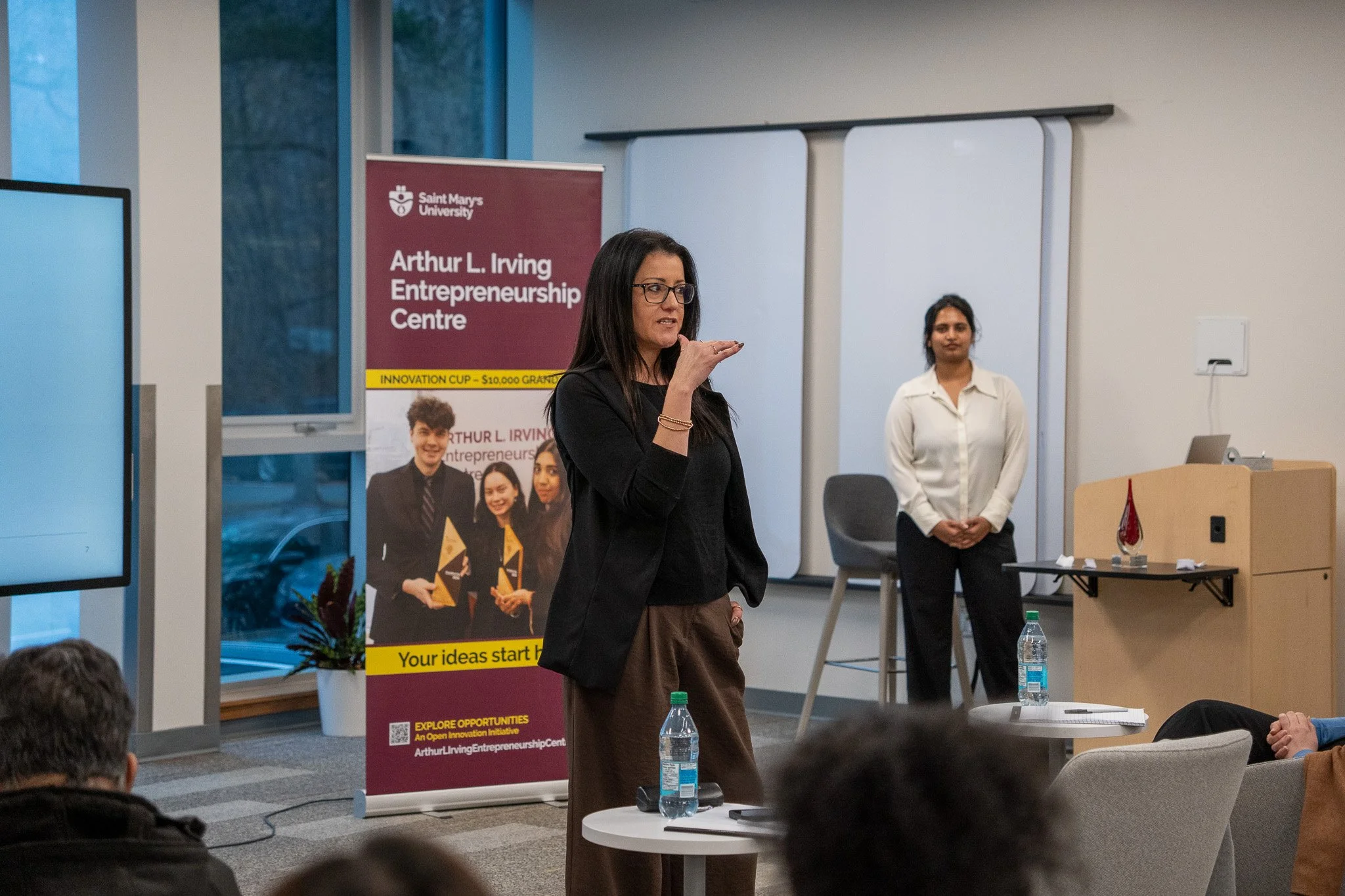
After a competitive final round judged by Max Medyk, Founder & CEO (I’m Canada Media), Jisun Ryu, Student Success Project Coordinator (EduNova) and Mike Rothenberg, Economic Development Officer (ACOA), this year’s winning team was Being There, led by Stuti Sandhu (Arts), Mia Makhlouf (Engineering) and Nahriza Zahid (Business).

Being There team members with finalist judges

The team won a total of $11,000—the $10,000 grand prize and an additional $1,000 for earning the Audience Choice Award. Their vision is to reshape how older adults age at home by offering evidence-based, preventive support that prioritizes dignity, independence and connection. Being There is a project of Enactus Saint Mary’s, which won the World Cup in Thailand last October.  

The Innovation Cup continues to be a launchpad for emerging changemakers. What begins as an idea in week one often becomes a refined, investment-ready concept by week ten, proving what happens when students are given the tools, mentorship, and community to bring their ideas to life.

Watch the 2025 Innovation Cup recap reel

Celebrating 25 years of excellence: The PhD in Business Administration at Saint Mary’s University

The first group of PhD candidates in Business Administration at Saint Mary's University in 2000

This year, Saint Mary’s University’s Sobey School of Business proudly marks the 25th anniversary of its Doctor of Philosophy (PhD) in Business Administration program – a milestone celebrating a quarter-century of cultivating exceptional business researchers, educators and leaders.

Since its launch in 2000 under the guidance of then-Director K. Kelloway, the PhD program has been dedicated to developing highly skilled researchers equipped to make meaningful contributions to academia, industry and the public sector. Designed to build both deep disciplinary expertise and a nuanced understanding of research contexts, the program has attracted students from diverse academic and professional backgrounds, all united by a commitment to advancing knowledge in business administration.

The original program emphasized human resource management and organizational behavior, while also preparing students to pursue research in specialized areas such as accounting, finance, marketing, international business and information management. Students engage in a rigorous curriculum that includes foundational courses in management thought and research paradigms, advanced functional courses tailored to individual research interests, comprehensive examinations, graduate seminars, teaching workshops and the completion of an original doctoral thesis.

Over the past 25 years, the PhD in Business Administration program has evolved to meet the changing needs of the global business landscape. Today, graduates of the program are recognized internationally for their research, holding faculty positions at universities around the world and driving innovation across sectors. The program continues to emphasize rigorous methodological training, interdisciplinary inquiry and impactful scholarship that shapes both theory and practice.

As the program celebrates this milestone, it reflects on a rich history of academic achievement and looks forward to continuing its tradition of excellence. With each cohort of PhD candidates, Saint Mary’s strengthens its commitment to developing leaders who will drive research, education and ethical decision-making in business for decades to come.

For more information about the PhD in Business Administration program at Saint Mary’s University, visit smu.ca/sobey/phd.

Digging deeper: Unearthing Beechville's past through research and real-world learning

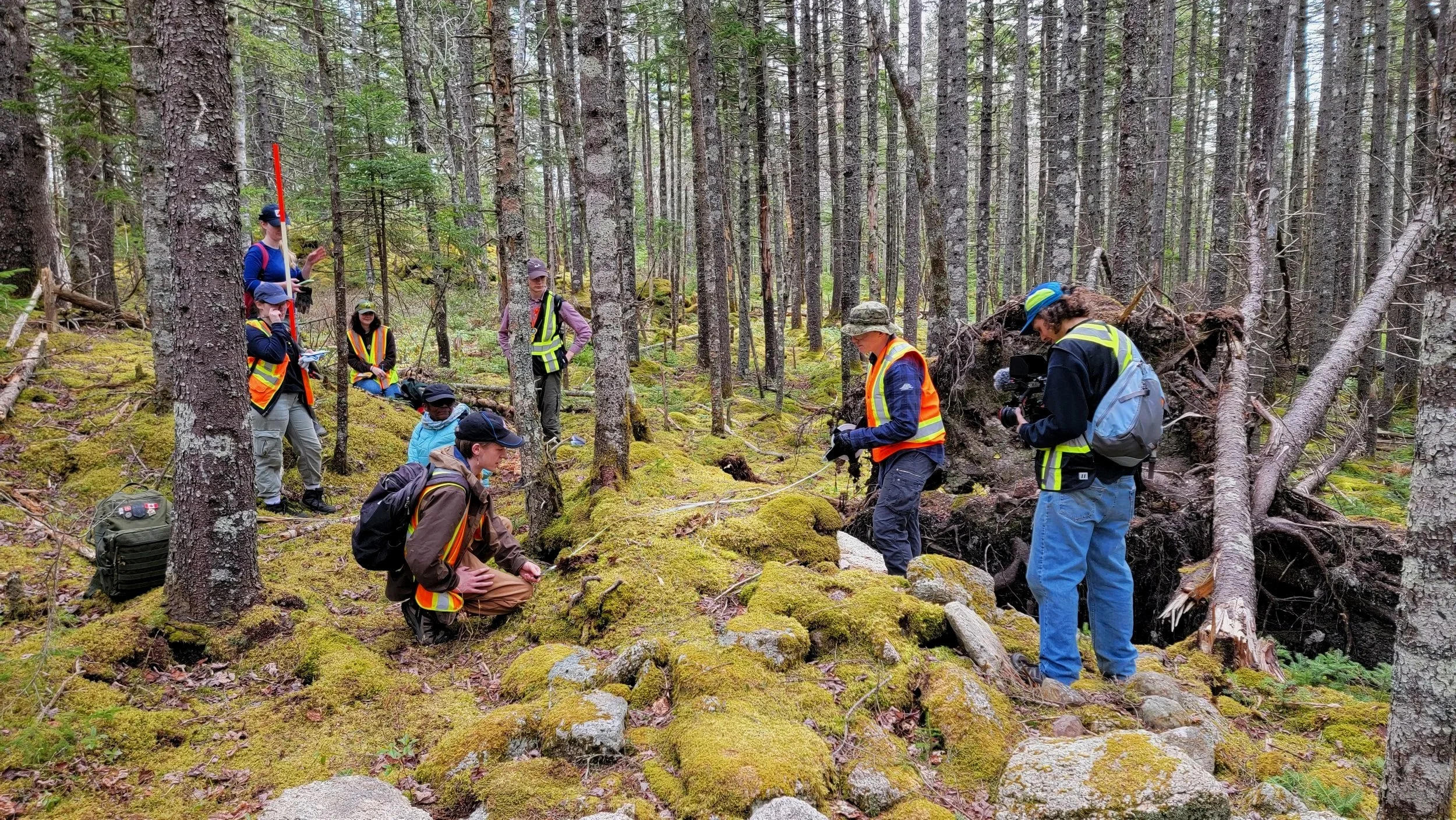
Students in the archeology field school survey grounds in Beechville

When Anthropology Professor Dr. Jonathan Fowler first walked into the community of Beechville over a decade ago, he thought he was taking on a small side project. "I began working at Beechville as an archaeologist in 2013," he says. "What began as just a little sidebar exercise grew over time."

The deeper he stepped into the woods with community members, students and new technology, the more he realized the work wasn't just about mapping the past – it was about reconnecting a community with its own history.

Beechville, founded just over 200 years ago by formerly enslaved people who self-emancipated during the War of 1812, carries a legacy that feels alive beneath the forest floor.

“Anytime we encounter the remnants of places that were formerly inhabited, we kind of encounter an echo of humanity. There’s this still resonant human story remaining in the things left behind.”
— Dr. Jonathan Fowler
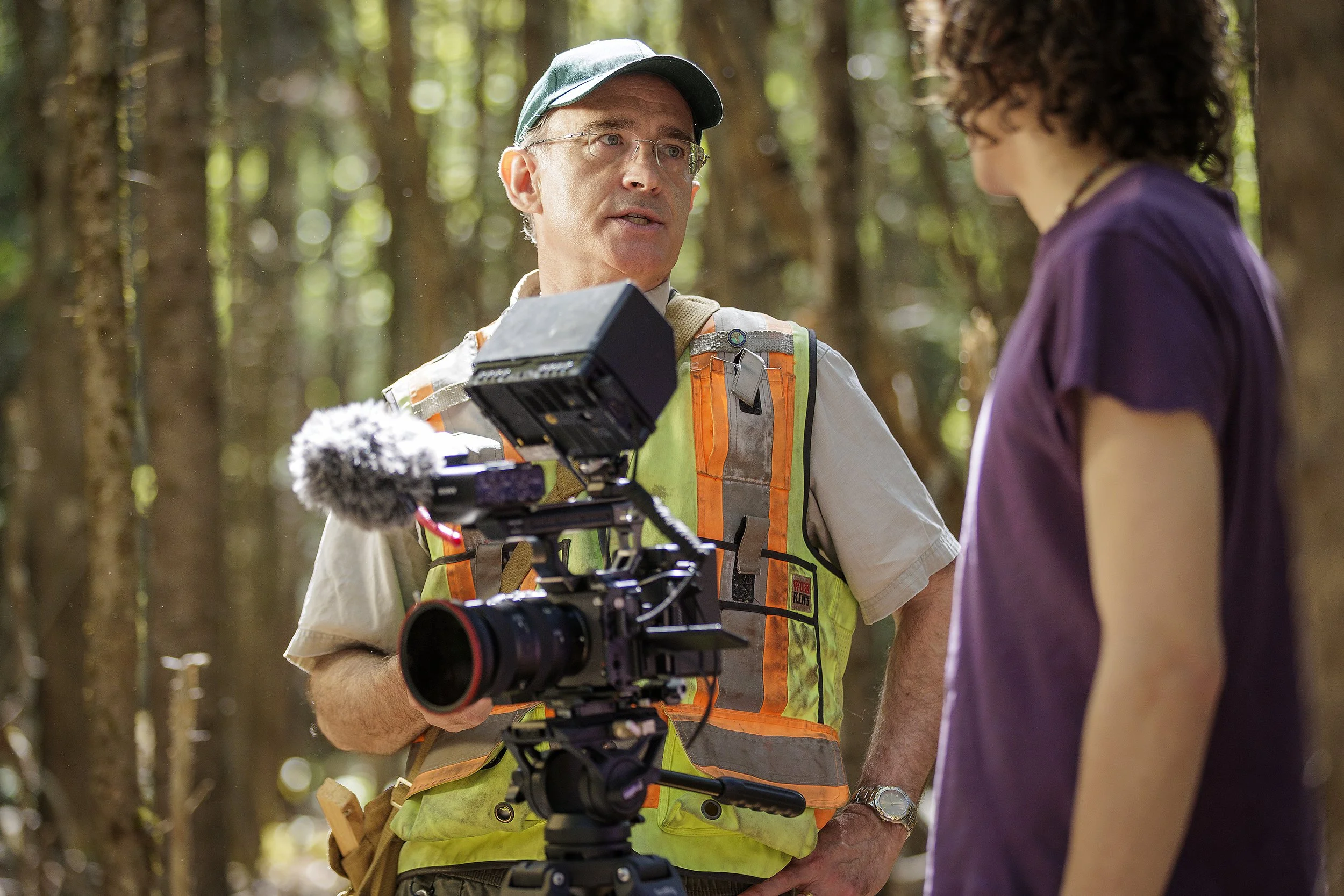
Jonathan and Ben seen in the woods with camera equipment

Dr. Jonathan Fowler with Ben Sheffar at Beechville

That story is especially powerful because many of today's Black Nova Scotians trace their connections back to these freedom fighters. "A lot of that story has been kind of lost through the process," Dr. Fowler says. That's why the Beechville community chose to work alongside Dr. Fowler and his students, as "collaborators and co-creators of knowledge," committed to uncovering and understanding the site together.

For Dr. Fowler, the project quickly became far more than research. "It's been really, really interesting and also very emotionally and personally satisfying," he says. "This is exciting work. It's academic work. It's community work… It's kind of soul craft."

A classroom under the canopy

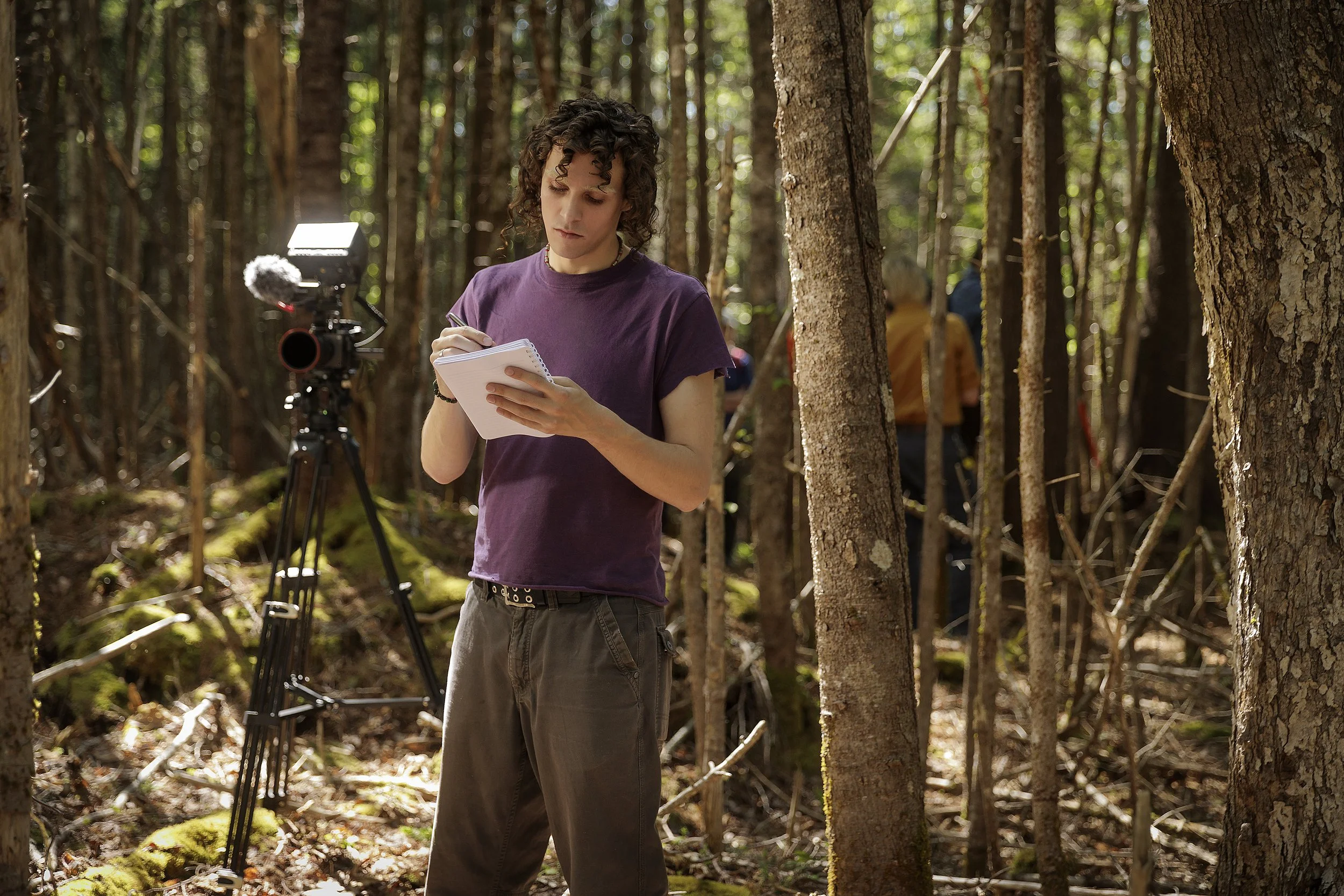
Ben in the woods with camera equipment

Recent graduate Ben Sheffar participated in Dr. Fowler’s Beechville field school

One of the first students to step into the thicket was anthropology student Ben Sheffar BA'25, whose academic path took a turn the moment they joined Dr. Fowler in the field.

Before working on the project, Ben admits their ideas of archaeology came from TV: a "dramatized version." But Beechville changed all that. "I did not fully grasp how systematic and organized everything truly is on archaeological sites," they say.

Even with museum experience under their belt, the reality of the work – deep brush, uneven terrain and the need for quick adaptation – came as a surprise.

Dr. Fowler remembers watching students like Ben transform. On day one, the forest was disorienting. Within days, something shifted.

“Seeing the students get out of the classroom, get into the brush...There’s a kind of experiential learning that takes place only in that environment. You can’t do it with PowerPoint on campus.”
— Dr. Jonathan Fowler
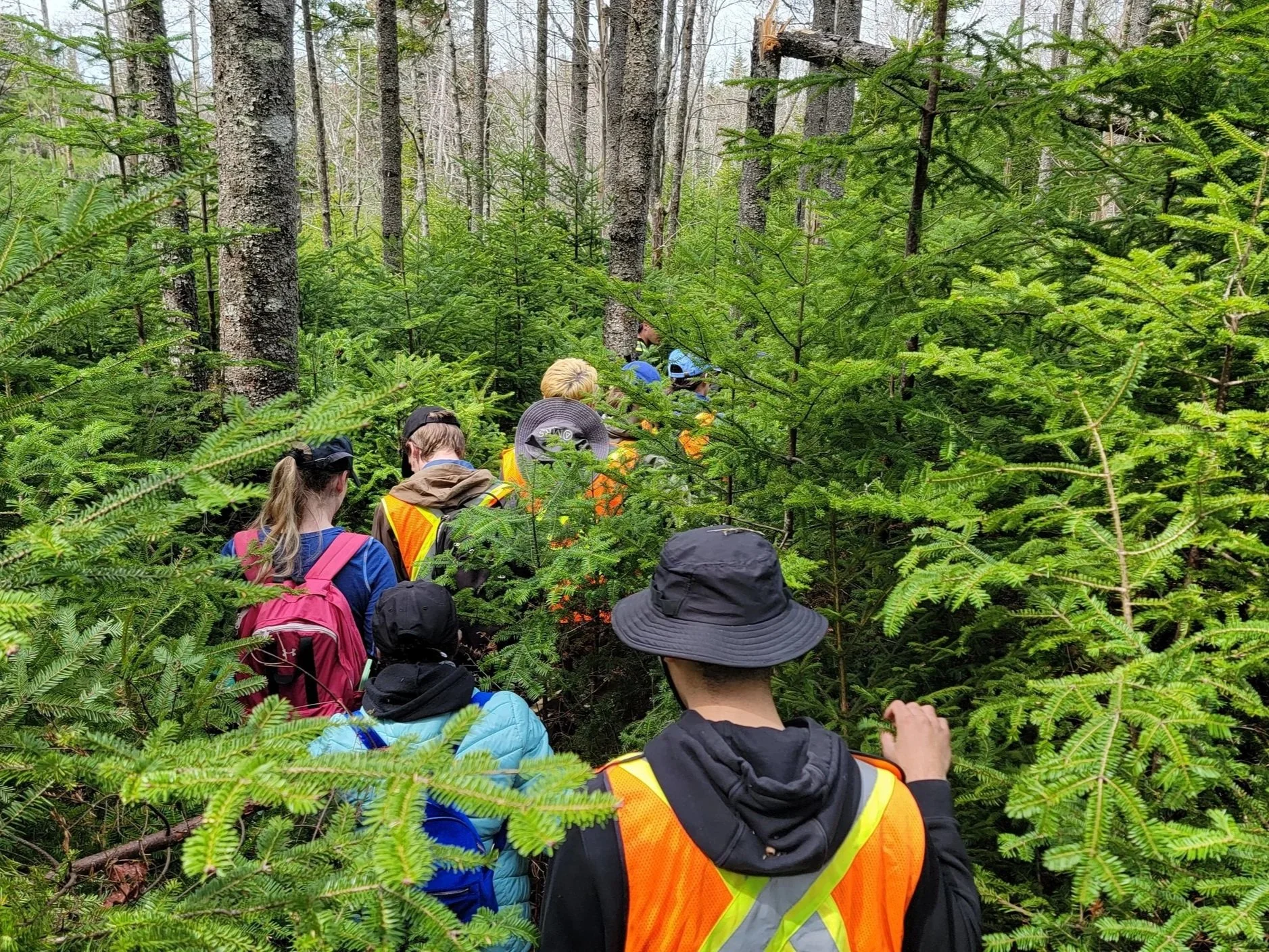
Students walk through the brush

In the field, learning becomes hands-on in a way the classroom can't replicate. Students begin to recognize signs of the old community just by looking closely at the forest floor, such as shallow cavities in the earth where cellars were located, and linear stone features that once formed walls or boundaries. They even learn how to spot old gardening areas by noticing unusual piles or patterns of rocks. "All of this is without digging yet," Dr. Fowler explains. "We start with remote sensing and then move on to our bushwhacking."

Ben recalls the on-the-ground learning vividly. Technology that worked in the classroom was suddenly challenging to use in a dense forest. "This required us to adjust our strategy and use a different method in the field," Ben says. "That adaptation is central to the work."

When community brings the past to life

Both point to community connections as the heart of the project.

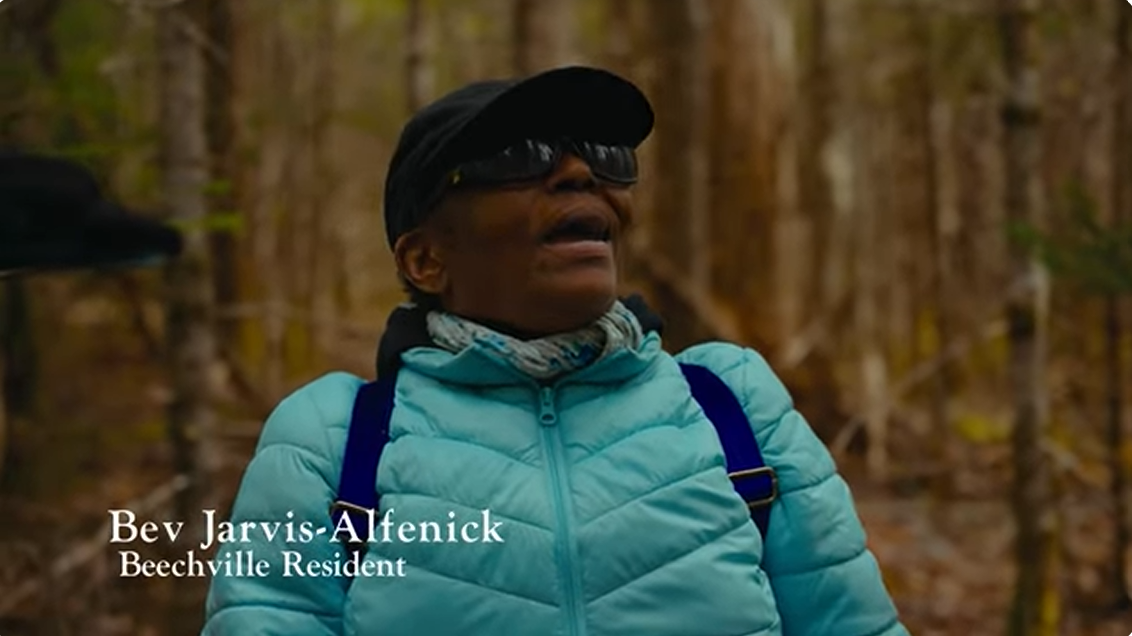
Bev speaks to the camera in the woods

Beechville resident Bev Jarvis-Alfenick, seen in Ben’s video: Uncovering Beechville: Surveying a 19th century settlement built by Black Refugees

For Ben, the most powerful moment came when Beechville residents joined them on site. "Working with community members, specifically having them in the survey space and sharing personal experiences about the area where their families might have been for at least a hundred years — it made the work 10 times more important to be trusted with those stories."

Dr. Fowler says research becomes most meaningful when academic perspectives and community knowledge come together.

"Community has their own perspective, informed by its traditions, memories and experience; a very intimate kind of experience on the land," he explains. When that insight meets the archeological and archival work he brings to the project, something more profound emerges. "When you put those two things together, you get a resulting picture that brings together these two incomplete experiences."

A new kind of storytelling

For Ben, the Beechville project was a chance to merge two passions. "I had started making videos for classes… it began on a smaller scale in high school, but significantly increased," they say. So, when the field school came up, they saw an opportunity and approached Dr. Fowler about creating a video that could serve both the research and the community.

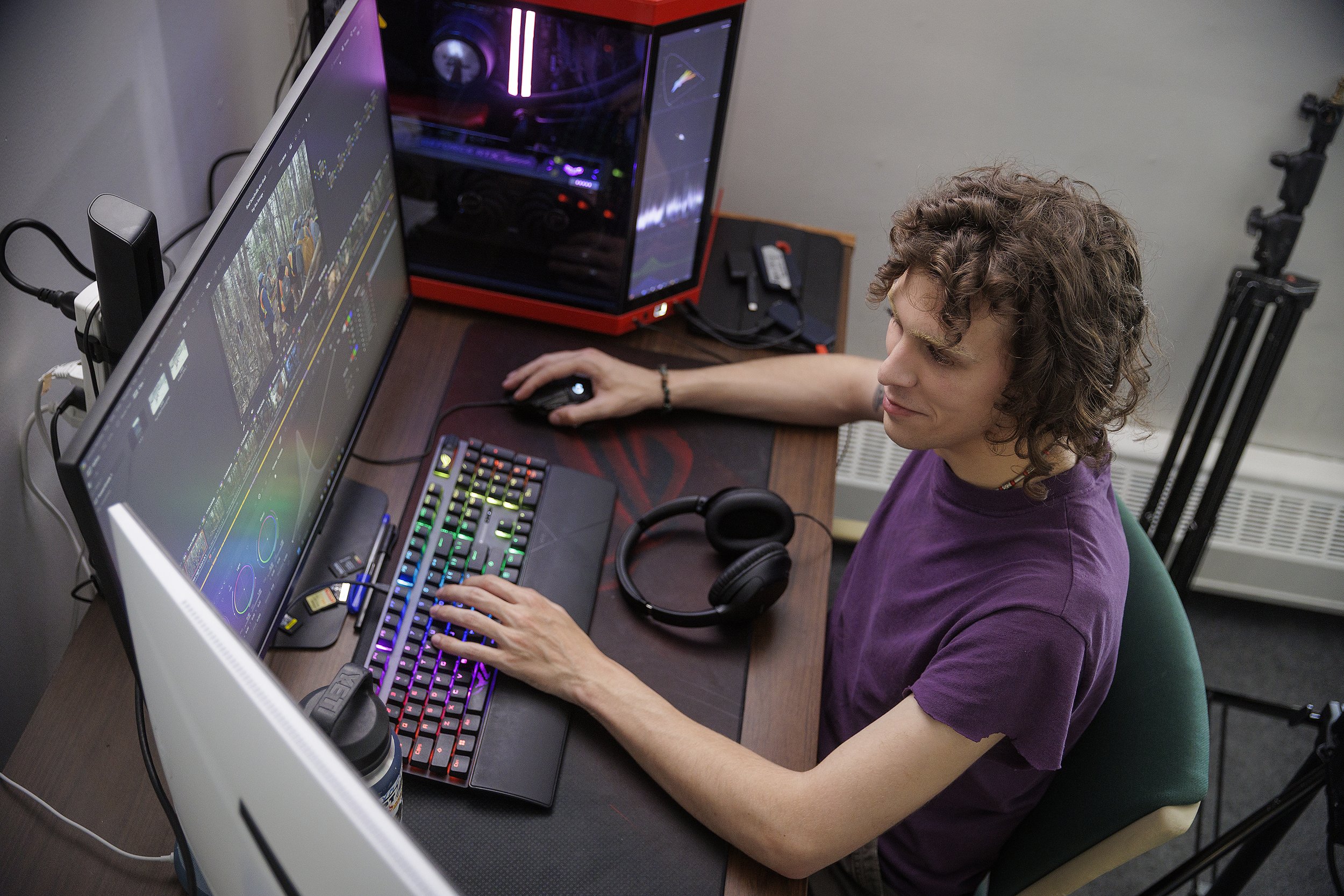
Ben sits at a computer desk with two monitors

Ben used their passion for storytelling and video to highlight the Beechville project

Ben filmed almost every day in the forest, often carrying a large tripod and camera, and later sorted through over a terabyte of footage to shape the story. What mattered most was capturing lived experience: "I consciously included at least one person each day who could reflect on the topic, which makes the lessons highly valuable."

The process showed Ben what was possible. "It cemented my ability to perform this type of work if I commit to it," they share. For the community, the video became a bridge – a way to see and feel the research in a more accessible and human way.

Dr. Fowler believes this kind of storytelling is essential. "It's not enough to do good science in the field," he says. "You really have to put a lot of emphasis on knowledge mobilization and communication."

Lighting the spark

Dr. Fowler often says his job isn't simply to teach, but to ignite curiosity. "I'm just there trying to strike those sparks into the tinder. Job number one is: can I make a little flame? If the flame starts, everything else follows."

For Ben, that spark caught quickly. Their experience through the Beechville project – which combined fieldwork, community connection and filmmaking – clarified the kind of work they want to pursue. Today, the recent graduate works full-time as a media professional at Detect in Burnside, expanding their camera kit and even becoming a licensed drone operator. It's work that blends everything Ben loves, letting them keep growing as both a storyteller and a researcher at heart.

And in Beechville's forest, where history, community and curiosity meet, those sparks continue to shape students and the stories they help bring to life.

Watch Ben’s video: Uncovering Beechville: Surveying a 19th century settlement built by Black Refugees on YouTube.